Key takeaways
- 80 Plus Bronze: the entry point, acceptable for budget builds but less efficient, meaning more heat and slightly higher running costs.
- 80 Plus Gold: the sweet spot for gaming, offering strong efficiency and cool, quiet operation without a large price premium. Most of our picks sit here.
- 80 Plus Platinum and Titanium: premium tiers that squeeze out a little more efficiency, worth it for high-wattage systems that run hard for long sessions.
What's inside
- Watch: What PSU Do I Need for Gaming? (2026 Guide) — Video Review
- Calculate Your System’s Wattage
- Understand Efficiency Ratings
- Why ATX 3.1 and Modern Cables Matter
- Modular vs Non-Modular Cables
- Don’t Skimp on Protection and Warranty
- Tips
- Related Guides
- Frequently Asked Questions
- Conclusion
- Related Articles
- Related Guides
The power supply is the least glamorous part of a gaming PC and the one most people underestimate, yet it quietly determines whether your build runs stable for a decade or throws mysterious crashes from day one. A good PSU delivers clean, consistent power to every component, protects them when something goes wrong, and does it quietly. A bad one sags under load, ages poorly, and in the worst cases takes other parts down with it. Because modern graphics cards can spike their power draw for milliseconds at a time, the demands on a PSU in 2026 are higher and more transient than they used to be.
- Watch: What PSU Do I Need for Gaming? (2026 Guide) — Video Review
- Calculate Your System’s Wattage
- Understand Efficiency Ratings
- Why ATX 3.1 and Modern Cables Matter
- Modular vs Non-Modular Cables
- Don’t Skimp on Protection and Warranty
- Tips
- Related Guides
- Frequently Asked Questions
- Conclusion
- Related Articles
- Related Guides
This guide explains how to work out the wattage your system actually needs, why the 80 Plus efficiency rating and the newer ATX 3.1 standard matter, and how to read the details that separate a reliable unit from a risky one. By the end you will be able to size a power supply with confidence, leave sensible headroom for upgrades, and avoid both the false economy of an underpowered unit and the waste of buying far more wattage than your parts will ever use. We have also picked out a few units that hit the mark for typical gaming builds.
As an Amazon Associate we earn from qualifying purchases at no extra cost to you. Product prices and availability are accurate as of the date shown and are subject to change.


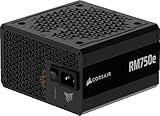


The power supplies above are our recommended picks across the wattage tiers most gamers land on. A unit like the CORSAIR RM850e (2025) or the MSI MAG A850GL PCIE5 suits a mainstream RTX-class build with room to grow, the MSI MAG A750GL and CORSAIR RM750e cover efficient mid-range systems, and the be quiet! Pure Power 13 M 1000W or ASUS ROG Strix 1000W Platinum give high-end GPUs generous overhead. All are ATX 3.1 and PCIe 5.1 ready, which matters for the newest cards.
⚡ Save on Your Next PC — Amazon Prime
Prime members get fast free shipping on the systems above, plus early access to Prime Day & Black Friday PC deals. New members get a 30-day free trial.
Watch: What PSU Do I Need for Gaming? (2026 Guide) — Video Review
Calculate Your System’s Wattage
Start by adding up the power draw of your two biggest consumers: the graphics card and the CPU. The GPU is almost always the largest single load, and its manufacturer publishes a recommended PSU wattage that already includes sensible margin. Add the CPU’s rated power, then a modest allowance for the motherboard, RAM, drives, and fans, which together rarely exceed 100 watts. The sum is your minimum. Do not run a PSU at its absolute ceiling; units are most efficient and quietest at around 50 to 70 percent load, so sizing for that band keeps the fan calm and extends the unit’s life.
Understand Efficiency Ratings
- 80 Plus Bronze: the entry point, acceptable for budget builds but less efficient, meaning more heat and slightly higher running costs.
- 80 Plus Gold: the sweet spot for gaming, offering strong efficiency and cool, quiet operation without a large price premium. Most of our picks sit here.
- 80 Plus Platinum and Titanium: premium tiers that squeeze out a little more efficiency, worth it for high-wattage systems that run hard for long sessions.
Higher efficiency means less of the power you pull from the wall is wasted as heat, which translates into a quieter, cooler PC and marginally lower electricity bills over the years you own the unit.
Why ATX 3.1 and Modern Cables Matter
The ATX 3.1 standard was introduced to handle the aggressive, split-second power spikes of recent graphics cards without tripping the PSU’s protections. Alongside it came the 12V-2×6 connector, a revised version of the 16-pin cable that powers high-end GPUs more safely than the earlier design. If you are buying a current or near-future graphics card, choosing an ATX 3.1 and PCIe 5.1 ready unit with a native 12V-2×6 cable saves you from adapters and gives the card the transient headroom it expects. Older ATX 2.x units still work, but they were designed before these spikes became the norm.
Modular vs Non-Modular Cables
Fully modular power supplies let you connect only the cables your build uses, which improves airflow and makes for a far tidier interior. Semi-modular units hardwire the essential motherboard and CPU cables while leaving the rest detachable. Non-modular units, like a basic bronze unit, have every cable permanently attached, which is cheaper but leaves you stuffing unused leads into a corner of the case. For most builders the extra cost of a fully modular unit pays for itself in cleaner cable management and easier upgrades down the line.
Don’t Skimp on Protection and Warranty
A quality PSU includes a suite of protection circuits: over-voltage, under-voltage, over-current, over-power, over-temperature, and short-circuit protection. These are your last line of defence when a component fails, and they are the reason a reputable unit will shut down safely rather than let a fault cascade. The warranty length is a useful proxy for how much the manufacturer trusts the internals; many of the units above carry seven to ten year warranties, which is a strong signal of quality capacitors and build. Treat the PSU as insurance for the expensive parts it feeds.
Tips
- Buy for one upgrade ahead: sizing your wattage with a little headroom means your next GPU will not force a PSU replacement too.
- Prefer a native 12V-2×6 cable over an adapter for high-end cards to reduce connector strain and failure risk.
- Seat the GPU power connector fully until it clicks; a partially inserted 12-pin plug is a known cause of overheating.
- Register the unit after purchase so the multi-year warranty is easy to claim if you ever need it.
Frequently Asked Questions
How many watts do I really need for a mid-range gaming PC?
A typical mid-range build with a modern mid-tier GPU is comfortable on a quality 650 to 750 watt unit. Stepping up to a high-end card pushes that to 850 watts or more, and the units above are sized to cover both cases with headroom.
Is a bigger PSU always better?
No. A wildly oversized unit spends most of its life at a low load where it is slightly less efficient, and you pay for capacity you never use. Size for roughly 50 to 70 percent load at peak and you get the best efficiency, noise, and longevity.
Can a weak power supply damage my components?
A failing or underpowered PSU can cause instability, unexpected shutdowns, and in rare cases damage connected parts. This is exactly why the protection circuits and quality capacitors in a reputable unit matter more than saving a few dollars.
Do I need ATX 3.1 if my GPU is older?
Not strictly, an older ATX unit will run an older card fine. But if you plan to upgrade the graphics card in the next few years, buying ATX 3.1 and PCIe 5.1 ready now means you will not need to replace the PSU when the new card arrives.
Conclusion
Choosing a power supply comes down to sizing the wattage for your GPU and CPU with sensible headroom, picking an 80 Plus Gold or better efficiency tier, and favouring a fully modular, ATX 3.1 ready unit with a long warranty. Get those fundamentals right and the PSU becomes the component you never think about again, quietly delivering clean power to everything else in the case for the entire life of the build.