Key takeaways
- Refresh rate over resolution: At this budget, a 144Hz 1080p panel will feel dramatically smoother than a 60Hz 1440p one. Prioritize high refresh unless you already own a mid-range or better GPU that can reliably push more pixels.
- Check for real adaptive sync: FreeSync (and G-Sync Compatible certification) eliminates screen tearing without the input lag penalty of V-Sync. It’s effectively free on modern budget panels, so treat its absence as a red flag.
- Match size to viewing distance: A 22-inch panel is ideal for cramped desks and competitive shooters where you want the whole screen in your field of view. 24 to 27 inches suits typical desk depth and immersive single-player games.
- Look for DisplayPort, not just HDMI: Many budget monitors cap out at 60Hz or 120Hz over HDMI while supporting their full refresh rate only via DisplayPort. Confirm the port you plan to use actually delivers the advertised numbers.
- Take color claims with context: “105% sRGB” is meaningful for content creation and vibrant visuals, but panel type matters more. IPS gives the best viewing angles, VA delivers deeper contrast, and TN trades color for speed.
What's inside
Shopping for a gaming monitor under $200 is trickier than it looks. The sub-$200 tier is crowded with panels that advertise big refresh-rate numbers but quietly cut corners on response time, color coverage, or connectivity — and once you add a decent stand or a DisplayPort cable, a “cheap” monitor stops feeling cheap. The good news is that budget panel quality in 2026 is dramatically better than it was even three years ago, and 144Hz at 1080p is now genuinely affordable rather than a compromise.
This guide covers the monitors we’d actually recommend to a friend building a budget gaming rig or upgrading from a 60Hz office display. Every pick below is realistically priced within the $200 cap, and we’ve focused on the specs that measurably affect gameplay — refresh rate, adaptive sync, panel type, and color accuracy — rather than marketing bullet points. We’ve also flagged which sizes and resolutions make sense for which GPUs, since a 1440p panel paired with an entry-level card is a false economy.
As an Amazon Associate we earn from qualifying purchases at no extra cost to you. Product prices and availability are accurate as of the date shown and are subject to change.







⚡ Save on Your Next PC — Amazon Prime
Prime members get fast free shipping on the systems above, plus early access to Prime Day & Black Friday PC deals. New members get a 30-day free trial.
Watch: Best Gaming Monitor Under $200 — Video Review
How to Choose Gaming Monitor Under $200
- Refresh rate over resolution: At this budget, a 144Hz 1080p panel will feel dramatically smoother than a 60Hz 1440p one. Prioritize high refresh unless you already own a mid-range or better GPU that can reliably push more pixels.
- Check for real adaptive sync: FreeSync (and G-Sync Compatible certification) eliminates screen tearing without the input lag penalty of V-Sync. It’s effectively free on modern budget panels, so treat its absence as a red flag.
- Match size to viewing distance: A 22-inch panel is ideal for cramped desks and competitive shooters where you want the whole screen in your field of view. 24 to 27 inches suits typical desk depth and immersive single-player games.
- Look for DisplayPort, not just HDMI: Many budget monitors cap out at 60Hz or 120Hz over HDMI while supporting their full refresh rate only via DisplayPort. Confirm the port you plan to use actually delivers the advertised numbers.
- Take color claims with context: “105% sRGB” is meaningful for content creation and vibrant visuals, but panel type matters more. IPS gives the best viewing angles, VA delivers deeper contrast, and TN trades color for speed.
The Best Picks Reviewed
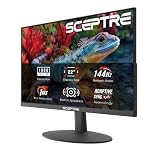
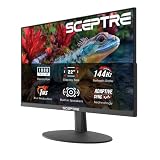
Sceptre 22-Inch 144Hz (E225W-FW144)
This is the sweet spot for competitive players on a tight budget — 144Hz at 1080p on a compact 22-inch panel means your GPU rarely has to work hard to keep frames flowing. Built-in speakers and both HDMI and DisplayPort inputs make it a genuinely complete package at a price that’s hard to argue with.
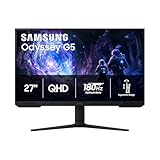
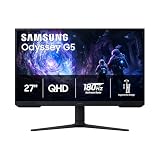
Samsung 27″ Odyssey G5 (G51F)
The most ambitious pick here, offering QHD 1440p on a 27-inch panel with Samsung’s proven Odyssey tuning — noticeably sharper text and more detail than any 1080p option on this list. It typically sits at the very top of the $200 range and demands a capable GPU, so treat it as the upgrade choice rather than the default.
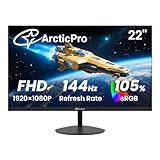
ArcticPro 22-Inch 144Hz
A strong value alternative to the Sceptre, pairing the same 144Hz FHD formula with 105% sRGB coverage that punches above its price for color-sensitive work and vibrant game visuals. It’s a sensible dual-purpose choice if your monitor doubles as a workstation display.
Sceptre 27-inch Prime (E275W-FW100T)
If you want screen real estate more than raw refresh rate, this 27-inch panel delivers 100Hz, 1ms response, 100% sRGB, and FreeSync with dual HDMI plus DisplayPort. It’s the best pick for immersive single-player gaming and general desktop use, though 1080p across 27 inches means slightly softer text than a 24-inch equivalent.
Philips 221V8LB 22-Inch
The most conservative recommendation on the list — a 100Hz VA panel with flicker-free tech and VESA mounting that prioritizes eye comfort and contrast over headline specs. It’s an excellent choice for long sessions, mixed work-and-play use, or as a secondary display.
Frequently Asked Questions
Is 144Hz worth it under $200?
Absolutely — it’s the single most noticeable upgrade you can make at this budget. The jump from 60Hz to 144Hz is immediately obvious in mouse movement and motion clarity, and budget 144Hz panels no longer require serious sacrifices elsewhere.
Should I buy 1080p or 1440p at this price?
Choose 1080p unless you own at least a mid-range current-generation GPU. A 1440p panel running at 40fps looks worse in motion than a 1080p panel running at 120fps, and budget 1440p options usually cap refresh rate lower.
Do I need FreeSync if I have an NVIDIA card?
Yes — most FreeSync monitors work as G-Sync Compatible displays on modern NVIDIA GPUs. You may need to enable it manually in the NVIDIA Control Panel, but the tear-free result is the same.
Are built-in speakers good enough for gaming?
They’re a convenience feature, not a replacement for headphones or desktop speakers. Treat them as a useful fallback for casual use rather than a reason to choose one monitor over another.
Final Thoughts
For most buyers, the Sceptre 22-Inch 144Hz is the smartest value in this category — it delivers the high-refresh experience that matters most in games without demanding an expensive GPU. If you want a larger, more immersive screen for single-player titles, the Sceptre 27-inch Prime is the better fit, while the Samsung Odyssey G5 is worth stretching for if your system can drive 1440p and you want the sharpest image on this list.