Key takeaways
- Frame pacing: 144Hz delivers a new frame every 6.94ms; 240Hz cuts that to 4.17ms. That 2.8ms reduction is real but subject to steep diminishing returns compared with the 60Hz-to-144Hz jump.
- Motion clarity: Higher refresh rates reduce persistence blur, so moving objects stay legible. Tracking a strafing target or reading text while panning is noticeably cleaner at 240Hz, especially with backlight strobing enabled.
- GPU demand: Hitting 240fps requires roughly 1.7x the rendering throughput of 144fps. Below that threshold the extra refresh headroom sits unused, aside from a slightly wider adaptive-sync range.
- Resolution pairing: 144Hz is commonly paired with 1440p and 4K panels; affordable 240Hz models are still overwhelmingly 1080p. You are often trading pixels for hertz.
- Price positioning: The premium for 240Hz at 1080p has collapsed to a modest margin. At 1440p and above, 240Hz still carries a meaningful surcharge.
- Panel quality: Cheap high-refresh panels sometimes cut corners on overdrive tuning, contrast, or uniformity. Fast IPS implementations handle 240Hz far better than budget VA.
What's inside
For years, 144Hz was the default recommendation for anyone stepping up from a 60Hz office panel to a real gaming display. It was the sweet spot: fast enough to feel transformative, cheap enough to be sensible, and easy enough to drive that a mid-range GPU could keep up. In 2026, that calculus has shifted. Panel costs have fallen, 240Hz has become the standard refresh rate on entry-level 1080p gaming monitors, and the price gap between the two tiers has narrowed to the point where “just get 144Hz to save money” is no longer automatic advice.
That doesn’t make the decision obvious. Refresh rate only matters if your graphics card can actually feed it, and the second half of the equation — resolution, panel type, response time, and pixel overdrive tuning — often affects how a monitor feels more than the number on the box. A well-tuned 144Hz IPS panel at 1440p can be a far better daily driver than a mediocre 240Hz screen with smeary pixel transitions. Below we break down where the real differences live, who genuinely benefits from 240Hz, and which current models are worth your money.
As an Amazon Associate we earn from qualifying purchases at no extra cost to you. Product prices and availability are accurate as of the date shown and are subject to change.


⚡ Save on Your Next PC — Amazon Prime
Prime members get fast free shipping on the systems above, plus early access to Prime Day & Black Friday PC deals. New members get a 30-day free trial.
Watch: 144Hz vs 240Hz Monitor: Worth It in 2026? — Video Review
Quick Verdict
Choose 144Hz if you play a mix of single-player and multiplayer titles, want to spend your budget on higher resolution (1440p) or better colour accuracy, or if your GPU is a mid-range card that won’t consistently push past 144fps at your settings. Choose 240Hz if competitive shooters, fighting games, or racing sims are your main diet, you play at 1080p with settings tuned for frame rate, and you have a GPU capable of sustaining 200fps or more. At 2026 prices, 240Hz panels like the Dell SE2726HG and ASUS TUF Gaming VG279QM5A cost so little more than comparable 144Hz screens that the higher tier is the default pick for most 1080p buyers.
Key Differences
- Frame pacing: 144Hz delivers a new frame every 6.94ms; 240Hz cuts that to 4.17ms. That 2.8ms reduction is real but subject to steep diminishing returns compared with the 60Hz-to-144Hz jump.
- Motion clarity: Higher refresh rates reduce persistence blur, so moving objects stay legible. Tracking a strafing target or reading text while panning is noticeably cleaner at 240Hz, especially with backlight strobing enabled.
- GPU demand: Hitting 240fps requires roughly 1.7x the rendering throughput of 144fps. Below that threshold the extra refresh headroom sits unused, aside from a slightly wider adaptive-sync range.
- Resolution pairing: 144Hz is commonly paired with 1440p and 4K panels; affordable 240Hz models are still overwhelmingly 1080p. You are often trading pixels for hertz.
- Price positioning: The premium for 240Hz at 1080p has collapsed to a modest margin. At 1440p and above, 240Hz still carries a meaningful surcharge.
- Panel quality: Cheap high-refresh panels sometimes cut corners on overdrive tuning, contrast, or uniformity. Fast IPS implementations handle 240Hz far better than budget VA.
144Hz Monitors: The Balanced Choice
A 144Hz display remains an excellent purchase, particularly at 1440p. The jump from 60Hz is dramatic and immediately obvious to anyone, while the frame rate target is achievable on mainstream hardware across almost every genre. If you play story-driven games, strategy titles, MMOs, or anything where visual fidelity matters more than reaction time, the money saved on refresh rate is better spent on resolution, HDR performance, or a larger panel.
The honest caveat is availability. In 2026 the 144Hz segment at 1080p has thinned considerably, because manufacturers can build 240Hz panels at nearly the same cost. Shoppers looking specifically for 144Hz will find the strongest selection at 1440p and ultrawide sizes, where the specification still represents a deliberate engineering trade-off rather than a cost-cutting one.
240Hz Monitors: The Competitive Standard
At 1080p, 240Hz is now the value tier. The ASUS TUF Gaming VG279QM5A is the standout on merit: a 27-inch Fast IPS panel with a 0.3ms rated response, G-SYNC compatibility, ELMB Sync strobing, and 99% sRGB coverage — a genuinely well-tuned esports display rather than a spec-sheet exercise. Dell’s SE2726HG (27-inch) and SE2426HG (23.8-inch) offer IPS panels, FreeSync Premium, and dual HDMI plus DisplayPort 1.4 at aggressive prices, making them ideal first upgrades.
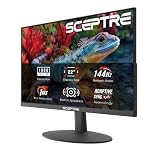
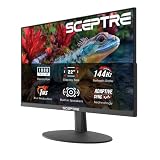
If you prefer curved panels for immersion, the Sceptre C255B-FWT240 packs a 24.5-inch 1500R screen with 1ms response and built-in speakers, while SANSUI’s 27-inch and 32-inch curved 240Hz models add HDR, FreeSync, and 1500R curvature at larger sizes. Note that at 32 inches, 1080p spreads thin — expect visible pixel structure unless you sit further back.
Which Should You Buy?
- For competitive FPS players: pick 240Hz. The ASUS TUF VG279QM5A is the best-tuned option here thanks to its Fast IPS panel and strobing support.
- For mixed gaming on a budget: pick 240Hz at 1080p — the Dell SE2426HG or SE2726HG deliver the tier at near-144Hz pricing.
- For visual fidelity and single-player games: pick 144Hz at 1440p and spend the difference on resolution and colour performance.
- For immersive, larger-screen setups: pick the SANSUI 32-inch curved 240Hz, provided your desk depth suits a large 1080p panel.
- For mid-range GPUs: pick 144Hz if your card rarely exceeds 150fps in your regular titles; the headroom would go unused.
Frequently Asked Questions
Can you actually see the difference between 144Hz and 240Hz?
Yes, though it is subtler than the leap from 60Hz. Most players notice improved motion clarity and smoother camera panning within a few minutes. The competitive advantage is measurable but small for casual play.
What GPU do I need for 240fps?
At 1080p with competitive settings, a current upper-mid-range card handles esports titles comfortably. Demanding AAA games will not reach 240fps on most hardware, but adaptive sync keeps them smooth regardless.
Is 240Hz worth it at 1080p on a 32-inch screen?
Only if you sit far enough back. Pixel density at 32 inches and 1080p is low, so text and fine detail soften. The SANSUI 32-inch suits console-style seating distances better than close desk use.
Does response time matter more than refresh rate?
They work together. A 240Hz panel with slow pixel transitions will smear and negate its own advantage, which is why Fast IPS implementations outperform budget VA at this refresh rate.
Final Verdict
For most 1080p buyers in 2026, 240Hz is the correct default — the price premium has largely evaporated, and options like the ASUS TUF VG279QM5A and Dell SE2726HG deliver genuinely well-engineered panels rather than inflated numbers. Reserve 144Hz for higher-resolution purchases, where the saved budget buys sharper images and better colour, and where your GPU is more likely to be the limiting factor anyway.