Key takeaways
- Viewing geometry: Curved panels keep the edges roughly equidistant from your eyes; flat panels force your focus to travel further at the extremes, which is only noticeable above about 30 inches.
- Immersion: The wrap on a 1500R or 1000R panel fills more peripheral vision, which helps in racing sims, flight sims and open-world titles. Flat screens feel more like a window than a cockpit.
- Geometric accuracy: Flat wins outright for photo editing, vector work, spreadsheets and anything where a straight line must look straight. Curves introduce subtle bow that no calibration fixes.
- Reflections: Curved surfaces can stretch a window or lamp reflection across a wider area; flat panels concentrate glare in one spot that’s easy to reposition away from.
- Multi-monitor setups: Flat panels butt together cleanly side by side. Curved screens create awkward angles at the seams unless you buy identical models and angle them deliberately.
- Price per inch: Budget curved models like the SANSUI 27-inch 240Hz have erased most of the premium, but at any given spec a flat equivalent usually still undercuts it slightly.
What's inside
Walk into any 2026 gaming setup and you’ll see the same fork in the road: a gently wrapped panel that curls toward your face, or a dead-flat slab that sits square on the desk. Curved monitors have moved from novelty to mainstream — 1500R and 1000R panels now ship at prices that were flat-screen territory only three years ago — while flat panels have quietly held their ground by doing the fundamentals cheaply and predictably. The gap in raw specs has closed almost entirely, which means the decision now comes down to how you sit, what you play, and what else you do at that desk.
The choice matters more in 2026 than it did in 2022 because panel sizes have inflated. A 27-inch screen at arm’s length behaves very differently from a 34-inch ultrawide, and curvature is largely a response to that growth: the wider the panel, the more the edges drift away from your eyes. Below you’ll find the standout curved options worth considering this year, followed by an honest breakdown of when a flat screen is still the smarter buy.
As an Amazon Associate we earn from qualifying purchases at no extra cost to you. Product prices and availability are accurate as of the date shown and are subject to change.


⚡ Save on Your Next PC — Amazon Prime
Prime members get fast free shipping on the systems above, plus early access to Prime Day & Black Friday PC deals. New members get a 30-day free trial.
Watch: Curved vs Flat Gaming Monitor: 2026 Guide — Video Review
Quick Verdict
Buy curved if you game at 32 inches or larger, sit close to a single screen, and play immersive first-person or racing titles — the Alienware AW3425DWM and Samsung Odyssey G55C are the safest picks here. Buy flat if you need accurate straight lines for design or CAD work, plan to run a multi-monitor array, mount to an arm, or simply want the lowest price per inch. Competitive esports players sit in the middle: both work, and refresh rate matters far more than curvature.
Key Differences
- Viewing geometry: Curved panels keep the edges roughly equidistant from your eyes; flat panels force your focus to travel further at the extremes, which is only noticeable above about 30 inches.
- Immersion: The wrap on a 1500R or 1000R panel fills more peripheral vision, which helps in racing sims, flight sims and open-world titles. Flat screens feel more like a window than a cockpit.
- Geometric accuracy: Flat wins outright for photo editing, vector work, spreadsheets and anything where a straight line must look straight. Curves introduce subtle bow that no calibration fixes.
- Reflections: Curved surfaces can stretch a window or lamp reflection across a wider area; flat panels concentrate glare in one spot that’s easy to reposition away from.
- Multi-monitor setups: Flat panels butt together cleanly side by side. Curved screens create awkward angles at the seams unless you buy identical models and angle them deliberately.
- Price per inch: Budget curved models like the SANSUI 27-inch 240Hz have erased most of the premium, but at any given spec a flat equivalent usually still undercuts it slightly.
Curved Gaming Monitors
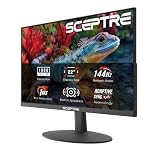
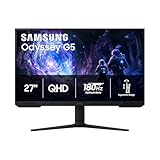
Curvature is measured in radius — 1000R is aggressive, 1500R is moderate, 1800R is gentle. The Samsung Odyssey G55C uses a 1000R curve on a 32-inch QHD panel at 165Hz, and that combination is close to ideal: the tight radius matches a typical desk viewing distance, and QHD gives 32 inches the pixel density it needs. At the ultrawide end, the Alienware AW3425DWM pairs 3440 × 1440 with 180Hz and a 1500R curve, while the Sceptre 34-inch C345B-QUT168 delivers the same resolution class with dual DisplayPort inputs and 99% sRGB coverage for less money.
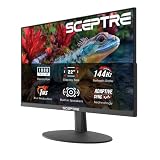
The high-refresh budget end belongs to SANSUI. The 32-inch 240Hz model and its 27-inch sibling both run 1500R curves at 1080p with 1ms MPRT, which is a genuinely unusual spec pairing — 240Hz at these prices normally means a flat TN panel. The trade-off is resolution: 1080p stretched across 32 inches looks soft if you sit close, so the 27-inch version is the better-balanced choice unless you’re seated further back. Gentler curves like the 1800R on the Samsung Essential S3 barely register visually and are best thought of as flat panels with a slight comfort tweak.
Flat Gaming Monitors
Flat panels remain the default for good reason. They’re cheaper to manufacture, easier to mount on arms and multi-screen brackets, and they never distort a straight edge. If your machine does double duty for work — spreadsheets, code, illustration, video timelines — flat removes an entire category of small daily irritations. At 24 to 27 inches, the immersion advantage of a curve is marginal enough that most players won’t notice its absence during a match.
Competitive shooters are the strongest flat-panel argument. Players who track crosshairs at screen centre and rely on muscle memory across multiple machines often prefer consistency between their home setup and tournament hardware, which is overwhelmingly flat. Flat also sidesteps the seating-position sensitivity of aggressive curves: a 1000R panel viewed off-axis or from a couch looks noticeably warped, whereas a flat screen tolerates casual viewing angles and shared-screen situations far better.
Which Should You Buy?
- For ultrawide immersion: pick curved — the Alienware AW3425DWM or the Sceptre 34-inch if you’re value-hunting.
- For a single big 16:9 screen: pick curved — the Samsung Odyssey G55C at 32-inch QHD hits the sweet spot.
- For high-refresh gaming on a budget: pick curved — the SANSUI 27-inch 240Hz offers frame rates flat rivals can’t match at the price.
- For creative or office work: pick flat, or accept the mild 1800R curve of the Samsung Essential S3 as a compromise.
- For dual or triple monitor rigs: pick flat, unless you buy three identical curved panels and angle them into a proper cockpit arc.
Frequently Asked Questions
Does a curved monitor actually improve gaming performance?
No. Curvature affects comfort and immersion, not input lag or frame delivery. Refresh rate, response time and adaptive sync support are what influence competitive performance.
What curve radius should I choose?
1000R suits close seating and 32-inch screens, 1500R is the versatile all-rounder used by most ultrawides, and 1800R is a subtle curve best suited to mixed work-and-play use.
Do curved monitors cause eye strain?
Generally the opposite — keeping the panel equidistant reduces refocusing. Strain issues usually come from brightness, blue light or poor desk distance rather than the panel shape itself.
Can I wall-mount or arm-mount a curved monitor?
Yes, provided it’s VESA compatible. Most models here are, including the SANSUI 32-inch, though heavier ultrawides need an arm rated for their weight and depth.
Final Verdict
For most gamers buying a single large display in 2026, curved is now the default: the price premium has evaporated, and at 32 inches or across an ultrawide the ergonomic benefit is real. Choose the Samsung Odyssey G55C for balanced 16:9 gaming, the Alienware AW3425DWM for premium ultrawide immersion, or a SANSUI 240Hz panel if refresh rate per dollar is your priority — and stay flat only if precision work or a multi-screen array is central to how you use your desk.