Key takeaways
- Contrast and black levels: OLED pixels switch off completely for true infinite contrast, while IPS relies on a backlight that produces grey-ish blacks and visible “IPS glow” in dark scenes.
- Motion clarity: OLED’s 0.03ms response time eliminates virtually all smearing; even the best Fast IPS panels show mild overshoot or dark-transition blur at high refresh rates.
- Brightness: IPS holds a clear edge in full-screen brightness for bright rooms, whereas OLED shines in small-highlight HDR but dims noticeably in large white windows.
- Burn-in risk: OLED still carries a small permanent image-retention risk, mitigated by pixel-shift and panel refresh features plus multi-year warranties; IPS has none.
- Text and desktop use: IPS renders crisp, conventional subpixels, while QD-OLED’s triangular layout can produce slight colour fringing on small text (much improved on 2025–2026 panels).
- Price: IPS remains roughly 30–50% cheaper at equivalent size and refresh rate, making it the value pick for high-Hz esports builds.
What's inside
Choosing between an OLED and an IPS gaming monitor used to be a simple trade-off between picture quality and price. In 2026, that line has blurred. QD-OLED panels have dropped into mainstream territory, third-generation panels hit brighter highlights, and nearly every major brand now ships burn-in coverage as standard. Meanwhile, Fast IPS hasn’t stood still — 1440p IPS panels routinely push 300Hz+ with 1ms GtG response times for a fraction of the cost.
So the decision is no longer “which is better,” but “which is better for how you actually play.” A competitive shooter player in a sunlit room has very different needs from someone playing story-driven RPGs at night on a 49-inch super ultrawide. Below we break down the real-world differences, then match each panel type to specific setups and budgets.
As an Amazon Associate we earn from qualifying purchases at no extra cost to you. Product prices and availability are accurate as of the date shown and are subject to change.


⚡ Save on Your Next PC — Amazon Prime
Prime members get fast free shipping on the systems above, plus early access to Prime Day & Black Friday PC deals. New members get a 30-day free trial.
Watch: OLED vs IPS Gaming Monitor: 2026 Comparison — Video Review
Quick Verdict
OLED is the better choice if image quality is your priority: perfect blacks, near-instant pixel response, and the best HDR experience available on a desktop. IPS is the smarter buy if you game in a bright room, want maximum refresh rate per dollar, or leave static UI elements on screen for eight hours a day. Both are excellent in 2026 — OLED simply costs more for that last 20% of visual impact.
Key Differences
- Contrast and black levels: OLED pixels switch off completely for true infinite contrast, while IPS relies on a backlight that produces grey-ish blacks and visible “IPS glow” in dark scenes.
- Motion clarity: OLED’s 0.03ms response time eliminates virtually all smearing; even the best Fast IPS panels show mild overshoot or dark-transition blur at high refresh rates.
- Brightness: IPS holds a clear edge in full-screen brightness for bright rooms, whereas OLED shines in small-highlight HDR but dims noticeably in large white windows.
- Burn-in risk: OLED still carries a small permanent image-retention risk, mitigated by pixel-shift and panel refresh features plus multi-year warranties; IPS has none.
- Text and desktop use: IPS renders crisp, conventional subpixels, while QD-OLED’s triangular layout can produce slight colour fringing on small text (much improved on 2025–2026 panels).
- Price: IPS remains roughly 30–50% cheaper at equivalent size and refresh rate, making it the value pick for high-Hz esports builds.
Why Choose an OLED Gaming Monitor
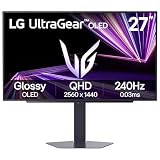
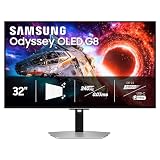
OLED is the enthusiast default in 2026. The Samsung 27″ Odyssey OLED G6 (G61SH) is the archetype of the modern 1440p QD-OLED: 240Hz, 0.03ms, a glare-free matte coating that tames reflections, and a three-year warranty that covers burn-in. The LG 27GX704A-B UltraGear matches that spec sheet with DisplayHDR True Black 400 and HDMI 2.1, making it a strong dual-duty option for PC and console players.
Go wider and OLED’s advantage grows. The Samsung 49″ Odyssey G93SC and MSI MPG 491CQP both deliver 5120×1440 DQHD across a deep curve — the G93SC at 240Hz for competitive play, the MSI at 144Hz with USB-C connectivity. The INNOCN 49Q1R undercuts both while adding 90W USB-C, KVM and PIP/PBP for hybrid work setups, and the LG 39GX90SA-W splits the difference at 39 inches with 240Hz, webOS smart features and a clean white finish.
Why Choose an IPS Gaming Monitor
IPS is not a compromise panel anymore. Modern Fast IPS displays reach 300–540Hz at 1440p, sustain 400–600 nits of full-screen brightness, and cost dramatically less than an equivalent OLED. For competitive players chasing the highest possible refresh rate on a fixed budget, IPS delivers more frames per dollar than any other technology, and its wide viewing angles and accurate factory colour make it a reliable choice for content creation too.
The bigger practical argument is durability. If your monitor spends most of its life displaying a taskbar, Discord sidebar, spreadsheet or streaming dashboard, IPS removes burn-in from the equation entirely. Add strong daylight performance and the absence of automatic brightness limiting, and IPS remains the sensible pick for shared family rooms, offices with big windows, and anyone who simply wants to plug in a monitor and forget about panel care.
Which Should You Buy?
- For competitive FPS on a budget: pick IPS — a 300Hz+ 1440p panel costs less than a 240Hz OLED.
- For single-player and HDR immersion: pick OLED, ideally the Odyssey OLED G6 or LG 27GX704A-B.
- For sim racing and flight sims: pick a 49-inch OLED such as the Odyssey G93SC or MSI MPG 491CQP.
- For work-and-play hybrid desks: pick the INNOCN 49Q1R for USB-C and KVM, or an IPS panel if static UI dominates your day.
- For bright, sunlit rooms: pick IPS, or a matte OLED like the G61SH if budget allows.
Frequently Asked Questions
Is OLED burn-in still a real risk in 2026?
It’s a manageable one. Pixel shifting, logo dimming and automatic panel refresh cycles have made retention rare in normal mixed use, and features like Samsung’s OLED Safeguard plus multi-year burn-in warranties cover the remaining risk.
Does OLED actually help in competitive games?
Yes. The 0.03ms response time removes dark-transition smearing, so fast strafing targets stay legible. At identical refresh rates, OLED motion clarity is measurably cleaner than IPS.
Is 144Hz enough on a big ultrawide?
For most players, yes. Driving 5120×1440 at 240Hz demands a top-tier GPU, so 144Hz panels like the MSI 491CQP or INNOCN 49Q1R are often the more realistic pairing.
Which is better for text and productivity?
IPS still edges it for all-day text work, though 2026 QD-OLED panels have narrowed the gap considerably and are perfectly usable for mixed work-and-gaming duty.
Final Verdict
Buy OLED if you want the best-looking games on your desk and can protect your investment with sensible habits; buy IPS if brightness, burn-in immunity, or raw refresh rate per dollar matter more. For most gamers upgrading in 2026, a 27-inch 1440p QD-OLED like the Odyssey OLED G6 or LG 27GX704A-B is the sweet spot.