Key takeaways
- GPU load: 4K renders about 8.3 million pixels per frame versus 3.7 million at 1440p, so expect roughly 40-55% lower native frame rates on the same card.
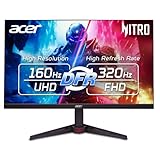
- Refresh rate ceiling: Affordable QHD panels now reach 165-180Hz as standard, while budget 4K sits at 120-160Hz — though the Acer Nitro VG270K V4 uses Dual Frame Rate to hit 320Hz at reduced resolution.
- Pixel density: A 27-inch 4K panel delivers roughly 163 PPI against 109 PPI at QHD. On a 32-inch screen, 1440p drops to about 92 PPI, where individual pixels become visible at close range.
- Panel technology: 4K models in this bracket typically use IPS for colour accuracy and viewing angles; QHD curved models more often use VA for deeper contrast and stronger blacks.
- Desktop and text clarity: 4K gives you far crisper text and genuine room for multiple full-size windows — a real advantage if the same monitor doubles as a work display.
- Total system cost: The monitor is only part of the bill. Driving 4K comfortably usually means a more expensive GPU, which is where the real price gap lives.
What's inside
The 1440p versus 4K argument used to be simple: QHD if you wanted frames, UHD if you wanted pixels. In 2026 the line is blurrier. High-refresh 4K panels have fallen to prices that QHD monitors occupied only a few years ago, HDMI 2.1 is standard rather than a premium feature, and upscaling plus frame generation now do a lot of the heavy lifting that raw GPU horsepower used to. A 4K display is no longer an automatic sign that you overspent on a monitor your graphics card cannot feed.
That said, the tradeoff has not disappeared — it has just moved. 4K still demands roughly 2.25x the pixels of 1440p, and every frame you render at native resolution costs you. Meanwhile, QHD panels have pushed refresh rates and response times further ahead, making them the default for anyone who plays competitively. Choosing correctly in 2026 comes down to three things: what GPU you own, how big your monitor is and how close you sit, and whether you value motion clarity or image detail more.
As an Amazon Associate we earn from qualifying purchases at no extra cost to you. Product prices and availability are accurate as of the date shown and are subject to change.




⚡ Save on Your Next PC — Amazon Prime
Prime members get fast free shipping on the systems above, plus early access to Prime Day & Black Friday PC deals. New members get a 30-day free trial.
Watch: 1440p vs 4K Gaming Monitor: 2026 Guide — Video Review
Quick Verdict
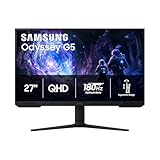
Pick 1440p if you play fast shooters, own a mid-range GPU, or want the highest refresh rate per dollar — the Samsung Odyssey G5 (G51F) at 27 inches and the 32-inch Odyssey G55C are the obvious mainstream picks. Pick 4K if you play story-driven or open-world games, sit on a 32-inch or larger screen, or use the monitor for editing and productivity as well as gaming. The Acer Nitro VG270K V4 and Dell S2725QS cover 27-inch 4K, while the CRUA 32″ 4K curved handles the larger-screen case.
Key Differences
- GPU load: 4K renders about 8.3 million pixels per frame versus 3.7 million at 1440p, so expect roughly 40-55% lower native frame rates on the same card.
- Refresh rate ceiling: Affordable QHD panels now reach 165-180Hz as standard, while budget 4K sits at 120-160Hz — though the Acer Nitro VG270K V4 uses Dual Frame Rate to hit 320Hz at reduced resolution.
- Pixel density: A 27-inch 4K panel delivers roughly 163 PPI against 109 PPI at QHD. On a 32-inch screen, 1440p drops to about 92 PPI, where individual pixels become visible at close range.
- Panel technology: 4K models in this bracket typically use IPS for colour accuracy and viewing angles; QHD curved models more often use VA for deeper contrast and stronger blacks.
- Desktop and text clarity: 4K gives you far crisper text and genuine room for multiple full-size windows — a real advantage if the same monitor doubles as a work display.
- Total system cost: The monitor is only part of the bill. Driving 4K comfortably usually means a more expensive GPU, which is where the real price gap lives.
1440p: Maximum Frames for the Money
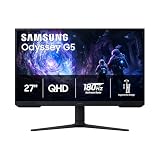
QHD remains the sweet spot for competitive play. The Samsung Odyssey G5 (G51F) is the archetype at 27 inches — 180Hz, 1ms response, FreeSync, plus Black Equalizer and a Virtual Aim Point overlay aimed squarely at shooter players. On a mid-range card you can realistically hold triple-digit frame rates in most modern titles at high settings without leaning on upscaling, and that consistency matters more for aim and tracking than extra texture detail ever will.
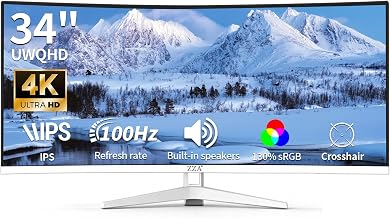
If you want a bigger canvas, the 32-inch Odyssey G55C keeps 1440p but adds an aggressive 1000R curve and 165Hz, which suits single-player immersion as much as multiplayer. For sim racing, flight sims and strategy games, the ZZA 34-inch ultrawide is worth considering: its 3440×1440 panel adds horizontal field of view at a modest 100Hz, trading refresh rate for peripheral coverage. All three keep the GPU requirement sane, which is why 1440p continues to dominate mainstream gaming builds.
4K: Detail, Density and Desktop Space
4K’s advantage is immediately visible in anything with fine geometry — foliage, distant terrain, UI text, HUD elements. The Acer Nitro VG270K V4 is the most flexible option here, pairing a 160Hz 4K IPS panel with dual HDMI 2.1 ports and a 320Hz Dual Frame Rate mode, effectively letting you switch between detail and speed depending on the game. The Dell S2725QS takes a calmer approach: 120Hz, 99% sRGB, USB-C input and a fully adjustable stand, making it the better pick for a mixed work-and-play desk.
Screen size is where 4K really justifies itself. On a 32-inch panel, 1440p can look soft at typical desk distances, whereas the CRUA 32″ 4K curved monitor keeps text sharp while adding a 1500R curve, 160Hz and HDMI 2.1 for current consoles. The catch remains GPU cost. Native 4K at high refresh is demanding, so budget for a card capable of it — or accept that you will be using upscaling in the most demanding titles.
Which Should You Buy?
- For competitive FPS: pick 1440p — the Samsung Odyssey G5 (G51F) at 180Hz gives you frames and latency over pixels.
- For single-player and open-world games: pick 4K — the Acer Nitro VG270K V4 offers detail with enough refresh rate to stay smooth.
- For a 32-inch screen: pick 4K — the CRUA 32″ 4K curved avoids the pixel-density drop that hurts QHD at this size.
- For work and gaming on one display: pick 4K — the Dell S2725QS adds USB-C and ergonomic adjustment to a sharp IPS panel.
- For a mid-range GPU or console: pick 1440p — the Odyssey G55C or ZZA 34-inch ultrawide deliver more perceived smoothness per frame rendered.
Frequently Asked Questions
Is 4K worth it on a 27-inch monitor?
Yes, if you sit close or use the screen for text-heavy work. At 27 inches the jump to roughly 163 PPI is clearly visible, but the benefit shrinks the further back you sit.
What GPU do I need for 4K gaming in 2026?
For 60-100fps at high settings, a current upper-mid-range card with upscaling enabled is the practical minimum. Native 4K above 120fps still requires a high-end GPU.
Does 1440p look bad on a 32-inch display?
Not bad, but noticeably softer. At about 92 PPI you may see pixel structure on text and edges from a normal desk distance, which is why 32-inch 4K has become popular.
Is an ultrawide better than standard 4K?
It depends on genre. Ultrawide 3440×1440 adds field of view for racing, sims and RPGs; 16:9 4K adds sharpness and is better supported in competitive shooters.
Final Verdict
If your priority is winning matches and stretching a mid-range GPU as far as it goes, 1440p is still the smarter buy in 2026 — the Samsung Odyssey G5 (G51F) and 32-inch Odyssey G55C prove how much refresh rate and contrast you get for the money. If you want the sharpest possible image, plan to run a 32-inch panel, or need one display for both games and serious desktop work, 4K has finally become the sensible default, with the Acer Nitro VG270K V4, CRUA 32″ curved and Dell S2725QS covering the speed, size and productivity angles respectively.