Key takeaways
- 4K pass-through: The card lets a 4K signal continue to your television or monitor while the computer receives a lower-resolution feed.
- 4K recording: The card can send 4K video to your computer for recording, editing, or live production.
- 4K streaming: The entire chain—including your software, computer, internet connection, and streaming service—can deliver a 4K broadcast.
What's inside
The Short Answer
A 4K capture card is worth it for streaming only if you have a 4K source, a display or recording workflow that benefits from 4K, and a computer powerful enough to handle the extra data. If your main goal is live streaming to Twitch, YouTube, or similar platforms at 1080p, a good 1080p60 capture card is usually the smarter buy.
That answer may sound less exciting than “4K is better,” but capture cards involve two separate questions: what resolution your console or camera sends, and what resolution your audience actually watches. A card can capture or pass through a 4K signal while you stream a 1080p version. That can be useful, but it is not automatically worth paying more for.
As an Amazon Associate we earn from qualifying purchases at no extra cost to you. Product prices and availability are accurate as of the date shown and are subject to change.


What You Actually Get
A capture card takes video and audio from an HDMI source—such as a PS5, Xbox Series X/S, Switch 2, camera, or second PC—and sends that signal to your computer. Streaming software such as OBS can then combine it with a webcam, microphone, overlays, alerts, and other scenes.
When a product is described as a “4K capture card,” check what the label really means. There are three common possibilities:
- 4K pass-through: The card lets a 4K signal continue to your television or monitor while the computer receives a lower-resolution feed.
- 4K recording: The card can send 4K video to your computer for recording, editing, or live production.
- 4K streaming: The entire chain—including your software, computer, internet connection, and streaming service—can deliver a 4K broadcast.
These features are not interchangeable. A card may support 4K pass-through but capture only 1080p. Another may capture 4K at 30 frames per second rather than 60. For fast games, the difference between 30fps and 60fps is noticeable, especially when you are moving the camera quickly or showing competitive play.
Many buyers also confuse capture resolution with refresh rate. A card that accepts 4K video does not necessarily support 4K at 120Hz. If you want a smooth 120Hz gaming display while streaming, look for a card that specifically lists 4K120 pass-through, along with the appropriate HDMI standard. Otherwise, the card may force you to lower the console’s output or refresh rate.
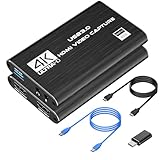
Budget models can be surprisingly useful. A typical inexpensive HDMI-to-USB 3.0 capture device may advertise 1080p at 60fps for capture, often with 4K input or pass-through claims. One generic option in this category costs about $25.89. It can make sense for a casual streamer, remote presentation, webcam-style camera setup, or someone testing whether streaming is worth pursuing.
A more specialized option, such as the Elgato 4K S for PS5, Xbox Series X/S, and Switch 2, costs about $146.99. The higher price generally buys a more established software experience, clearer specifications, better support, and a design aimed at current-generation console streaming. It is still important to verify the exact capture and pass-through modes before buying.
Pros
- Better-looking local recordings: Capturing in 4K preserves more detail for edited videos, tutorials, gameplay guides, and archival footage, even if your live broadcast is 1080p.
- Flexible output: A capable card can let you play at 4K while sending a 1080p feed to your streaming software.
- Useful for modern consoles: The PS5, Xbox Series X/S, and Switch 2 can output high-resolution video, so a suitable card keeps more of that quality in your workflow.
- More room to crop: A 4K recording gives editors extra pixels for reframing, zooming into menus, or creating vertical clips without making the image look as soft.
- Longer useful life: A well-specified 4K card is less likely to feel outdated if you upgrade your monitor, camera, or content style later.
- Professional production options: If you stream product demonstrations, events, classes, or multiple camera angles, 4K input can provide useful flexibility beyond gaming.
Cons
- Higher cost: A basic capture device may cost roughly $25 to $60, while a dependable 4K model commonly lands around $120 to $250 or more.
- More demanding computer requirements: 4K video uses substantially more processing power, storage, and data bandwidth than 1080p. A weak or busy computer can produce dropped frames, delay, or stuttering.
- Large recordings: A 4K file can consume much more storage than a 1080p file. Anyone recording regularly may need a fast SSD and a practical file-management routine.
- Internet limitations: Your audience may not receive a true 4K stream if your platform, upload speed, or encoding settings cannot support it. A fast home download connection does not guarantee sufficient upload capacity.
- Compatibility complications: HDMI versions, HDCP copy protection, HDR, variable refresh rate, ultrawide resolutions, and high refresh rates can affect whether everything works together.
- Limited benefit for ordinary live streams: Many viewers watch on phones, laptops, or congested connections. A clean 1080p60 stream can look better than a poorly encoded or unstable 4K broadcast.
Who Should Buy It
Buy a 4K capture card if you regularly record gameplay or camera footage for editing, own a 4K television or monitor, and want to preserve that source quality. It is also a sensible purchase for creators who make tutorials, cinematic gameplay, product videos, or clips that will be cropped and reused across platforms.
It is particularly worthwhile when you want 4K pass-through with a 1080p60 stream. This setup allows you to play at a sharp resolution while keeping the broadcast’s file size and encoding load more manageable. Just confirm that the card supports your desired refresh rate. A 4K60 source is a very different requirement from a 4K120 gaming setup.
Choose the better-built model if streaming is an important part of your work. The roughly $146.99 Elgato 4K S is more appropriate for someone who wants a current-console setup with established software support rather than the absolute lowest entry price. Check the included cables, operating-system compatibility, audio features, and passthrough specifications before placing the order.
Who Should Skip It
Skip a 4K capture card if you stream only at 720p or 1080p, do not make local recordings, and play on a 1080p display. In that situation, the extra resolution may add cost without improving what your audience sees.
You should also skip it if your computer struggles with ordinary 1080p streaming or if your upload connection is unreliable. A stable 1080p60 broadcast is more valuable than a technically superior 4K setup that drops frames or overwhelms your encoder.
Finally, avoid buying based on the word “4K” alone. A low-cost card may accept a 4K signal but capture at 1080p, operate at 30fps, or lack the passthrough mode you need. Read the input, capture, passthrough, frame-rate, and HDR specifications as separate lines.
Cheaper Alternatives
| Option | Cost | Trade-off |
|---|---|---|
| Basic USB 3.0 1080p60 HDMI capture card | About $25–$60 | Affordable and adequate for most live streams, but usually limited to 1080p capture and simpler software or support. |
| 1080p60 capture card with 4K pass-through | About $60–$120 | Lets you play at 4K while streaming at 1080p, but does not necessarily record 4K. |
| Generic 4K-input/1080p-capture USB device | About $25.89 | Very low entry price, but specifications, latency, audio handling, and compatibility can vary by seller and model. |
| Established 4K capture card | About $120–$250 | Better fit for regular creators and modern consoles, but costs considerably more and still requires a capable computer. |
FAQ
Can I stream 4K with a 4K capture card?
Not automatically. The card, console or camera, computer, encoder, streaming software, internet upload speed, and streaming platform must all support the intended 4K workflow. Many creators use a 4K card to capture locally or pass through 4K while broadcasting at 1080p.
Is 1080p60 enough for streaming in 2026?
For most gaming, webcam, and casual creator streams, yes. 1080p at 60fps offers a sharp, smooth picture while using less bandwidth and processing power than 4K. It is often the best balance between quality, reliability, and viewer accessibility.
Does a 4K capture card reduce gaming performance?
The card itself typically does not reduce the console’s game performance, but your setup can introduce limitations. A card without the right high-refresh-rate passthrough may force a lower output mode. On the computer side, capturing, encoding, recording, and streaming at once can increase system load.
What should I check before buying?
Confirm the maximum input resolution, capture resolution, frame rates, passthrough resolution, HDMI requirements, HDR and variable-refresh support, USB connection, audio inputs, operating-system compatibility, and HDCP limitations. Also check whether the card works with your streaming software and whether its warranty and support are adequate for your needs.