Key takeaways
- Compare gaming soundbars and PC speakers by stereo imaging, desk space, bass, connections, upgrade options, and everyday usability.
The soundbar-versus-speakers decision is mainly a trade between tidy placement and physical stereo separation. A soundbar puts audio, controls, and often lighting into one enclosure beneath the display. A pair of PC speakers occupies more surface area and needs more cable management, but each speaker can be placed on the correct side of the monitor and aimed toward the listener. For gaming, that geometry often matters more than the number printed on the box.
This comparison is based on form factor, connection standards, and manufacturer documentation. It is not a claim that we laboratory-tested every design. Individual products can depart sharply from their category, so compare exact dimensions, inputs, and return terms before purchasing.
Our top picks
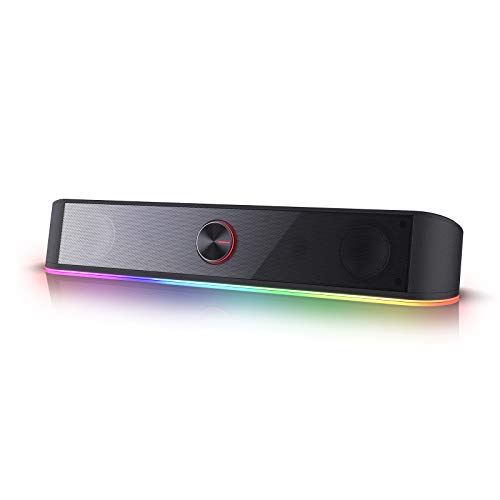 Redragon GS560 RGB Desktop Soundbar
- Rich Sounds & Look - The first Redragon…
- Lightshow Projection - What's better than play your…
- Bounce to Daylight - Easy to place it…

 Razer Leviathan V2 X
- PC Soundbar with Full-Range Drivers: Armed with two…
- Compact Desktop Form Factor: The most compact soundbar…
- USB Type C Power and Audio Delivery: Powered…


 LENRUE G11 Computer Speakers for Desktop
- Surge Stereo Sound - 4 large amplifier IC…
- Touch Angular Game Lights - Unique Dynamic Angular…
- All In One Compact - Fits any desktop…

As an Amazon Associate we earn from qualifying purchases at no extra cost to you.
Soundbar versus speakers at a glance
| Decision factor | Soundbar | Separate PC speakers |
|---|---|---|
| Desk footprint | One long space below display | Two side positions, sometimes a subwoofer |
| Stereo separation | Limited by bar width and processing | Adjustable through physical placement |
| Cable appearance | Usually tidier | More visible signal and power cables |
| Controls | Centralized | Usually on one speaker or external controller |
| Upgrade path | Usually replace the complete unit | Some powered or passive systems allow more flexibility |
| Multi-monitor fit | Can sit below the center display | May be difficult to place outside a wide array |
| Near-field listening | Model-dependent | Common strength of desktop monitors/speakers |
| TV integration | Strong on HDMI ARC/eARC models | Less common on conventional PC speakers |
If you need the shortest answer: choose speakers when accurate stereo placement and music reproduction are priorities; choose a soundbar when the desk cannot accommodate two correctly positioned enclosures or when a TV-style HDMI setup is central.
Positional audio: width is physical before it is virtual
Two speakers can create a clear stereo image because the left and right sources are physically separated. A common starting point is a roughly symmetrical triangle between the listener and the two speakers, with tweeters near ear height. Exact placement depends on the room and product, but the listener can alter spacing and toe-in.
A soundbar also contains left and right drivers, yet they remain constrained by the enclosure width. Digital processing may broaden the perceived field, and premium bars can use side-firing, upward-firing, or beamforming techniques. Those features can increase immersion, but they do not give the user the same placement freedom as two separate cabinets.
This distinction matters in games that communicate direction through stereo cues. It does not mean speakers always win: poorly positioned speakers hidden behind monitors can perform worse than a well-placed bar. Keep either option unobstructed and centered relative to the listening position.
Desk space and visual organization
Soundbars solve a particular geometry problem. Many desks have unused horizontal space below a raised monitor but little room at the sides. A low-profile bar can occupy that strip and leave space for a mousepad, dock, and work equipment. It also simplifies the visual layout because the left and right channels share one enclosure.
Measure carefully. A bar may interfere with the monitor stand, cover the bottom edge of the panel, or force the keyboard forward. Separate speakers can fit behind or outside a display, but placing them at very different distances or angles damages symmetry. Multi-monitor arrays make side placement particularly challenging and can favor a centered bar.
Neither option is automatically compact when a large subwoofer is included. The subwoofer needs floor space, ventilation, a power outlet, and a route for its cable or wireless link. Treat it as a separate component during planning.
Sound character and bass control
Separate PC speakers have room for dedicated left and right enclosures. Larger cabinets may support deeper output or lower distortion, but specifications alone cannot guarantee sound quality. Near-field monitors are specifically designed for close listening; mainstream multimedia speakers may emphasize bass or treble instead.
Soundbars use multiple small drivers and processing to deliver a broad presentation from a shallow cabinet. Some add a subwoofer to handle low frequencies. At a short desktop distance, strong bass can overwhelm dialogue and footsteps, especially near walls or corners. Independent subwoofer level, EQ, or a night mode is therefore useful in either category.
When reading frequency-response claims, check whether the manufacturer specifies a tolerance and measurement method. A bare range such as “40 Hz–20 kHz” does not reveal balance, maximum clean output, or how the system behaves at a desk.
Connections and source switching
PC speakers commonly use USB, 3.5 mm analog, Bluetooth, or a combination. Analog is simple and broadly compatible; USB bypasses the computer’s analog output stage and may enable software features. Bluetooth is convenient for a phone but is not our first choice for competitive gaming because the complete wireless path can add delay.
Desktop soundbars often offer similar inputs. TV-oriented bars add HDMI ARC or eARC and optical audio. According to HDMI Licensing Administrator, eARC can carry high-bitrate formats and uncompressed multichannel audio from a compatible TV to a soundbar. That is valuable in a living-room system, but irrelevant if a desktop monitor has no ARC/eARC output.
Count sources before buying. A gaming PC, work laptop, console, and phone can exceed the inputs on a minimalist product. Also check whether switching is performed with a hardware button, remote, app, or automatic detection. Convenience on a specification sheet can become friction if the control method does not match the desk.
Surround sound and spatial processing
Both formats may advertise virtual surround. Windows offers Windows Sonic and supports optional Dolby Access and DTS Sound Unbound software. Some soundbars and speaker systems add their own processing. Layering multiple virtualization systems can alter tonal balance and positioning, so begin with one processor or plain stereo and compare deliberately.
Dolby describes Atmos for games as object-based audio rendered at playback, with height information available in compatible titles and systems. To benefit from it, the game, operating environment, output format, connection, and endpoint must all cooperate. A badge on the enclosure is only one link in that chain.
For a small desk, high-quality stereo can be preferable to aggressive virtualization. For couch gaming and films, a wider Atmos-capable TV soundbar may provide a more enveloping presentation. Set expectations according to placement: a front-mounted bar is not the same physical layout as discrete surround speakers.
Upgradeability and lifespan
Most active soundbars and multimedia speaker kits are closed systems. When the amplifier, software support, or proprietary subwoofer fails, replacing one part may be difficult. Some powered speakers accept a separate subwoofer, while traditional passive speakers can be paired with a replaceable amplifier. That route costs more space and planning but offers the strongest upgrade flexibility.
Software dependence is another consideration. USB audio should provide basic playback, but EQ, lighting, spatial modes, and firmware tools may depend on a vendor application. Check operating-system support and whether essential controls remain available without an account or continuously running utility.
Choose a soundbar when…
- The only viable audio space is directly below the monitor.
- A clean, centered installation is more important than adjustable stereo width.
- You frequently move between desk and television use.
- HDMI ARC/eARC is required for a TV-centered console setup.
- Central controls and fewer desktop cables simplify daily use.
- A wide multi-monitor layout prevents sensible speaker placement.
Our best gaming soundbar guide explains how to shortlist by input and room rather than feature count.
Choose PC speakers when…
- You can place left and right speakers symmetrically and unobstructed.
- Stereo imaging for games and music is a leading priority.
- You want to adjust spacing, angle, or height.
- Analog and USB sources are sufficient.
- You prefer a system with a possible subwoofer or component upgrade path.
- You do not need TV-specific HDMI control.
A practical audition checklist
Whether buying a bar or speakers, use the return period methodically. First, verify that the product wakes reliably and remains the selected Windows output. Play spoken dialogue at low volume and check whether voices remain clear. Use a familiar stereo scene to judge left-center-right placement. Then run a game with immediate visual actions and listen for obvious synchronization errors.
Move bass controls through their range and test at the volume you actually use, not only at showroom level. Switch every planned source. Restart the computer. Put it to sleep and wake it. If a product succeeds acoustically but fails these routine behaviors, it may still be the wrong system.
For setup instructions, see how to connect a soundbar to a gaming PC. If action and audio appear separated, diagnose soundbar input lag before returning hardware.
FAQ
Are soundbars worse than speakers for gaming?
Not categorically. Soundbars sacrifice adjustable physical separation for compact, centralized placement. Separate speakers have a structural advantage when they can be placed correctly, while a soundbar may outperform badly positioned or obstructed speakers on a constrained desk.
Can a soundbar replace a 2.1 speaker system?
Yes, particularly a bar supplied with a subwoofer. However, matching the “2.1” label does not mean the systems have equal crossover behavior, tonal balance, output, or stereo width. Compare the complete products and room requirements.
Is Bluetooth acceptable for single-player games?
It may be acceptable if perceived delay does not bother you, but latency depends on the source, codec negotiation, receiver, buffering, and game. A wired USB, HDMI, optical, or analog path is easier to troubleshoot and usually preferable when timing matters.
Which is better for music?
Well-positioned stereo speakers usually offer more natural separation and a flexible soundstage. A good soundbar can still be enjoyable, especially where furniture prevents speaker placement. Product design and room interaction remain decisive.
Bottom line
Buy for the desk you have. Separate PC speakers are the stronger default when you can give them symmetrical space and want precise stereo imaging. A gaming soundbar is the practical answer when placement, visual simplicity, centralized controls, or TV integration outweigh adjustable separation. The best choice is the one that remains correctly positioned and reliably connected every day.
Sources
- HDMI Licensing Administrator: Enhanced Audio Return Channel
- Microsoft Support: Turn On Spatial Sound in Windows
- Dolby Professional: Dolby Atmos Documentation for Gaming
- Dolby: Soundbar Setup Guide