Key takeaways
- Confirm it’s actually mechanical: Plenty of budget boards advertise a “mechanical feel” while using rubber domes underneath. Look for a named switch type — red, brown, blue, yellow — and a stated actuation force or travel distance. If the listing won’t tell you what’s under the keycaps, assume it’s membrane.
- Prioritise hot-swap if you can get it: A hot-swappable PCB lets you pull and replace a failed switch with a $0.30 part instead of binning the whole board. It also lets you upgrade the feel later without buying a new keyboard, which effectively doubles the lifespan of a cheap purchase.
- Insist on PBT keycaps, ideally double-shot: ABS keycaps develop a greasy shine within weeks of heavy use, and pad-printed legends wear off entirely. PBT resists both. Double-shot legends are moulded from a second piece of plastic and physically cannot fade — this is the single biggest perceived-quality upgrade available under $50.
- Match the layout to your desk, not the spec sheet: A full-size board with a numpad is right if you work in spreadsheets; a 75% or TKL frees up significant mouse-swing room for low-sensitivity shooter players. Compact layouts also tend to have better build quality at the same price, because there’s simply less plastic to pay for.
- Treat wireless as a premium feature, not a given: Reliable 2.4GHz wireless with a decent battery is genuinely hard to do cheaply. If a board offers it under $50, check that it also has a wired mode — and expect the trade-off to appear somewhere else, usually in the case material or the stabilisers.
What's inside
Sub-$50 mechanical keyboards used to mean a compromise you could feel in every keystroke — mushy stabilizers, thin ABS keycaps that go shiny in a month, and switches soldered in place so a single dead key ruined the board. That’s no longer the case. Hot-swap sockets, double-shot PBT keycaps, and pre-lubed switches have all trickled down into budget territory, and in 2026 the gap between a $45 keyboard and a $120 one is narrower than it has ever been.
The catch is that the budget shelf is also where the most misleading marketing lives. “Mechanical-feel” membrane boards, unnamed switch clones, and inflated list prices designed to make a permanent discount look temporary are everywhere. This guide cuts through that. Below are six keyboards that genuinely deliver at or near the $50 mark, what to prioritise when you’re spending this little, and honest notes on where each one cuts corners — because at this price, every board cuts something.
As an Amazon Associate we earn from qualifying purchases at no extra cost to you. Product prices and availability are accurate as of the date shown and are subject to change.





⚡ Save on Your Next PC — Amazon Prime
Prime members get fast free shipping on the systems above, plus early access to Prime Day & Black Friday PC deals. New members get a 30-day free trial.
Watch: Best Mechanical Keyboard Under $50 — Video Review
How to Choose Mechanical Keyboard Under $50
- Confirm it’s actually mechanical: Plenty of budget boards advertise a “mechanical feel” while using rubber domes underneath. Look for a named switch type — red, brown, blue, yellow — and a stated actuation force or travel distance. If the listing won’t tell you what’s under the keycaps, assume it’s membrane.
- Prioritise hot-swap if you can get it: A hot-swappable PCB lets you pull and replace a failed switch with a $0.30 part instead of binning the whole board. It also lets you upgrade the feel later without buying a new keyboard, which effectively doubles the lifespan of a cheap purchase.
- Insist on PBT keycaps, ideally double-shot: ABS keycaps develop a greasy shine within weeks of heavy use, and pad-printed legends wear off entirely. PBT resists both. Double-shot legends are moulded from a second piece of plastic and physically cannot fade — this is the single biggest perceived-quality upgrade available under $50.
- Match the layout to your desk, not the spec sheet: A full-size board with a numpad is right if you work in spreadsheets; a 75% or TKL frees up significant mouse-swing room for low-sensitivity shooter players. Compact layouts also tend to have better build quality at the same price, because there’s simply less plastic to pay for.
- Treat wireless as a premium feature, not a given: Reliable 2.4GHz wireless with a decent battery is genuinely hard to do cheaply. If a board offers it under $50, check that it also has a wired mode — and expect the trade-off to appear somewhere else, usually in the case material or the stabilisers.
The Best Picks Reviewed
AULA F75 Pro Wireless
The most complete package here by a wide margin: 75% layout, hot-swap sockets, pre-lubed Reaper switches, side-printed PBT caps, a volume knob, and tri-mode connectivity via 2.4GHz, Bluetooth 5.0, or USB-C. The gasket-style mounting gives it a softer, deeper sound than anything else at this price, and the only real compromise is a plastic case that flexes if you squeeze it.
Redragon Hot-Swappable Mechanical Keyboard
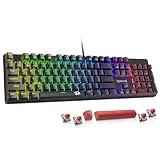
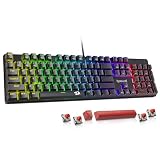
This is the value benchmark for wired boards — hot-swap sockets and double-shot PBT keycaps at a price where most competitors offer neither, plus 11 backlight modes and full anti-ghosting. The linear reds are unremarkable out of the box, but that’s exactly the point: swap in a set of switches you like and you’ve built a genuinely good keyboard for well under the budget.
Razer BlackWidow V4 X
Usually the priciest option on this list and frequently just over $50 at full RRP, so buy it on a dip — but when it lands in budget, nothing else here matches its rigidity or the polish of its Yellow linear switches, which are light, fast, and quiet enough for shared spaces. You also get six dedicated macro keys and Razer’s Synapse ecosystem, though the ABS keycaps will shine up eventually.
Logitech G413 SE
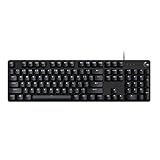
The choice for anyone who wants a keyboard that simply works for five years without thinking about it: a brushed aluminium top plate, tactile switches, PBT keycaps, and single-colour white backlighting instead of RGB. There’s no hot-swap and no software-heavy feature set, but the build quality is a clear step above the plastic competition.
Redragon K580
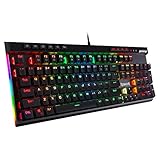
A full-size board aimed at players who want dedicated hardware controls — five macro keys down the left flank and a proper media wheel, both of which are rare below $50. Per-key RGB and a solid steel plate round it out, though it’s a chunky, tall keyboard that really wants a wrist rest.
Frequently Asked Questions
Are cheap mechanical keyboards actually durable?
The switches are — most budget switches are rated for 50 to 100 million actuations, the same ballpark as premium ones. What fails first on inexpensive boards is usually the USB cable, the stabilisers on the spacebar and Enter key, or the keycap legends. Hot-swap sockets and PBT caps mitigate two of those three problems for a few dollars.
Which switch type should I pick for gaming?
Linear switches (red, yellow) are the default recommendation because there’s no tactile bump to push past, which makes rapid repeated presses feel smoother. Tactile switches (brown) are the better all-rounder if you also type for hours. Clicky blues are satisfying but genuinely loud, and a poor choice for voice chat or shared rooms.
Is wireless worth it at this price?
Only if the board offers 2.4GHz with a dongle rather than Bluetooth alone. Bluetooth latency is fine for typing but noticeable in competitive shooters. A tri-mode board like the AULA F75 Pro lets you use 2.4GHz at your desk and Bluetooth on a laptop, which is the best of both.
Do I need software to use these keyboards?
No. Every board here handles lighting and basic functions through onboard shortcuts, so they work fully on a fresh install or a console with keyboard support. Software from Razer and Logitech adds macro recording and profile syncing, but it’s optional rather than required.
Final Thoughts
If you want the most keyboard for the money, the AULA F75 Pro is the clear winner — hot-swap, PBT caps, a knob, and tri-mode wireless is a feature set that cost twice as much two years ago. Budget-focused buyers who only need a wired board should take the Redragon hot-swappable model and put the savings toward a switch set they actually like, while anyone who values build quality and long-term reliability over features will be happiest with the aluminium-topped Logitech G413 SE.