Key takeaways
- Actuation and feel: Mechanical switches actuate partway through travel with a defined tactile or linear response; membrane requires bottoming out a rubber dome, producing a softer, mushier press.
- Durability: Mechanical switches are rated for 50–100 million presses per key. Membrane domes typically fade after 5–10 million and degrade unevenly, so WASD dies first.
- Noise: Membrane is naturally quiet. Mechanical ranges from loud clicky blues, as on the Redragon K580, to whisper-quiet pre-lubed linears on the RK R104.
- Repairability: Hot-swap mechanical boards let you pull and replace a single failed switch in seconds. A dead membrane sheet means a dead keyboard.
- Anti-ghosting and rollover: Mechanical boards routinely offer full N-key rollover; budget membrane often caps at 6 keys or fewer, which matters during frantic ability combos.
- Price and weight: Membrane is cheaper and lighter; mechanical boards, especially aluminium-framed ones like the Logitech G413 SE, cost more but feel immovable in play.
What's inside
The keyboard sitting under your hands is the single most-used piece of hardware in your setup, and in 2026 the gap between the two dominant technologies has never been more interesting. Mechanical keyboards use an individual spring-loaded switch beneath every keycap, while membrane boards press a rubber dome onto a printed circuit sheet. That one structural difference cascades into everything: how fast the board registers a press, how long it survives, how loud it is at 1 a.m., and how much you pay.
What has changed recently is price. Mechanical boards that once demanded a premium now start at genuinely budget money, with hot-swap sockets, pre-lubed switches and PBT keycaps appearing on entry-level models. Membrane, meanwhile, has doubled down on what it does best — silence, spill resistance and cost. Choosing well means being honest about your games, your desk, your ears and your housemates. Here is how the two stack up.
As an Amazon Associate we earn from qualifying purchases at no extra cost to you. Product prices and availability are accurate as of the date shown and are subject to change.


⚡ Save on Your Next PC — Amazon Prime
Prime members get fast free shipping on the systems above, plus early access to Prime Day & Black Friday PC deals. New members get a 30-day free trial.
Watch: Mechanical vs Membrane Keyboard: 2026 Guide — Video Review
Quick Verdict
Mechanical is the right default for most gamers in 2026: faster, more consistent actuation, vastly longer life, and a repairable, customisable platform. Boards like the AULA F75 Pro and RK ROYAL KLUDGE R104 deliver enthusiast features at mainstream prices. Membrane still wins if you need near-silent typing, maximum spill tolerance, or the absolute lowest cost — and hybrids such as the SteelSeries Apex 5 split the difference with a membrane-cushioned mechanical switch.
Key Differences
- Actuation and feel: Mechanical switches actuate partway through travel with a defined tactile or linear response; membrane requires bottoming out a rubber dome, producing a softer, mushier press.
- Durability: Mechanical switches are rated for 50–100 million presses per key. Membrane domes typically fade after 5–10 million and degrade unevenly, so WASD dies first.
- Noise: Membrane is naturally quiet. Mechanical ranges from loud clicky blues, as on the Redragon K580, to whisper-quiet pre-lubed linears on the RK R104.
- Repairability: Hot-swap mechanical boards let you pull and replace a single failed switch in seconds. A dead membrane sheet means a dead keyboard.
- Anti-ghosting and rollover: Mechanical boards routinely offer full N-key rollover; budget membrane often caps at 6 keys or fewer, which matters during frantic ability combos.
- Price and weight: Membrane is cheaper and lighter; mechanical boards, especially aluminium-framed ones like the Logitech G413 SE, cost more but feel immovable in play.
Mechanical Keyboards
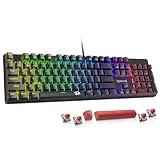
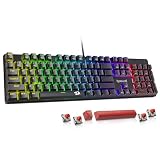
The core advantage is consistency. Every switch is an identical mechanism, so the thousandth press feels like the first, and actuation happens at a known point rather than at the bottom of a squashy dome. For competitive shooters and rhythm games this shortens the distance between intent and input. Linear switches — the pre-lubed reds found on the Redragon hot-swappable board and the quiet linears in the RK R104 — travel smoothly for rapid double-taps, while tactile and clicky blues like those in the Redragon K580 give typists a satisfying bump and audible confirmation.
Mechanical is also a platform rather than a product. Hot-swap sockets on the AULA F75 Pro and the hot-swappable Redragon let you change switch feel without soldering; PBT keycaps resist the greasy shine that kills cheap ABS; gasket mounting softens the typing sound. Add MMO conveniences — the K580’s five on-board keybinding buttons and media wheel, the F75 Pro’s knob and triple 2.4GHz/Bluetooth/USB-C connectivity — and you get a board that adapts as your tastes change. The trade-offs are noise, price and, on full-size aluminium models, considerable heft.
Membrane Keyboards
Membrane’s strengths are practical rather than glamorous. A sealed rubber sheet under the keys shrugs off crumbs and minor spills, the boards weigh very little, and the soft landing suits people who type heavily and dislike sharp feedback. Crucially, they are quiet — a real consideration for shared rooms, open-plan offices, late-night sessions and anyone streaming with an open microphone. If you need a competent keyboard for the price of a couple of games, membrane remains unbeaten.
The limits show up under pressure. Domes lose springiness unevenly, so a two-year-old board often feels inconsistent across the movement keys, and cheaper models limit simultaneous key registration. Nothing is serviceable. This is exactly the gap hybrids target: the SteelSeries Apex 5 pairs a mechanical click mechanism with a membrane cushion, delivering tactile feedback with a dampened bottom-out, wrapped in an aircraft-grade aluminium frame with per-key RGB and an OLED smart display. It is the clearest evidence that the two technologies are converging rather than competing.
Which Should You Buy?
- For competitive FPS: Pick mechanical linears — the Redragon hot-swappable red switch board or the aluminium Logitech G413 SE for a no-nonsense, anti-ghosting workhorse.
- For MMO and MOBA players: Pick the Redragon K580 for its five dedicated macro keys, media controls and full-size layout.
- For a quiet shared space: Pick the RK ROYAL KLUDGE R104 with pre-lubed quiet linears and gasket mount, or a membrane board if silence outranks everything.
- For customisation and a clean desk: Pick the AULA F75 Pro — 75% layout, hot-swap sockets, a control knob and wireless flexibility.
- For a premium hybrid: Pick the SteelSeries Apex 5 if you want mechanical feedback, membrane damping and an OLED display in one aluminium package.
Frequently Asked Questions
Are mechanical keyboards actually faster?
Marginally, but meaningfully. Mechanical switches actuate before bottoming out and reset more predictably, which helps with rapid repeat presses. The larger real-world gain is consistency and full key rollover during complex inputs.
Can I make a mechanical keyboard quieter?
Yes. Choose pre-lubed linear switches, add o-rings or foam dampening, and favour gasket-mounted designs. A quiet linear board is close to membrane volume while keeping mechanical precision.
What does hot-swappable mean?
The switches sit in sockets rather than being soldered, so you can pull them out with a puller tool and fit different ones. It lets you change feel or replace a faulty switch without any soldering.
Is membrane still worth buying in 2026?
For tight budgets, spill-prone desks and silence-critical environments, yes. For gaming longevity and repairability, entry-level mechanical boards now cost so little that the argument has narrowed considerably.
Final Verdict
Mechanical wins on merit for the vast majority of gamers in 2026 — better feel, longer life, real repairability and prices that no longer sting — with the AULA F75 Pro for enthusiasts, the RK R104 for quiet full-size typing and the Redragon K580 for macro-heavy play; membrane and hybrids like the SteelSeries Apex 5 remain the smart call when silence, spill resistance or budget lead your list.