Key takeaways
- Sensor quality over DPI numbers: Ignore inflated 26,000+ DPI claims — almost nobody plays above 3,200 DPI. Look instead for a proven optical sensor with consistent tracking and no smoothing or angle snapping, which is where budget mice most often cut corners.
- Shape and grip style: Palm grippers need a taller, filled-out hump; claw and fingertip players want something shorter and lighter. Measure your hand from wrist crease to middle fingertip and match it to the mouse’s length before anything else.
- Weight and glide: Under 80g is the sweet spot for fast-paced shooters, while 90–120g suits players who prefer stability for tracking. Check that the feet are PTFE rather than generic plastic, since bad skates ruin an otherwise good mouse.
- Wired vs. wireless: Modern budget wireless is genuinely competitive now, but only with a dedicated 2.4GHz dongle — never rely on Bluetooth alone for gaming. If you’re on the tightest budget, wired still buys you more sensor and switch quality per dollar.
- Switches and software: Look for rated 50-million-click switches or better, and confirm the software lets you save profiles to onboard memory so your settings travel with the mouse to LAN parties or a second PC.
What's inside
Shopping for a gaming mouse under $50 sounds simple until you actually start looking. The sub-$50 tier is the most crowded segment on the market, packed with everything from genuinely excellent sensors in unassuming shells to cheap knockoffs with inflated DPI numbers and mushy switches that fail within months. Marketing spec sheets rarely tell you what matters: whether the sensor tracks cleanly at high speeds, whether the click latency holds up in a firefight, and whether the shape actually fits your hand and grip style.
This guide cuts through that noise. We’ve focused on mice that deliver flagship-caliber sensors, durable switches, and thoughtful ergonomics at prices that genuinely stay under the $50 mark — no bait-and-switch “sale” pricing that reverts next week. Below you’ll find our top picks, a short buyer’s checklist to help you narrow things down by grip and playstyle, and answers to the questions we get asked most often about budget gaming mice in 2026.
As an Amazon Associate we earn from qualifying purchases at no extra cost to you. Product prices and availability are accurate as of the date shown and are subject to change.




⚡ Save on Your Next PC — Amazon Prime
Prime members get fast free shipping on the systems above, plus early access to Prime Day & Black Friday PC deals. New members get a 30-day free trial.
Watch: Best Gaming Mouse Under $50 — Video Review
How to Choose Gaming Mouse Under $50
- Sensor quality over DPI numbers: Ignore inflated 26,000+ DPI claims — almost nobody plays above 3,200 DPI. Look instead for a proven optical sensor with consistent tracking and no smoothing or angle snapping, which is where budget mice most often cut corners.
- Shape and grip style: Palm grippers need a taller, filled-out hump; claw and fingertip players want something shorter and lighter. Measure your hand from wrist crease to middle fingertip and match it to the mouse’s length before anything else.
- Weight and glide: Under 80g is the sweet spot for fast-paced shooters, while 90–120g suits players who prefer stability for tracking. Check that the feet are PTFE rather than generic plastic, since bad skates ruin an otherwise good mouse.
- Wired vs. wireless: Modern budget wireless is genuinely competitive now, but only with a dedicated 2.4GHz dongle — never rely on Bluetooth alone for gaming. If you’re on the tightest budget, wired still buys you more sensor and switch quality per dollar.
- Switches and software: Look for rated 50-million-click switches or better, and confirm the software lets you save profiles to onboard memory so your settings travel with the mouse to LAN parties or a second PC.
The Best Picks Reviewed
Logitech G305 Lightspeed
Still the benchmark for budget wireless in 2026, the G305 pairs Logitech’s Lightspeed connection with a genuinely low-latency sensor and an absurd battery life that stretches into months on a single AA. At 99g it isn’t the lightest option here, but the tracking consistency and reliability are hard to beat at this price.
Logitech G502 Hero
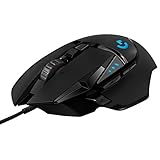
The G502 remains the go-to for MMO and RPG players who want a button under every finger, with 11 programmable inputs and an adjustable weight system for dialling in feel. It’s a heavier, wider mouse best suited to palm grippers with medium-to-large hands, and the free-spin scroll wheel is still one of the best in the business.
Redragon M612 Predator
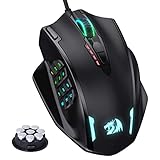
Redragon’s M612 is the value outlier of this roundup, delivering a competent 8000 DPI optical sensor, remappable side buttons, and full RGB for roughly half the price of its name-brand rivals. Build quality is a step below the Logitech and Razer options, but for a first gaming mouse or a secondary rig it’s genuinely difficult to argue with.
Razer Basilisk V3
The Basilisk V3 punches well above its price with a smart-reel scroll wheel that switches between tactile and free-spin, plus a removable paddle for a customisable thumb rest. It’s an ergonomic right-handed shape that rewards palm and claw grips, and the 11 programmable buttons make it a strong all-rounder for players who mix shooters with strategy titles.
Razer DeathAdder Essential
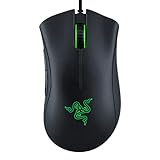
The DeathAdder shape has been a competitive staple for over a decade, and the Essential strips it back to the fundamentals: a reliable optical sensor, mechanical switches, and one of the most universally comfortable right-handed shells ever made. There’s no wireless and minimal RGB, but for pure plug-and-play shooter performance on a tight budget it’s an easy recommendation.
Frequently Asked Questions
Is a wireless gaming mouse worth it under $50?
Yes, provided it uses a dedicated 2.4GHz wireless dongle rather than Bluetooth. Modern budget wireless mice like the G305 have latency that is effectively indistinguishable from wired for the vast majority of players, so the main trade-offs are battery management and slightly higher weight.
How much DPI do I actually need?
Far less than the box advertises. Most competitive players sit between 400 and 1,600 DPI and adjust in-game sensitivity from there, so a mouse advertising 26,000 DPI offers no practical benefit over one capping at 8,000 — sensor consistency matters far more than the headline number.
Do budget gaming mice last as long as premium ones?
Reputable budget mice from Logitech and Razer typically use switches rated for 50–70 million clicks, which is comparable to their flagship models. The bigger differences show up in shell materials, cable quality, and scroll wheel encoders, which tend to be the first components to degrade on cheaper models.
Should I prioritise a lightweight mouse?
Only if you play fast-paced shooters where large, rapid arm movements are common. For MMO, MOBA, and strategy players, a heavier mouse can actually improve precision by damping small hand tremors, so weight is a preference rather than a universal upgrade.
Final Thoughts
If you want the best all-round package under $50, the Logitech G305 Lightspeed is still the pick to beat — wireless freedom, excellent tracking, and a battery you’ll rarely think about. Players who want maximum buttons and customisation should look at the Razer Basilisk V3, while anyone chasing the cleanest possible shooter experience on the tightest budget will be well served by the Razer DeathAdder Essential. All three deliver performance that would have cost twice as much a few years ago, which makes this one of the best value tiers in gaming hardware right now.