Key takeaways
- 240Hz at 1440p is easy to drive, delivering high, stable frame rates
- 0.03ms response gives class-leading, smear-free motion clarity
- True black contrast and DisplayHDR True Black 400 for immersive dark scenes
- Fully adjustable stand and effective semi-matte anti-glare coating
What's inside
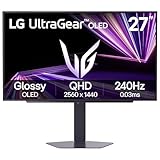
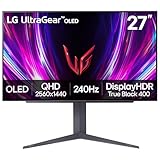
The LG UltraGear OLED (27GX704A-B) is a 27-inch, 1440p WOLED gaming monitor built around a single-minded goal: motion clarity at a 240Hz refresh rate with a 0.03ms response time. Unlike the QD-OLED crowd, LG uses its own WOLED panel here, and the result is a display tuned for players who care more about how clean a flick shot looks than about maximum resolution.
It is aimed at competitive and mixed-genre PC gamers who want OLED contrast without stepping up to the price and GPU demands of a 4K panel. If you sit close, play a lot of shooters or fast-paced action games, and run a GPU in the RTX 4070 to 4080 range, this is squarely your zone. Creators who need dense 4K real estate or anyone gaming in a bright, sunlit room should read the caveats before buying.
As an Amazon Associate we earn from qualifying purchases at no extra cost to you. Product prices and availability are accurate as of the date shown and are subject to change.



⚡ Save on Your Next PC — Amazon Prime
Prime members get fast free shipping on the systems above, plus early access to Prime Day & Black Friday PC deals. New members get a 30-day free trial.
Watch: LG UltraGear OLED Review — Video Review
Design & Build
LG keeps the UltraGear look restrained: a matte black chassis, thin bezels, and a hexagonal-footprint stand that offers tilt, height, swivel, and pivot adjustment. The panel is flat, which many competitive players prefer over a curve, and the anti-glare coating leans toward a semi-matte finish that handles overhead lighting well while keeping colors reasonably vivid. Connectivity is generous for the class, with HDMI 2.1, DisplayPort, and USB passthrough, plus VESA DisplayHDR True Black 400 certification. The build feels solid without being flashy, and cable management through the stand is tidy.
Performance
This is where the 27GX704A-B earns its keep. At QHD the 240Hz refresh is easy to feed for most modern GPUs, so you get consistently high frame rates paired with OLED’s instantaneous pixel transitions. The practical effect is motion that stays crisp during fast pans, with none of the dark smearing that plagues VA panels. G-Sync Compatible and FreeSync Premium Pro support keeps tearing away across the full refresh range.
Contrast and HDR punch are the other half of the story. True blacks and per-pixel lighting make dark dungeon crawls and night maps genuinely immersive, and small HDR highlights sparkle. As with all OLEDs, sustained full-field brightness is modest, so HDR is most convincing in a controlled lighting environment. WOLED subpixel structure also produces slight text fringing on thin fonts, which is the usual OLED desktop trade-off.
Pros & Cons
- 240Hz at 1440p is easy to drive, delivering high, stable frame rates
- 0.03ms response gives class-leading, smear-free motion clarity
- True black contrast and DisplayHDR True Black 400 for immersive dark scenes
- Fully adjustable stand and effective semi-matte anti-glare coating
- 1440p resolution feels less sharp than 4K for desktop and creative work
- Limited full-screen brightness dampens HDR in bright rooms
- Minor text fringing from the WOLED subpixel layout
Alternatives to Consider
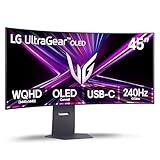
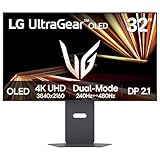
If you want even faster motion for esports, the LG 27GX790A-B pushes the same 27-inch OLED to a blistering 480Hz refresh rate. Players who would rather have 4K sharpness with flexible refresh should consider the LG 32GX850A-B, a 32-inch glossy OLED with a dual-mode that switches between 4K/165Hz and 1080p/330Hz. And for a fully immersive setup, the LG 45GX950A-B is a 45-inch 5K2K curved ultrawide that trades competitive pace for cinematic scale.
Frequently Asked Questions
Is WOLED better or worse than QD-OLED?
They are different trade-offs. WOLED like this LG panel tends to handle bright-room reflections and text fringing slightly differently, while QD-OLED often shows marginally more saturated color. In motion and contrast both are excellent, and the gap is small enough that panel tuning matters more than the underlying tech.
Do I need a top-tier GPU to hit 240Hz?
Not necessarily. Because this is a 1440p panel, most current mid-to-high-end cards can sustain high frame rates in competitive titles, and variable refresh smooths out the rest in heavier games.
Will static UI elements cause burn-in?
LG includes pixel-refresh and screen-shift protections to reduce the risk. For mixed gaming and general use it should not be a practical worry, though leaving a static image on screen for hours daily is still best avoided.
Is the flat panel better than a curved one?
For competitive play at 27 inches, many players prefer flat because it keeps geometry consistent across the screen. Curves are more about immersion on larger ultrawide displays, so at this size flat is a sensible choice.
Verdict
The LG UltraGear OLED (27GX704A-B) is a focused, high-value entry point into OLED gaming, delivering the motion clarity and contrast that make the technology worthwhile without demanding a 4K-capable GPU or a premium ultrawide budget. Its resolution and brightness ceilings are predictable OLED compromises rather than flaws, and for competitive-leaning players it is one of the easiest recommendations in its class.