Key takeaways
- Memory: The 9070 XT ships 16GB of GDDR6 on a 256-bit bus; the RTX 5070 uses 12GB of faster GDDR7 on a narrower 192-bit bus. Bandwidth is broadly comparable, but capacity is not — and capacity is what breaks at 4K with high-resolution texture packs.
- Rasterized performance: Across a typical 1440p test suite, the 9070 XT generally leads by roughly 15–25%, occasionally more in AMD-favored engines. That gap widens as resolution climbs.
- Ray tracing: RDNA 4 closed most of the historic deficit. The two trade wins in moderate RT titles, though NVIDIA still pulls ahead in heavy path-traced showcases.
- Upscaling and frame gen: FSR 4 is a genuine leap and now ships in a large and growing library, but DLSS 4 remains ahead on image stability and has broader adoption, plus Multi Frame Generation for very high refresh displays.
- Power and thermals: The 9070 XT draws roughly 300W+ under load versus around 250W for the RTX 5070. AMD partners generally require a 750W-class PSU; NVIDIA’s card is happier on 650W.
- Non-gaming work: CUDA, OptiX, and NVENC give the RTX 5070 a decisive edge in Blender, DaVinci Resolve, Premiere, and local AI tooling.
What's inside
The $550-to-$650 bracket has quietly become the most competitive slice of the GPU market, and in 2026 it comes down to two cards: AMD’s Radeon RX 9070 XT and NVIDIA’s GeForce RTX 5070. Both are built for high-refresh 1440p gaming, both sit on PCIe 5.0, and both are widely available from board partners after the supply chaos of early 2025 finally settled. On paper they look close. In practice, they are two very different philosophies about what a mid-to-upper-tier graphics card should prioritize.
The RX 9070 XT leans on RDNA 4’s much-improved shader and ray-tracing hardware plus a generous 16GB frame buffer, betting that raw rendering throughput and VRAM headroom will age best. The RTX 5070 counters with Blackwell’s software stack — DLSS 4 with Multi Frame Generation, a mature CUDA ecosystem, and the best hardware encoder available — from a leaner 12GB, 192-bit configuration. Choosing correctly depends less on benchmark averages than on which games you play, what resolution you play them at, and whether your PC ever does work that isn’t gaming.
As an Amazon Associate we earn from qualifying purchases at no extra cost to you. Product prices and availability are accurate as of the date shown and are subject to change.




⚡ Save on Your Next PC — Amazon Prime
Prime members get fast free shipping on the systems above, plus early access to Prime Day & Black Friday PC deals. New members get a 30-day free trial.
Watch: RX 9070 XT vs RTX 5070: 2026 Comparison — Video Review
Quick Verdict
The Radeon RX 9070 XT is the better pure gaming card for most people at 1440p and entry-level 4K: it wins the majority of rasterized titles by a comfortable margin, matches or beats the RTX 5070 in many ray-traced games, and its 16GB of GDDR6 removes texture-quality anxiety for the next several years. The RTX 5070 is the smarter pick if you value DLSS 4’s frame generation in demanding single-player games, stream or edit video with NVENC, run CUDA-accelerated creative or AI workloads, or need a cooler, lower-wattage card for a compact build with a modest power supply.
Key Differences
- Memory: The 9070 XT ships 16GB of GDDR6 on a 256-bit bus; the RTX 5070 uses 12GB of faster GDDR7 on a narrower 192-bit bus. Bandwidth is broadly comparable, but capacity is not — and capacity is what breaks at 4K with high-resolution texture packs.
- Rasterized performance: Across a typical 1440p test suite, the 9070 XT generally leads by roughly 15–25%, occasionally more in AMD-favored engines. That gap widens as resolution climbs.
- Ray tracing: RDNA 4 closed most of the historic deficit. The two trade wins in moderate RT titles, though NVIDIA still pulls ahead in heavy path-traced showcases.
- Upscaling and frame gen: FSR 4 is a genuine leap and now ships in a large and growing library, but DLSS 4 remains ahead on image stability and has broader adoption, plus Multi Frame Generation for very high refresh displays.
- Power and thermals: The 9070 XT draws roughly 300W+ under load versus around 250W for the RTX 5070. AMD partners generally require a 750W-class PSU; NVIDIA’s card is happier on 650W.
- Non-gaming work: CUDA, OptiX, and NVENC give the RTX 5070 a decisive edge in Blender, DaVinci Resolve, Premiere, and local AI tooling.
Radeon RX 9070 XT: Raw Performance and Headroom
The 9070 XT is the card to buy if frames per dollar is your metric. It handles 1440p ultra in essentially everything current at well above 100 FPS, and it is a legitimate 4K card in older or well-optimized titles. The 16GB buffer matters more each year: several 2025–2026 releases already exceed 12GB at 4K with high textures, and the Radeon simply doesn’t stutter where a 12GB card starts swapping. DisplayPort 2.1a support also future-proofs it for high-refresh 4K and ultrawide panels.
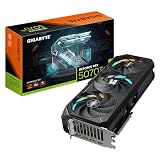
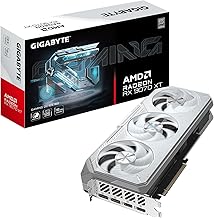
Board partner choice is mostly about acoustics and case fit. The ASRock RX 9070 XT Challenger 16GB OC and PowerColor Reaper RX 9070 XT are the compact, no-nonsense options for mid-tower builds. The GIGABYTE RX 9070 XT Gaming OC 16G and its white Gaming OC ICE sibling run cooler and quieter thanks to a thicker 2.7-slot heatsink. The ASUS Prime RX 9070 XT OC adds dual BIOS and ball-bearing Axial-tech fans in a restrained 2.5-slot shroud, while the XFX Swift RX 9070 XT triple-fan is a strong middle ground. Verify clearance and confirm your PSU before ordering.
GeForce RTX 5070: Software Stack and Efficiency
The RTX 5070 loses most raw-throughput comparisons, yet it remains a compelling product because of everything wrapped around the silicon. DLSS 4’s transformer-based upscaler produces cleaner results at aggressive quality presets than any competing solution, and Multi Frame Generation can push heavy single-player games onto 240Hz panels convincingly. Reflex 2, near-universal day-one DLSS support, and rock-solid driver behavior are worth real money to some buyers.
It is also the easier card to live with. Lower power draw means less heat dumped into small cases, quieter fan curves, and compatibility with 650W supplies that would be marginal for a 9070 XT. If your machine doubles as a workstation — 3D rendering, video encoding, local model inference — the RTX 5070’s ecosystem advantage isn’t a tiebreaker, it’s the whole decision.
Which Should You Buy?
- For 1440p high-refresh gaming: Pick the RX 9070 XT. It delivers more native frames per dollar with room to spare.
- For 4K on a budget: Pick the RX 9070 XT. The 16GB buffer is the deciding factor.
- For path-traced showcase titles: Pick the RTX 5070, where DLSS 4 and NVIDIA’s RT hardware keep heavy scenes playable.
- For streaming and content creation: Pick the RTX 5070 for NVENC and CUDA acceleration.
- For small-form-factor or 650W builds: Pick the RTX 5070, or a compact Reaper/Challenger model if you can support the extra wattage.
Frequently Asked Questions
Is 12GB of VRAM still enough in 2026?
At 1080p and most 1440p settings, yes. At 4K with ultra textures or heavy ray tracing, 12GB is increasingly the limiting factor, and that trend will continue.
How close is FSR 4 to DLSS 4?
Much closer than previous generations. FSR 4 is competitive in motion clarity and detail retention; DLSS 4 still holds a modest edge in stability and appears in more titles.
What power supply do I need?
Plan on a quality 750W unit for the RX 9070 XT and 650W for the RTX 5070, adjusting upward for high-core-count CPUs or heavy overclocking.
Which RX 9070 XT model should I choose?
For quiet operation, the GIGABYTE Gaming OC or ASUS Prime. For tight cases, the PowerColor Reaper or ASRock Challenger. Performance differences between models are small.
Final Verdict
For gaming first and everything else second, the Radeon RX 9070 XT is the stronger buy in 2026 — more performance, more VRAM, better longevity at 4K. Choose the RTX 5070 if DLSS 4, efficiency, or creative and AI workloads carry real weight in your build.