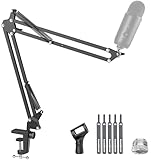
Key takeaways
- Buying exactly the measured distance: A 6-foot measurement does not leave room for pivots, movement, or connector clearance. Round up instead.
- Confusing connector size with cable length: A standard XLR uses three pins, but the connector format does not determine whether the cable is 6, 10, or 15 feet long.
- Ignoring the cable diameter: A thick cable may not fit comfortably in narrow boom-arm channels or clips. Check the arm’s cable-management opening if the manufacturer lists one.
- Routing over moving joints: Cable placed tightly across a pivot can kink or pull whenever the microphone moves. Leave a small service loop at each active joint.
- Choosing 20 feet for every setup: Extra length creates loops that can catch on chair arms, monitor stands, and desk drawers. Use 15 feet only when the route genuinely requires it.
- Forgetting microphone placement: A microphone suspended 12 inches above the desk needs a different route from one extended 30 inches toward the user.
What's inside
The Short Answer
For most desk-mounted microphone boom arms, a 10-foot XLR cable is the best starting point for boom arm routing. It gives enough length to travel from the microphone, along the arm, down toward the desk, and onward to an audio interface without creating a tight bend.
Choose a 6-foot cable for a compact setup where the interface sits beside or directly below the arm. Choose 15 feet when the interface is on the opposite side of a wide desk, mounted under the desktop, or positioned on the floor. Cables longer than 15 feet are usually unnecessary for a single desk microphone and can leave excess cable to coil or snag.
As an Amazon Associate we earn from qualifying purchases at no extra cost to you. Product prices and availability are accurate as of the date shown and are subject to change.


The cable’s electrical size matters less than its physical routing. A standard microphone XLR cable typically uses a three-pin male-to-female connector and has an outside diameter of approximately 0.20 to 0.28 inch (5 to 7 mm). A slim cable is easier to secure inside a boom arm’s clips, while a heavily braided or extra-thick cable may resist folding around the arm joints.
Standard Sizes
These common lengths work for most home studios, streaming desks, podcast stations, and voice-over setups. Measurements below refer to the cable’s total end-to-end length, not the usable distance after bends and connector clearance.
| Cable length | Length in centimeters | Best use | Recommended desk depth or routing distance |
|---|---|---|---|
| 6 ft | 72 in / 183 cm | Compact desk; interface beside the arm | Up to about 48 in / 122 cm of actual routing |
| 10 ft | 120 in / 305 cm | Most boom-arm and streaming setups | About 60–84 in / 152–213 cm of actual routing |
| 15 ft | 180 in / 457 cm | Wide desk or interface positioned below or beside the desk | About 90–120 in / 229–305 cm of actual routing |
| 20 ft | 240 in / 610 cm | Room-scale routing or equipment rack placement | More than 120 in / 305 cm of actual routing |
Do not use every inch of a cable’s length for a straight-line measurement. Boom arms move, and the cable needs slack at the microphone, at each pivot, and near the desk clamp. For example, a 60-inch measured path should generally use a 10-foot cable rather than a 6-foot cable. The shorter option may reach when the arm is stationary but pull on the connector when the microphone is moved.
For most home users, a standard flexible XLR cable in the 5 to 7 mm diameter range is easier to route than a thick stage cable. Star-quad and dual-shielded designs can be useful in electrically noisy environments, but they may be less flexible and more expensive. A 10-foot premium cable commonly costs about $20 to $35, while basic cables often range from $10 to $20. Boom arms with an integrated XLR lead can cost approximately $15 to $70, depending on construction, included hardware, and cable quality.
How to Measure Your Space
- Mark the microphone position. Move the boom arm to the position you actually use, rather than measuring with the arm folded beside the desk. Mark the location of the microphone connector or shock mount.
- Measure along the arm. Follow the path where the cable will be secured. Measure around each arm section and across the pivot areas instead of measuring in a straight line from the microphone to the desk.
- Measure from the arm to the desk edge. Include the drop from the final arm joint to the desktop or cable exit point. A typical desk-mounted arm may need 12 to 24 inches (30 to 61 cm) of cable after it leaves the arm.
- Measure to the interface. Follow the route from the desk edge to the audio interface, mixer, or computer-mounted adapter. Include the distance under the desktop if the equipment is stored on a shelf or floor.
- Add movement slack. Add at least 12 inches (30 cm) for a compact arm and 18 to 24 inches (46 to 61 cm) for a full-size arm that swings between speaking and storage positions.
- Round up to the next standard length. If your total is 7 feet, buy a 10-foot cable. If it is 12 feet, buy a 15-foot cable. Avoid stretching a cable to make the connectors meet.
Leave a gentle loop near the microphone rather than pulling the cable directly from the connector. The loop should be large enough to move with the microphone but small enough to stay clear of the arm joints. Secure the cable with the arm’s built-in clips, reusable hook-and-loop ties, or low-profile cable sleeves. Do not use tight zip ties that could crush the cable jacket or restrict movement.
By Room or Use Case
Small bedroom or apartment desk
A 6-foot XLR cable can work when the audio interface is next to the boom-arm clamp and the desk is approximately 40 to 48 inches wide. A 10-foot cable is safer if the desk is against a wall or the interface sits behind a monitor. Slim cables are especially useful when the arm must fold close to the wall for storage.
Gaming and streaming setup
Choose 10 feet for most gaming desks. This length accommodates a microphone positioned 18 to 30 inches in front of the user, cable routing along a 24- to 32-inch boom arm, and a short run to the interface. If the interface is mounted under the desk or located beside a PC tower, 15 feet may provide a cleaner route without tension.
Podcast or two-person desk
A 15-foot cable is often more practical when each host has a separate boom arm. Wide desks, central equipment placement, and crossed routing paths use more cable than a single-user station. Measure each microphone independently; one side of the desk may need 10 feet while the other needs 15 feet.
Home office or voice-over corner
Use 6 feet when the interface is directly beneath the microphone arm. For a treated closet, side table, or equipment shelf several feet away, choose 10 or 15 feet. Keep the cable path away from chair wheels and walking areas. If a cable must cross an open floor, use a proper floor cover rather than relying on loose coils.
Integrated-cable boom arm
Some suspension arms include a built-in XLR cable, which can make installation faster and reduce visible cable. Check the included cable length before buying. A built-in lead may be approximately 60 to 100 inches (152 to 254 cm), and some designs terminate near the base rather than extending all the way to an interface. You may still need a separate extension cable, but avoid stacking multiple adapters where possible.
Common Sizing Mistakes
- Buying exactly the measured distance: A 6-foot measurement does not leave room for pivots, movement, or connector clearance. Round up instead.
- Confusing connector size with cable length: A standard XLR uses three pins, but the connector format does not determine whether the cable is 6, 10, or 15 feet long.
- Ignoring the cable diameter: A thick cable may not fit comfortably in narrow boom-arm channels or clips. Check the arm’s cable-management opening if the manufacturer lists one.
- Routing over moving joints: Cable placed tightly across a pivot can kink or pull whenever the microphone moves. Leave a small service loop at each active joint.
- Choosing 20 feet for every setup: Extra length creates loops that can catch on chair arms, monitor stands, and desk drawers. Use 15 feet only when the route genuinely requires it.
- Forgetting microphone placement: A microphone suspended 12 inches above the desk needs a different route from one extended 30 inches toward the user.
FAQ
Is a 10-foot XLR cable long enough for a boom arm?
Usually, yes. Ten feet, or 120 inches (305 cm), covers most desk-mounted arms with the interface on or near the same desk. Choose 15 feet if the interface is under the desk, across a wide workstation, or more than about 6 feet from the arm’s base.
Can I use a 6-foot XLR cable with a microphone boom arm?
Yes, if the arm is short and the interface is close to the clamp. A 6-foot cable is best for compact setups with roughly 48 inches (122 cm) or less of total routing. It may become tight when the arm swings forward, so check the microphone’s farthest position before choosing it.
Does a longer XLR cable reduce sound quality?
A properly made XLR cable at 10 or 15 feet is suitable for normal home recording and streaming. Cable construction, connector quality, shielding, and secure connections matter more than choosing the shortest possible length. For a desk setup, avoid unnecessary excess but do not sacrifice movement clearance.
What cable diameter fits most boom-arm clips?
A flexible cable approximately 0.20 to 0.28 inch (5 to 7 mm) in diameter fits many standard clips. Because clip openings vary, compare the cable’s listed outside diameter with the boom arm’s specifications. If no specification is available, a medium-thickness flexible microphone cable is generally easier to manage than a rigid, heavily jacketed stage cable.