Key takeaways
- Table of Contents 7 sections 11 min read 1 Quick Verdict 2 Side by Side 3 Where Low Profile Boom Arm Wins 4 Where Standard Overhead Mic Arm Wins 5 Cost Over 5 Years 6 Which One for Your Home…
What's inside
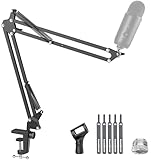
The real decision is not simply whether you want a microphone arm. It is whether your desk needs to stay visually open above the work surface or whether you need the greatest possible reach and height adjustment. A low profile boom arm sits close to the desktop and usually runs beneath or beside a monitor, while a standard overhead mic arm rises above the desk and swings downward toward your voice.
Both styles can make a home office, gaming setup, podcast corner, or video-call station more comfortable than a fixed desktop stand. The better choice depends on monitor placement, desk depth, microphone weight, household traffic, and whether you want the arm to disappear into the furniture or remain visibly accessible.
As an Amazon Associate we earn from qualifying purchases at no extra cost to you. Product prices and availability are accurate as of the date shown and are subject to change.


Quick Verdict
Choose a low profile boom arm if you have a monitor-centered desk, limited vertical clearance, or a strong preference for a clean, built-in appearance. Its horizontal, under-monitor path can keep the microphone close without putting a metal arm across your eye line. It is especially practical for compact desks measuring roughly 40 to 55 inches wide.
Choose a standard overhead mic arm if you need broad reach, frequently change positions, share a desk, or use a taller monitor arrangement. The elevated design is usually easier to swing in from the side, above a monitor, or from behind the desk. It is also the safer all-purpose choice when you are unsure exactly where the microphone will live.
For most permanent home workspaces in 2026, low profile models offer the more furniture-friendly look. For flexible creator spaces and multipurpose desks, standard overhead arms remain the more adaptable format.
Side by Side
| Buying factor | Low profile boom arm | Standard overhead mic arm |
|---|---|---|
| Comfort | Keeps hardware below the monitor line; excellent for seated, screen-focused work. | Offers more angles and higher placement options, especially for standing or reclining positions. |
| Durability | Usually has fewer dramatic extension positions, which can reduce everyday strain on joints. | Can be very durable, but springs, hinges, and tension knobs see more movement when repositioned often. |
| Typical price range | About $25 to $100 for common desk-clamp models. | About $20 to $120, with heavier-duty studio-oriented arms costing more. |
| Maintenance | Occasional screw and clamp checks; cable channels may need cleaning. | More frequent tension adjustment can be needed after changing microphone weight or arm position. |
| Space needed | Needs clear desk-edge space and usually 4 to 8 inches of usable surface behind or beside the monitor. | Needs vertical clearance; many setups work best with 20 to 35 inches above the desktop. |
| Look | Minimal, integrated, and often easier to coordinate with modern home-office furniture. | More technical and studio-like; visually prominent when raised. |
| Resale appeal | Appeals to gamers, streamers, and buyers with monitor-heavy desks. | Has wider general compatibility and can be easier to resell locally. |
| Best microphone placement | Directly in front of or slightly beside the speaker, just below screen height. | From above, from the side, behind a display, or across a larger desk. |
| Best for | Small home offices, clean desk setups, ultrawide monitors, and dedicated personal stations. | Shared desks, large rooms, variable seating, taller displays, and flexible recording setups. |
Where Low Profile Boom Arm Wins
A low profile boom arm wins when visual calm matters as much as function. In a living room office nook or bedroom workstation, an overhead arm can make the desk feel more like a broadcast studio. A low profile design keeps most of its structure close to the desktop, so the monitor, lamp, and wall art remain the focal points instead of the equipment.
It also works well with large displays. A 27-inch monitor typically stands about 14 to 18 inches tall without its stand, and a 32-inch model can occupy even more vertical space. With a standard arm, the upper segment may need to pass in front of the display or hover visibly above it. A low profile arm avoids that conflict by routing beneath the screen. This can be especially useful with an ultrawide monitor or a dual-monitor arrangement where the center seam already limits placement options.
Low profile arms are generally intuitive once installed. You pull the microphone toward you, position it 4 to 8 inches from your mouth for close speaking, and push it back when finished. Their flatter movement path can feel less intrusive during routine video calls because there is no high arm to duck under or swing around.
Budget buyers have several accessible choices. The InnoGear low profile microphone boom arm, listed around $25.19, illustrates how this style has become available well below premium studio pricing. At the more substantial end, the FIFINE BM88 low profile microphone boom arm stand is listed around $56.99. These price points make the format realistic for a home desk upgrade without committing to a costly audio overhaul.
There are limits. A low profile arm needs a clear route across the desk. If your keyboard, desktop speakers, monitor stand, and decorative objects fill the surface, the arm may have nowhere to travel. It also may be less convenient when you want the microphone high and out of the way between uses. Before buying, measure the clear area from your desk clamp to the intended microphone position; 20 to 30 inches of horizontal reach is common in this category, but the usable reach shrinks around monitor bases and speakers.
Where Standard Overhead Mic Arm Wins
A standard overhead mic arm wins on range and adaptability. Its articulated sections can lift the microphone above a monitor, extend it around a large display, and bring it down from the side. That flexibility is valuable if you alternate between typing at a desk, leaning back for a meeting, recording guitar, or moving a chair between work and gaming positions.
It is also often more forgiving of furniture layouts. If a desk is 24 to 30 inches deep and backed against a wall, there may be little room to run a low profile arm behind the monitor. An overhead model can rise from a rear corner and approach from above. If your desk has shelving, however, check clearance carefully: an arm that needs 24 inches of upward travel will not be useful beneath a shelf positioned 16 inches over the desktop.
Standard arms are particularly practical for microphones that need more support. Always compare the manufacturer’s stated load range with the total installed weight: microphone, shock mount, pop filter, adapter, and cable. A microphone that weighs 1.5 pounds can approach 2 pounds once accessories are attached. Do not assume that an arm designed for a lightweight USB microphone will remain stable with a heavier broadcast-style model.
A product such as the Frgyee mic boom arm, listed around $52.99, reflects the appeal of an overhead design with added height. The CACENCAN foldable desk mic arm, listed around $28.99, represents the more traditional, budget-friendly adjustable-arm approach. Neither style is automatically better built based on its format alone; clamp construction, joint design, stated load rating, and how carefully it is installed matter more.
The tradeoff is visual and physical presence. Overhead arms can cut across a sightline, cast a small shadow under desk lighting, or look busy in a minimal room. Their exposed joints can also invite curiosity from children and pets. If the arm is in a shared area, folding it back after use is wise, but do not rely on a folded arm as childproof storage.
Cost Over 5 Years
The purchase price is only part of the long-term cost. For either type, a reasonable home-use budget is usually $25 to $100 upfront, plus a possible $10 to $25 for a better cable, adapter, replacement desk-clamp pad, or compact pop filter. These arms do not consume electricity, so there is no wattage or operating-energy cost to calculate.
Over five years, a low profile arm may cost roughly $35 to $125 total if it stays compatible with your microphone and desk. The lower range assumes a basic $25 to $60 arm with no replacement parts. The upper range allows for an accessory change or a replacement if you move to a heavier microphone.
A standard overhead arm may land around $30 to $145 total. The range is slightly wider because owners are more likely to adjust tension, add an extension or riser, or replace an arm after upgrading to a heavier microphone. That does not mean overhead arms are inherently less durable; it reflects their broader use cases and the tendency to move them more often.
Protect the desk to avoid the most expensive surprise. A clamp can compress soft veneer, particleboard, or thin glass. Use the supplied pad if included, and consider a small hardwood or metal reinforcement plate for desks with thin edges. Replacing a damaged desktop costs far more than choosing the right clamp arrangement at the start.
Which One for Your Home
Small apartment
Choose a low profile boom arm if your desk faces a wall and the room doubles as a bedroom or living space. It produces less visual clutter and works neatly with a single monitor. Pick an overhead arm instead only if shelving, a monitor riser, or a crowded desktop blocks the low route.
Family with kids or pets
Choose the arm that can be folded and parked furthest from curious hands or paws. In many rooms, that is a standard overhead arm raised behind a monitor; in others, a low profile arm tucked tightly along the back edge is safer. Keep cables secured, avoid placing the clamp at a frequently bumped corner, and never leave a heavy microphone extended unattended.
Rental
Either format can work well, but favor a clamp-mounted model over drilling through a desktop. Measure the desk edge thickness before ordering; many clamps fit surfaces around 0.8 to 2.4 inches thick, but specifications vary. A low profile arm is often the more discreet option for furnished rentals, while an overhead arm is better if the provided desk is unusually deep or has a bulky monitor stand.
Long-term home
For a dedicated office with a stable desk layout, choose low profile for a refined, custom-looking workstation. For a flexible studio, guest-office, or hobby room where equipment changes often, choose standard overhead for its reach and future adaptability. In either case, buy for your total microphone setup weight rather than the microphone alone.
FAQ
Do low profile boom arms work with USB microphones?
Yes, provided the arm’s stated weight capacity supports the microphone and its mount. Many USB microphones use 3/8-inch or 5/8-inch threaded connections, sometimes through an included adapter. Confirm both thread compatibility and total weight before purchasing.
Will a low profile arm block my keyboard or monitor?
It can if the desk is shallow or crowded. On a desk less than about 20 inches deep, plan the arm path carefully. Mounting it at a rear corner and placing the microphone slightly to one side of the keyboard often preserves the most usable space.
Are overhead mic arms better for heavy microphones?
Not automatically. Heavy microphones require an arm with an appropriate stated load capacity and a sturdy clamp. Some overhead arms are designed for light microphones, while some low profile arms support heavier setups. Check the full assembled weight, including shock mount and pop filter.
Can I install a microphone arm on a glass desk?
Only if the desk manufacturer permits clamp loads and the glass is appropriately thick and supported. Tempered glass can still be damaged by concentrated pressure. A wood or metal desk with a solid edge is the simpler and safer mounting surface for either arm style.