Key takeaways
- Buying based on desk width. Desk depth and clamp location matter more. A 60-inch-wide desk can still need only a 24-inch arm if the microphone mounts at the side.
- Choosing maximum reach with no buffer. If your measurement says 30 inches, buy a 32- to 36-inch arm. At full extension, many arms have less flexibility and can be harder to balance.
- Ignoring the monitor’s footprint. The screen may be thin, but its stand, VESA arm, and rear cables can consume 6 to 12 inches (15 to 30 cm) of desk space.
- Forgetting accessory weight. A pop filter, metal shock mount, and heavy XLR cable can push a setup beyond an arm’s practical limit.
- Assuming every clamp fits every desk. Thick tops, beveled edges, glass surfaces, and desks with drawers directly underneath require extra attention before ordering.
- Mounting too far away for appearance. A microphone positioned 12 inches (30 cm) or more from your mouth may look unobtrusive, but it usually requires higher gain and captures more room noise.
What's inside
The Short Answer
For most streaming desks, a boom arm with 28 to 32 inches (71 to 81 cm) of horizontal reach is the practical sweet spot. That length usually lets you clamp the arm to a rear desk corner, bring the microphone 4 to 8 inches (10 to 20 cm) from your mouth, and still keep the mic out of your monitor’s main viewing area.
Choose a 20- to 24-inch (51- to 61-cm) arm for a compact desk, a single monitor, or a microphone mounted close to your speaking position. Step up to 36 inches (91 cm) or more if your desk is deeper than 30 inches, you need to mount behind an ultrawide monitor, or you want to share one microphone between two seats. A low-profile arm can be especially useful when the monitor sits directly in front of you because it travels below the screen rather than arching over it.
As an Amazon Associate we earn from qualifying purchases at no extra cost to you. Product prices and availability are accurate as of the date shown and are subject to change.

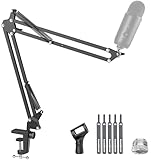


Reach is only one part of sizing. Confirm that the clamp fits your desktop thickness, that the arm can carry your microphone and shock mount, and that its joints can clear monitor stands, shelves, and cable trays. In 2026, most desktop boom arms use a C-clamp and a standard 5/8-inch microphone thread, often with 3/8-inch and 1/4-inch adapters included.
Standard Sizes
Manufacturers may list “maximum reach,” “horizontal reach,” or the combined length of two arm sections, so compare like with like. The measurements below describe common usable reach categories for desktop microphone arms rather than one specific model.
| Arm size category | Typical horizontal reach | Typical vertical range | Best desk depth | Best use |
|---|---|---|---|---|
| Compact | 18–24 in. (46–61 cm) | 12–20 in. (30–51 cm) | 18–24 in. (46–61 cm) | Small desks, laptop setups, close side mounting |
| Standard | 25–30 in. (64–76 cm) | 18–28 in. (46–71 cm) | 24–30 in. (61–76 cm) | Most gaming and streaming desks |
| Long-reach | 31–36 in. (79–91 cm) | 24–32 in. (61–81 cm) | 30–36 in. (76–91 cm) | Deep desks, rear mounting, large monitors |
| Extra-long or multi-joint | 37–48 in. (94–122 cm) | 28–40 in. (71–102 cm) | 36 in.+ (91 cm+) | Dual-person setups, cameras, overhead angles |
| Low-profile arm | 26–32 in. (66–81 cm) | Usually 3–10 in. (8–25 cm) above desk level | 24–36 in. (61–91 cm) | Monitor-forward setups and clean sightlines |
A standard 28- to 30-inch arm suits many streamers because a typical desk is 24 to 30 inches deep. When clamped at the back edge, the arm can reach past a monitor stand and land near the front half of the desk. If you clamp at a side edge instead, you may need less reach: an arm that extends 20 to 24 inches is often enough.
Do not confuse arm reach with microphone distance. Your microphone should generally sit 4 to 8 inches (10 to 20 cm) from your mouth for close-mic streaming. An arm does not need to span the entire desk; it needs to place the microphone comfortably in that zone without forcing you to lean forward.
How to Measure Your Space
- Measure desk depth. Measure from the back edge to the front edge of the desktop. Common desks are 24, 27, and 30 inches deep. Write down the number in inches or centimeters.
- Choose the clamp location. Mark where the boom arm will attach: rear corner, side edge, or rear center. A rear-corner mount usually needs the greatest horizontal reach; a side mount often needs 4 to 8 inches (10 to 20 cm) less.
- Measure from the clamp to your mouth position. Sit normally, with your chair at its usual height. Have someone measure from the planned clamp location to a point 4 to 8 inches in front of your mouth. This is your required working reach.
- Add clearance for obstacles. Add 3 to 6 inches (8 to 15 cm) if the arm must travel around a monitor, monitor riser, desktop shelf, or PC tower. Add more if the arm has to rise over a tall display.
- Check desktop thickness. Measure the desktop where the clamp will sit. Many C-clamps fit tops roughly 0.4 to 2.4 inches (1 to 6 cm) thick, but thicker butcher-block tops and desks with a deep underside lip may need a different clamp or a grommet mount.
- Measure the underside clearance. Look below the desktop for drawers, metal rails, cable-management trays, and crossbars. Leave at least 2 inches (5 cm) of unobstructed space where the clamp’s lower pad and screw need to sit.
- Weigh the full microphone setup. Include the microphone, shock mount, pop filter, and any adapter. A 2-pound (0.9 kg) microphone can become a 3-pound (1.4 kg) load with accessories. Buy an arm rated above that total, not exactly at it.
By Room or Use Case
Small Bedroom Desk or Laptop Setup
For a desk measuring 18 to 24 inches (46 to 61 cm) deep, start with an 18- to 24-inch arm. Clamp it to the left or right rear corner and bring the microphone in diagonally. This avoids using a long arm that may protrude beyond the desk, feel visually bulky, or block a window.
If the desk is against a wall, make sure the clamp can sit at least 2 inches (5 cm) away from the wall or that the arm can pivot forward immediately. A compact spring arm in the approximately $25 to $40 range can work well for lighter USB microphones, while sturdier enclosed or low-profile designs commonly fall around $50 to $100.
Standard Gaming or Streaming Desk
A 24- to 30-inch-deep desk is the most common scenario for a 28- to 32-inch arm. Mounting at the rear corner gives you enough travel to position the mic in front of your face, slightly below mouth level, while leaving room for a keyboard and mouse.
For a large USB microphone such as a Blue Yeti-style model, prioritize load capacity and joint stability over maximum length. These microphones can be substantially heavier than compact USB models, especially with a shock mount. A standard arm that sags when extended fully is less useful than a shorter, stronger model that stays where you put it.
Ultrawide Monitor or Dual-Monitor Setup
Use a 32- to 36-inch (81- to 91-cm) arm when you have a 34-inch ultrawide display, two 27-inch monitors, or a monitor stand occupying much of the rear desktop. The added length helps the arm clear the display and reach your speaking position without mounting the microphone directly in front of the screen.
A low-profile arm is often the tidier choice here. It runs along the desktop behind or beneath the display instead of crossing the upper part of your frame. Check that the arm’s lowest position clears your keyboard and that its base does not conflict with the monitor mount’s clamp.
Standing Desk
For a sit-stand desk, choose a boom arm based on your seated position first, then confirm that its vertical articulation still works when the desk rises. Because the entire desktop moves, an arm clamped to it moves with the microphone, which is ideal. However, leave slack in the USB or XLR cable so it is not pulled taut at full standing height.
A 28- to 32-inch arm is usually sufficient, but avoid a model with only a narrow vertical adjustment range if you alternate frequently between seated and standing streaming. Route cables with a gentle loop; do not fasten them tightly to a stationary wall-mounted cable tray.
Podcasting, Interviews, or Camera Mounting
For two people sharing a desk, aim for 36 inches (91 cm) or more per arm, or use separate side-mounted arms. A 32-inch multi-joint magic arm may be useful for a phone, compact camera, or small light, but it is not automatically a substitute for a microphone boom. Camera arms are often designed around different mounting loads and joint behavior.
Keep each speaker’s mic 4 to 8 inches (10 to 20 cm) from their mouth. If two microphones point toward each other across a narrow desk, allow at least 18 inches (46 cm) between capsules when possible to reduce physical crowding and make framing easier.
Common Sizing Mistakes
- Buying based on desk width. Desk depth and clamp location matter more. A 60-inch-wide desk can still need only a 24-inch arm if the microphone mounts at the side.
- Choosing maximum reach with no buffer. If your measurement says 30 inches, buy a 32- to 36-inch arm. At full extension, many arms have less flexibility and can be harder to balance.
- Ignoring the monitor’s footprint. The screen may be thin, but its stand, VESA arm, and rear cables can consume 6 to 12 inches (15 to 30 cm) of desk space.
- Forgetting accessory weight. A pop filter, metal shock mount, and heavy XLR cable can push a setup beyond an arm’s practical limit.
- Assuming every clamp fits every desk. Thick tops, beveled edges, glass surfaces, and desks with drawers directly underneath require extra attention before ordering.
- Mounting too far away for appearance. A microphone positioned 12 inches (30 cm) or more from your mouth may look unobtrusive, but it usually requires higher gain and captures more room noise.
FAQ
Is a 24-inch boom arm long enough for streaming?
Yes, if your desk is 24 inches deep or less and you mount the arm at the side or near your seating position. For a rear-corner mount on a 30-inch-deep desk, 24 inches can feel short once you account for the monitor and the desired 4- to 8-inch microphone distance.
How far should my streaming microphone be from my mouth?
Start at 4 to 8 inches (10 to 20 cm) from your mouth. Place it slightly off to one side, angled toward your mouth, rather than directly in front of your lips. This placement helps preserve your view and can reduce plosive sounds when used with a pop filter.
Do I need a low-profile boom arm?
You do not need one, but it is a strong option when a traditional top-swing arm would block your monitor, camera view, or lighting. Low-profile arms work particularly well on 24- to 36-inch-deep desks with center-mounted or ultrawide monitors.
What weight capacity should I choose for a boom arm?
Add the weight of the microphone, mount, pop filter, and adapters, then choose an arm rated above that total. For example, a 2.2-pound (1 kg) microphone setup is better paired with an arm rated for at least 3.3 pounds (1.5 kg), giving the joints and springs a useful margin rather than running at their limit.