Key takeaways
- Capacity over raw speed: At this budget, 1TB is the sweet spot. Modern games routinely exceed 100GB, and a 1TB Gen 4 drive will serve you far better than a 500GB drive with a slightly higher headline read speed.
- PCIe 4.0 is enough: Gen 5 drives are impressive on paper but deliver almost no real-world gaming benefit, run hot, and sit well above $100. A solid Gen 4 x4 drive saturates what current games can actually use.
- Watch for DRAM-less designs: Most budget NVMe drives omit a DRAM cache and rely on Host Memory Buffer instead. That’s acceptable for a game library, but if the drive will be your boot and work volume, a DRAM-equipped model handles sustained writes far more gracefully.
- Check TBW and warranty: Terabytes Written ratings vary wildly at this price. Look for at least 300–600 TBW per terabyte and a five-year warranty; anything with a three-year term is usually cutting corners on NAND quality.
- Confirm the form factor and heatsink clearance: Nearly everything here is M.2 2280, but PS5 installs require a heatsink, and some motherboards with large GPUs leave very little vertical room. Measure before you buy.
What's inside
Storage prices have finally stabilized after the DRAM crunch of the past two years, but shopping for a fast NVMe drive on a strict $100 budget is still a minefield. Manufacturers routinely list peak sequential speeds that only appear in a benchmark run, sell DRAM-less drives alongside cached ones with nearly identical model numbers, and quietly swap NAND after launch. For gamers, the numbers that actually matter — random 4K reads, sustained write speed once the SLC cache is exhausted, and how long the drive lasts under load — rarely appear on the box.
This guide focuses on drives you can realistically buy for under $100 in 2026, plus a couple of premium options worth knowing about if you can stretch the budget or catch a sale. We cover what to look for at this price point, review the strongest picks currently on the market, and answer the questions we see most often from PC and console gamers upgrading storage for the first time.
As an Amazon Associate we earn from qualifying purchases at no extra cost to you. Product prices and availability are accurate as of the date shown and are subject to change.


⚡ Save on Your Next PC — Amazon Prime
Prime members get fast free shipping on the systems above, plus early access to Prime Day & Black Friday PC deals. New members get a 30-day free trial.
Watch: Best SSD Under $100 — Video Review
How to Choose SSD Under $100
- Capacity over raw speed: At this budget, 1TB is the sweet spot. Modern games routinely exceed 100GB, and a 1TB Gen 4 drive will serve you far better than a 500GB drive with a slightly higher headline read speed.
- PCIe 4.0 is enough: Gen 5 drives are impressive on paper but deliver almost no real-world gaming benefit, run hot, and sit well above $100. A solid Gen 4 x4 drive saturates what current games can actually use.
- Watch for DRAM-less designs: Most budget NVMe drives omit a DRAM cache and rely on Host Memory Buffer instead. That’s acceptable for a game library, but if the drive will be your boot and work volume, a DRAM-equipped model handles sustained writes far more gracefully.
- Check TBW and warranty: Terabytes Written ratings vary wildly at this price. Look for at least 300–600 TBW per terabyte and a five-year warranty; anything with a three-year term is usually cutting corners on NAND quality.
- Confirm the form factor and heatsink clearance: Nearly everything here is M.2 2280, but PS5 installs require a heatsink, and some motherboards with large GPUs leave very little vertical room. Measure before you buy.
The Best Picks Reviewed
Kingston NV3 1TB
The NV3 is the value benchmark under $100 — a DRAM-less Gen 4 drive rated up to 6,000 MB/s that consistently sells in the $60–$75 range for a full terabyte. Load times in real games are within a second or two of drives costing twice as much, making it the easiest recommendation for a secondary game library.
SanDisk Optimus 5100 500GB
SanDisk’s Optimus 5100 hits up to 6,600 MB/s in a compact 500GB package, and its strength is consistency rather than peak numbers — it holds speed better than most budget drives once the cache fills. Choose it only if you specifically need a small, reliable boot or scratch drive; otherwise the extra capacity elsewhere is better value.
Samsung 990 PRO 1TB
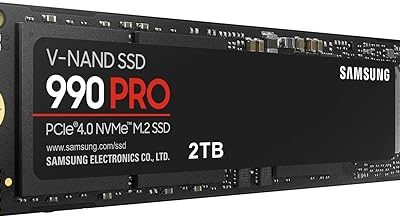
At up to 7,450 MB/s with a proper DRAM cache and a 600 TBW rating, the 990 PRO 1TB is the drive to buy if a sale pushes it near the $100 mark. Its random read performance is genuinely class-leading, which is what DirectStorage-enabled titles actually stress.
Samsung 990 PRO 2TB
The 2TB version is the long-term answer for anyone tired of uninstalling games, offering the same 7,450 MB/s ceiling with double the endurance headroom. It sits above budget at list price, but it’s the drive most people should target on Prime Day or Black Friday.
Samsung 9100 PRO 1TB
Samsung’s Gen 5 flagship pushes up to 14,700 MB/s, and while that’s overkill for gaming today, it’s the most future-proof option here for creators who also game. Budget for adequate cooling — Gen 5 controllers throttle quickly without a heatsink or good airflow.
Frequently Asked Questions
Will a cheaper SSD actually slow down my games?
Rarely. Once you’re on any NVMe drive, load-time differences between a $70 Gen 4 drive and a $200 flagship are typically under two seconds. The bigger risk is running out of space and being forced to reinstall constantly.
Do I need PCIe 5.0 in 2026?
Not for gaming. Gen 5 delivers meaningful gains in large file transfers and professional workloads, but no current game engine comes close to saturating Gen 4 bandwidth.
Can I use these drives in a PlayStation 5?
Yes, provided the drive is M.2 2280, PCIe 4.0 or faster, and fitted with a heatsink. Sony’s minimum is 5,500 MB/s sequential read, so verify the spec before purchasing a budget model.
Is DRAM-less really a dealbreaker?
No, but it matters for your primary drive. HMB-equipped DRAM-less SSDs handle gaming workloads well; they only stumble under heavy sustained writes like video editing or large backups.
Final Thoughts
For most gamers on a genuine $100 budget, the Kingston NV3 1TB is the clear pick — full terabyte capacity, Gen 4 speeds, and money left over for a heatsink. If your workload demands a proper DRAM cache and you can catch a discount, the Samsung 990 PRO 1TB is the best all-round drive at this tier, while the SanDisk Optimus 5100 500GB remains a sensible, dependable choice for a compact boot volume.