Our Top Picks
 Breville BES500BSS Bambino Plus Espresso MachineSmall7.6 x 12.5 x 12.2 inches11 poundsCheck on Amazon


As an Amazon Associate we earn from qualifying purchases.
An espresso machine in a gaming room is a different purchase from an espresso machine in a kitchen. The corner it has to fit into is smaller, the sink is usually further away, and it will live within splashing distance of a keyboard, a monitor and a PC tower. That makes three things decisive here: the system type, the footprint, and how much daily mess the machine creates. Everything else — steam power, basket size, tank capacity — matters only after those three are settled.
The system decision comes first because it shapes your whole routine. Four of the machines below are pump machines with a portafilter: you dose ground coffee, tamp, lock in and pull the shot yourself. They make real espresso with proper milk drinks, but they demand a grinder or pre-ground coffee, a knock-out routine for spent pucks, and regular cleaning. The fifth is a capsule machine: one button, no dosing, no puck to knock out, and the used capsule drops into a bin inside the machine. Capsules cost more per drink and produce a used pod every time, but between matches they are hard to beat for speed. Neither route is wrong; they suit different tolerances for hobby-level involvement.
Be honest with yourself about that involvement before choosing. Espresso is the most hobby-heavy way to put coffee in a game room. A pump machine wants its drip tray emptied, its group head flushed and its steam wand wiped after every milk drink, and a wet puck left sitting in the portafilter overnight is a small science project by morning. At this level, the quality of the grinder and the freshness of the grind decide more about what lands in the cup than the machine does. And one safety rule applies to every pick: place the machine so the steam wand points away from your desk electronics, route the cord behind the furniture, and carry the water tank — never a full kettle — across your setup when refilling.
Affiliate Disclosure: This article contains affiliate links. If you buy through them, we may earn a commission at no additional cost to you.
1. Breville Bambino Espresso Machine (BES450)
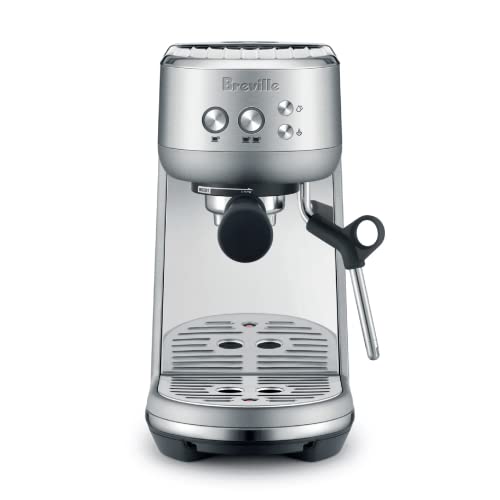
The Bambino is the pump machine that best fits a gaming room because it attacks the two problems that corner creates: width and waiting. It is only about 6.7 inches wide, so it slides onto a side table or a shelf end where wider machines will not, and Breville’s ThermoJet heating system carries a maker claim of a 3-second heat-up — effectively ready before you have sat back down. The 54 mm portafilter, low-pressure pre-infusion and dual-wall baskets mean it pulls a proper shot from pre-ground coffee as well as from a home grinder, which makes it a forgiving first machine.
Milk is fully manual: a single-hole steam wand you position yourself, with an automatic purge after steaming so milk does not bake inside it. That is a skill worth learning if lattes are the goal, and a chore if they are not. The 47-ounce removable tank is mid-sized — enough for a day of drinks without dominating the corner. Cleanup is the standard pump-machine set: knock out the puck, rinse the basket, empty the slim drip tray. For a solo setup where counter width is the hard limit, this is the most complete small-footprint option on the list.
Specs
- System: Pump espresso machine, 54 mm portafilter
- Pump: 15-bar Italian pump (maker figure) with low-pressure pre-infusion
- Heating: ThermoJet; maker-claimed 3-second heat-up
- Water tank: 47 oz (1.4 L), removable
- Milk: Manual steam wand with automatic purge
- Footprint: Approx. 12.2 x 6.7 x 12.5 in (D x W x H)
- Baskets: Dual-wall 1-cup and 2-cup filter baskets included
2. Breville Bambino Plus Espresso Machine (BES500)
The Bambino Plus is the same compact idea with the milk step automated. Its steam wand has a temperature sensor and textures milk on its own: you place the jug, choose from three milk temperatures and three texture levels, and the machine steams and stops at the setting. For a gaming room, that matters more than it sounds — a latte between matches stops being a small project and becomes a button, a pour and a wipe of the wand. It keeps the ThermoJet system and the maker-claimed 3-second heat-up from the smaller machine.
You pay for the automation in width and tank. At about 7.7 inches wide it still fits a corner comfortably, and the 64-ounce tank is the largest among the pump machines here, so refills are infrequent — though a bigger tank of standing water next to a PC is its own argument for keeping it on a stable, out-of-the-way surface. The accessory kit is generous, with single and dual-wall baskets, a dosing tool and a stainless milk jug. If milk drinks are the main reason the machine exists, this is the pick that removes the learning curve.
Specs
- System: Pump espresso machine, 54 mm portafilter
- Pump: 15-bar pump (maker figure) with low-pressure pre-infusion
- Heating: ThermoJet; maker-claimed 3-second heat-up
- Water tank: 64 oz (1.9 L), removable
- Milk: Automatic steam wand with temperature sensor; 3 milk temperatures, 3 texture levels
- Footprint: Approx. 12.2 x 7.7 x 12.2 in (D x W x H)
- Extras: Single and dual-wall baskets, dosing tool, 16 oz stainless milk jug included
3. De’Longhi Dedica Deluxe Espresso Machine (EC685M)
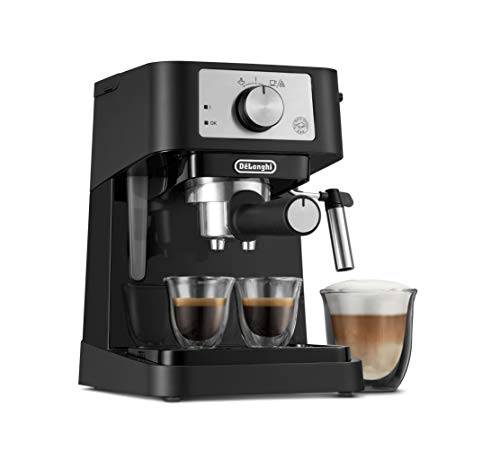
The Dedica Deluxe is the narrowest machine in this roundup, and for genuinely tight gaming corners that is the whole argument. De’Longhi builds it around an ultraslim body about 5.9 inches wide — it can stand on a bookshelf ledge or the end of a desk where even the Bambino would crowd the mouse space. Its thermoblock heater is ready in roughly 40 seconds by the maker’s figures, the 15-bar pump is the class standard, and a flow-stop function ends the shot at a programmed single or double volume so the cup is consistent without watching it.
The compromises are capacity and milk handling. The 35-ounce removable tank is the smallest of the pump machines here, fine for one or two drinkers and a chore for a shared room. The adjustable frother wand works for cappuccino foam and flatter latte milk, but it is a manual wand with a learning curve, and the 51 mm pressurized baskets lean on pressure rather than grind precision — forgiving with pre-ground coffee, less expressive with a good grinder. It also accepts ESE pods for a no-dosing fallback. For the smallest possible footprint with real portafilter espresso, nothing else on the list goes this slim.
Specs
- System: Pump espresso machine, 51 mm portafilter
- Pump: 15-bar pump (maker figure)
- Heating: Thermoblock; ready in about 40 seconds per the maker
- Water tank: 35 oz, removable
- Milk: Adjustable manual frother steam wand
- Footprint: Approx. 5.9 in wide (ultraslim body)
- Extras: Flow-stop auto shutoff for single and double shots; ESE pod compatible
4. De’Longhi Stilosa Manual Espresso Machine (EC260BK)
The Stilosa is the starter machine: a straightforward manual pump model with pressurized baskets that take the guesswork out of a first month of espresso. At about 8 inches wide it is not the slimmest here, but it is light, simple and undemanding — load the portafilter with the included scoop-tamper, turn the dial, and steam milk with the manual panarello wand when you want a cappuccino. The pressurized single and double filters tolerate pre-ground coffee and an imperfect tamp, which is exactly where beginners live.
Its limits are the flip side of that simplicity. The 33.8-ounce tank is small, the boiler is a basic stainless unit that handles one job at a time — brew or steam, not both — and the pressurized baskets put a ceiling on how far the shots improve as your grinder and technique get better. None of that matters if the goal is a decent daily espresso and the occasional latte in a dorm or first gaming room without committing to the hobby. It also takes ESE pods when even the scoop feels like too much. Think of it as the low-commitment entry point to the pump-machine side of this list.
Specs
- System: Manual pump espresso machine, pressurized filter baskets
- Pump: 15-bar pump (maker figure)
- Water tank: 33.8 fl oz (1 L), removable
- Milk: Manual panarello frother wand
- Footprint: 8.07 x 13.5 x 11.22 in (W x D x H)
- Power: 1100 W, 120 V
- Extras: Single and double pressurized filters, scoop/tamper included; ESE pod compatible
5. Nespresso VertuoPlus Coffee and Espresso Maker by Breville (BNV420IBL)
The VertuoPlus is the capsule entry, and it exists for the reader who read the cleaning paragraphs above and quietly opted out. There is no portafilter, no grinder, no puck: you drop in a Vertuo capsule, close the motorized head, and the machine reads the capsule’s barcode and spins it — Nespresso’s Centrifusion system — to brew one of four sizes, from a 1.35-ounce espresso to a 7.7-ounce coffee. Heat-up is 25 seconds by the listing, the used capsule ejects into an internal container, and the 40-ounce water tank can be repositioned to suit the corner it sits in.
The trade-offs are the capsule system’s own. You are locked into Vertuo capsules, which cost more per drink than ground coffee and leave a used pod behind every time, and this solo model has no milk frother — milk drinks mean adding a separate Aeroccino or drinking it black. In exchange, the daily maintenance is a rinse cycle and an emptied capsule bin, and the drinks are identical every time with zero technique. For a stream room or shared space where coffee is fuel rather than a hobby, that consistency is the point.
Specs
- System: Capsule machine (Nespresso Vertuo capsules); Centrifusion extraction with barcode reading
- Brew sizes: Espresso 1.35 oz, Double Espresso 2.7 oz, Gran Lungo 5 oz, Coffee 7.7 oz
- Heat-up: 25 seconds per the listing
- Water tank: 40 oz, adjustable placement
- Milk: None built in; Aeroccino frother sold separately
- Power: 1350 W, 120 V
- Footprint: Approx. 9.8 x 13.3 x 12.7 in (W x D x H)
- Extras: Motorized head opening, automatic capsule ejection, energy-saving auto shut-off
How to Choose
Start with the system, because it decides your daily routine. A pump machine with a portafilter makes the best milk drinks and the most adjustable espresso, but it needs a grinder or a standing order of pre-ground coffee, and it adds a small cleaning ritual to every session. A capsule machine gives that up for one-button consistency and almost no cleanup. If you already know you will not knock out pucks and wipe steam wands at midnight, believe yourself and take the capsule route.
Next, measure the corner before falling for a machine. Width is the binding constraint in most gaming rooms: the Dedica Deluxe needs about 6 inches, the Bambino about 6.7, the Bambino Plus about 7.7, the Stilosa about 8, and the VertuoPlus about 9.8 — but also check depth and the clearance above, because tanks lift out upward and steam wands swing out sideways. A machine that fits on paper but cannot have its tank removed in place will annoy you daily.
Then match the milk system to your actual drinks. Straight espresso and americanos need no wand at all. Occasional cappuccinos suit a manual wand — the Bambino, Dedica and Stilosa all ask you to learn a simple skill. Daily lattes argue for the Bambino Plus and its automatic texturing, or for the capsule machine plus a separate frother. Finally, weigh the tank against the room: a bigger tank means fewer refills but more standing water near your electronics, and every machine here should sit on a stable surface with its steam wand pointed away from the desk, its cord routed behind furniture, and a clear path for carrying the empty tank to the sink.
FAQ
Do I need a grinder for the pump machines?
Not strictly. All four pump machines here ship with pressurized or dual-wall baskets designed to work with pre-ground coffee. A burr grinder improves consistency and lets the Breville machines in particular show what they can do, but it is an upgrade, not a requirement for the first month.
Can a capsule machine make a real latte?
The drink itself, yes; the machine alone, no. The VertuoPlus listed here has no frother, so milk drinks require the separate Aeroccino frother or another milk heater. What you get in return is a shot that tastes the same every time with no technique involved.
How much daily cleaning does a pump machine actually need?
A few minutes: knock out the puck, rinse the basket, wipe and purge the steam wand after milk, and empty the drip tray regularly. Descaling is an occasional job on a cycle of weeks to months depending on your water. Skipping the daily steps is what makes espresso corners smell stale.
Is 15 bar the number that matters?
Not really. Nearly every home machine advertises a 15-bar pump because that is the pump’s maximum rating, not the pressure at the coffee. Basket type, grind consistency and dose have a far bigger effect on the shot than the headline bar figure, which is why the pressurized baskets on the starter machines are so forgiving.
Conclusion
For most gaming rooms, the Breville Bambino is the sweet spot: genuinely narrow, ready almost immediately, and capable of proper milk drinks once the manual wand clicks. The Bambino Plus earns its place if lattes are a daily habit and automation sounds better than practice. Where width is measured in single inches, the Dedica Deluxe is the only real answer, and the Stilosa covers the first-machine brief with the least commitment. And if the honest priority is a good cup with no ritual attached, the VertuoPlus makes that trade openly. Measure the corner, decide how much hobby you actually want, and the list narrows itself.
More from Amazon
Programs that pair well with the guide above. Offers and eligibility are set by Amazon and may change.
Free shipping on eligible items, Prime Video and more. Eligible new members can start with a free trial.
Start a Prime free trialAd-free music streaming. Eligible new subscribers can start with a free trial.
Try Music Unlimited freeA Prime membership for ages 18-24 with a trial period. Eligibility is set by Amazon.
See Prime for Young AdultsAudiobooks and podcasts to listen to on the go. Eligible new members can start with a free trial.
Try Audible freeAs an Amazon Associate we earn from qualifying purchases.