Our Top Picks
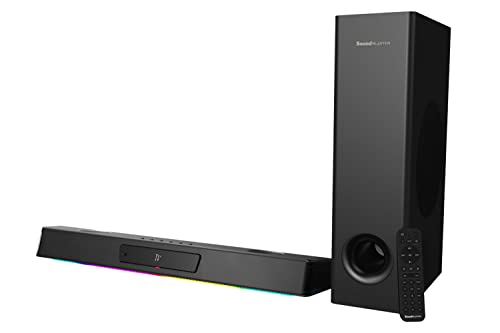 Creative Sound Blaster Katana V2X RGB Gaming Soundbar3.74 x 23.6 x 2.44 inches15.17 poundsCheck on Amazon
 Samsung HW-Q600C 3.1.2ch Soundbar w/Dolby Audio2.2" x 40.6" x 4.1"1 x 1 x 1 inches20.5 poundsCheck on Amazon


As an Amazon Associate we earn from qualifying purchases.
A gaming setup usually gets its audio from one of two weak points: the small speakers built into a monitor or TV, or a headset that stays on for hours. A soundbar fixes the first problem and relieves the second. It sits in a single line under the screen, needs no speaker stands or cable runs around the room, and gives games the dialogue clarity, bass weight and stereo width that built-in speakers cannot produce. The five bars below cover the two places gaming audio actually happens — the desk, where short bars with wired subwoofers fit under a monitor, and the TV corner, where wider bars with wireless subwoofers and height channels handle console play.
Two honest limits before the picks. First, no soundbar matches a discrete surround system with separate speakers placed behind you: a bar fires everything from the front, and anything labelled virtual surround or spatial audio is signal processing that widens the image, not sound arriving from real rear speakers. Second, competitive players will still reach for a headset when voice chat and precise directional cues decide a match. What a soundbar does better is shared, comfortable, room-filling sound for story games, films and everything played on the TV. Read the channel count, the connection list and the bar width on each listing carefully — those three things decide whether a bar suits your setup far more than any headline wattage.
1. Razer Leviathan V2
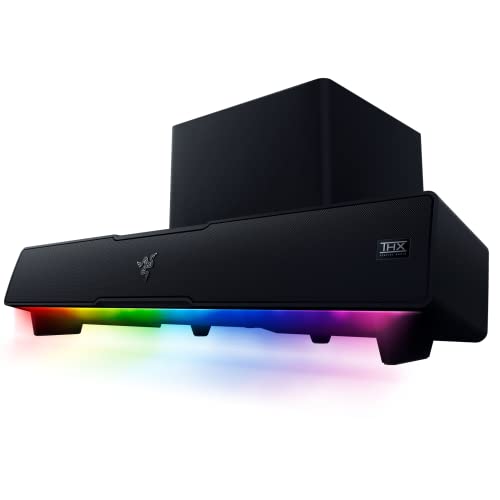
The Leviathan V2 is the desk-first option in this roundup: a 500 mm bar built to slide under a monitor, paired with a separate down-firing subwoofer that connects by cable. Inside the bar are two full-range drivers, two tweeters and two passive radiators, and Razer feeds them through THX Spatial Audio on PC, which renders a virtual 7.1 surround image from the stereo feed. That processing runs in Razer’s Synapse software on Windows, so it is a PC feature rather than something the bar does on its own for a console.
Connections are deliberately narrow. Audio arrives over USB-C from a PC, or wirelessly over Bluetooth 5.2 with a stated 60 ms low-latency mode, which suits a Nintendo Switch or a phone as a secondary source. There is no HDMI, no optical input and no 3.5 mm jack, so this bar cannot take sound from a TV or a console dock at all — it is a PC battlestation speaker, full stop. Razer Chroma RGB runs across 18 lighting zones, a custom 10-band EQ is available in the software, and two sets of detachable feet let you tilt the bar up toward your ears.
Specs
- Configuration: 2.1 system — soundbar plus wired down-firing subwoofer
- Drivers: 2 full-range (48 x 95 mm), 2 tweeters (20 mm), 2 passive radiators (43 x 135 mm), 5.5-inch subwoofer driver
- Spatial audio: THX Spatial Audio (virtual 7.1, via Razer Synapse on Windows)
- Connections: USB-C audio input, Bluetooth 5.2 (60 ms low latency); no HDMI or optical
- Output power: 65 W
- Frequency response: 45 Hz – 20 kHz
- Lighting: Razer Chroma RGB, 18 zones
- Soundbar dimensions: 500 x 91.3 x 84 mm; weight 1.4 kg
- Subwoofer dimensions: 220 x 220 x 241.5 mm; weight 3.0 kg
2. Creative Sound Blaster Katana V2X
The Katana V2X is Creative’s multi-channel gaming bar, built around a tri-amplified five-driver design: separate amplifier channels drive the tweeters, the mid-range drivers and the subwoofer independently. Physically it is a 2.1 system, but it plays back 5.1-channel content and uses Creative’s Super X-Fi processing to widen the soundstage beyond the bar’s 600 mm width. An SXFI Battle Mode is included specifically for games, boosting the audio cues — footsteps and reloads — that matter in competitive play, and Dolby Audio (Dolby Digital) decoding is supported over the HDMI ARC and optical inputs.
Connectivity is the widest of any desk bar here: USB-C audio for PC and current consoles, HDMI ARC for a TV, an optical input, a 3.5 mm AUX input, Bluetooth 5.0, a headset output and an SXFI output for compatible headphones. Two built-in beamforming microphones let you join a voice chat without a headset for short sessions. The V2X’s subwoofer is wired and deliberately slim — at 116 mm wide it slides beside a desk leg where cube-shaped subs will not fit — and total output is rated at 90 W RMS (180 W peak). RGB underglow lighting runs along the base. For a single setup that must serve a PC, a console and a TV, this is the most flexible bar in the list.
Specs
- Configuration: 2.1 system — soundbar plus wired compact subwoofer; 5.1-channel playback with virtual surround
- Drivers: 2 mid-range, 2 tweeters (19 mm), 1 subwoofer driver; tri-amplified design
- Processing: Super X-Fi, SXFI Battle Mode, Dolby Audio (Dolby Digital via HDMI ARC and optical)
- Connections: USB-C, HDMI ARC, optical-in, 3.5 mm AUX-in, Bluetooth 5.0, headset-out, SXFI-out
- Output power: 90 W RMS total (50 W soundbar, 40 W subwoofer), 180 W peak
- Frequency response: 50 Hz – 20 kHz
- Extras: dual built-in beamforming microphones, RGB underglow
- Soundbar dimensions: 600 x 95 x 62 mm; weight 1.52 kg
- Subwoofer dimensions: 116 x 250 x 423 mm; weight 3.3 kg
3. Samsung HW-Q600C
The HW-Q600C is the TV-first pick, and the only bar here with real height channels. Its 3.1.2 configuration puts a dedicated centre channel under the screen for dialogue, stereo left and right channels either side, and two up-firing drivers that bounce height effects off the ceiling for Dolby Atmos content — those up-firing drivers are physical speakers, not processing, which is what separates it from the virtual-surround bars above. Nine speakers in total are driven by 360 W of amplification, and the wireless subwoofer connects without a cable, so it can sit beside the sofa rather than beside the TV stand.
The connection that matters most for console gaming is HDMI eARC: run the console into the TV, and one HDMI cable carries the full-quality audio — including Atmos — from the TV down to the bar, with the TV remote controlling volume. Game Mode Pro is Samsung’s low-latency game setting, and there is also optical input and Bluetooth. Two features only work with Samsung TVs: Q-Symphony plays the TV’s own speakers alongside the bar instead of muting them, and Tap Sound pairs a Samsung phone by touching it to the bar. At just over a metre wide, this bar belongs under a TV rather than a monitor; measure your stand before ordering.
Specs
- Configuration: 3.1.2 channels, 9 speakers — centre channel plus two up-firing height drivers
- Formats: Dolby Atmos, DTS:X, Dolby Audio per the listing
- Subwoofer: wireless, separate cabinet
- Connections: HDMI eARC, optical-in, Bluetooth
- Output power: 360 W total
- Game features: Game Mode Pro; Q-Symphony and Tap Sound (Samsung TVs/phones)
- Sound modes: Adaptive Sound, Acoustic Beam
- Soundbar dimensions: 40.6 x 2.2 x 4.1 inches
- Subwoofer dimensions: 7.2 x 13.5 x 11.6 inches
4. Sony HT-S400
The HT-S400 keeps the formula simple: a 2.1-channel bar, a wireless subwoofer, and connections that cover a TV and a phone without a page of settings. Sony rates total output at 330 W, and its S-Force PRO Front Surround processing widens the stereo image from the bar’s two front channels. That is virtual surround — the listing is clear that the physical hardware is two channels plus the sub — and Dolby Digital decoding handles the standard format that consoles and streaming services send over HDMI ARC and optical.
For a gaming room, the practical points are the wireless subwoofer, which can live wherever the room allows instead of where a cable reaches, and the straightforward HDMI ARC hookup: one cable from the TV, and the TV remote controls the bar’s volume. Bluetooth streaming covers music and podcasts from a phone when the screen is off, and a USB port plays audio files directly. The bar is 900 mm wide, sized for TVs rather than desktop monitors. Voice mode lifts dialogue frequencies for late-night sessions when the sub has to stay quiet, and night mode compresses the dynamic range for the same reason.
Specs
- Configuration: 2.1 channels — soundbar plus wireless subwoofer
- Processing: S-Force PRO Front Surround (virtual surround), Dolby Digital decoding
- Connections: HDMI ARC, optical-in, Bluetooth, USB (audio playback)
- Output power: 330 W total
- Sound modes: Voice mode, Night mode
- Soundbar dimensions: 900 x 64 x 88 mm; weight 2.4 kg
- Subwoofer dimensions: 192 x 387 x 400 mm; weight 7.3 kg
5. Hisense HS214
The HS214 takes the opposite approach to every other bar here: everything lives in one cabinet. It is a 2.1-channel bar with a subwoofer built into the underside of the chassis, so there is no second box to place, no subwoofer cable and nothing on the floor — a genuine advantage in a small gaming room, a dorm or a bedroom setup where the TV sits on a dresser. The trade-off is physics: a 3-inch built-in woofer inside a 65 cm bar cannot move the air a separate subwoofer cabinet does, so expect fuller sound than TV speakers rather than room-shaking bass.
Hisense rates output at 108 W, and the connection list is complete for a TV bar: HDMI ARC (a cable is included), optical (also included), coaxial, a 3.5 mm AUX input, USB and Bluetooth. Dolby Audio processing is built in, three EQ modes cover movies, music and news-style dialogue, and Roku TV Ready certification means a Roku TV recognises the bar over HDMI ARC and folds its settings into the TV’s own menus. At 25.6 inches wide it suits TVs from 32 inches upward and fits on shallow shelves where a metre-wide bar would overhang. A wall-mount kit is in the box.
Specs
- Configuration: 2.1 channels, all-in-one — built-in down-firing subwoofer, no separate cabinet
- Drivers: 3 speakers including the built-in subwoofer
- Processing: Dolby Audio; 3 EQ modes (Movie, Music, News)
- Connections: HDMI ARC, optical-in, coaxial, 3.5 mm AUX, USB, Bluetooth
- Output power: 108 W (2 x 27 W plus 54 W subwoofer)
- Frequency response: 40 Hz – 20 kHz
- Extras: Roku TV Ready; HDMI cable, optical cable and wall-mount kit included
- Dimensions: 25.6 x 3.7 x 2.3 inches; weight 4.8 lbs
How to Choose a Soundbar for Gaming
Start with the channel count, and read it literally. The first number is front channels, the second is the subwoofer, and a third means height channels. A 2.1 bar like the Sony HT-S400 plays stereo plus bass. A 3.1.2 bar like the Samsung HW-Q600C adds a real centre channel for dialogue and real up-firing speakers for Atmos height effects. Anything described as virtual surround, spatial audio or front surround on a 2-channel bar is processing: it can sound wider, but no sound will genuinely come from behind or above you.
Match the connection to your chain. For a console connected to a TV, HDMI eARC is the connection to look for — it carries the highest-quality formats from the TV to the bar over one cable and keeps volume control on the TV remote. Plain HDMI ARC covers Dolby Digital, which is what most games actually output. Optical carries the same Dolby Digital but no remote-control integration. For a PC desk, USB audio is the cleanest path, and note that the Razer Leviathan V2 offers only USB and Bluetooth: it cannot be connected to a TV at all.
Decide the subwoofer question with your floor plan. A separate subwoofer — wireless in the Samsung and Sony, wired in the Razer and Creative — produces deeper bass and can be positioned where the room sounds best. A built-in subwoofer like the Hisense HS214’s removes a box and a cable entirely, at the cost of low-end depth. On a desk, check the subwoofer’s footprint as carefully as the bar’s length; the Katana V2X’s slim sub exists because cube-shaped subs do not fit under most desks.
Measure the bar against the screen. A desk bar should be shorter than your monitor’s width — the Razer is 500 mm, the Creative 600 mm. A TV bar should roughly match the TV’s width, and check the height too: a bar taller than the gap under the panel can block the screen’s lower edge or its remote sensor.
Treat game modes and wattage as secondary. A stated game mode usually lowers processing delay and adjusts the EQ, which is useful, but no bar here adds the kind of delay that affects single-player gaming over HDMI. Wattage figures are measured differently by every brand and say little about how a bar sounds at the volume you will actually use; driver layout and connection fit matter more.
FAQ
Can a soundbar replace a gaming headset?
For single-player games, films and shared viewing, yes — that is exactly the job. For competitive multiplayer, most players still prefer a headset, because it isolates directional cues, carries a close microphone for voice chat and keeps game audio out of the room. Many setups keep both: the bar for everything else, the headset for ranked sessions.
Does Dolby Atmos on a soundbar mean real surround sound?
Only partly. On a bar with physical up-firing drivers, like the 3.1.2-channel Samsung HW-Q600C, Atmos height effects are produced by real speakers bouncing sound off the ceiling. On a 2-channel bar advertising virtual surround, the effect is processing applied to a stereo signal — wider-sounding, but not sound arriving from separate positions.
Should I connect my console to the TV or the soundbar first?
With an eARC bar, connect the console to the TV and let the TV pass audio to the bar: this preserves the TV’s low-latency game mode for the picture while the bar receives full-quality sound. Most gaming bars have no HDMI input of their own for a console to plug into, which settles the question anyway.
Will a soundbar add audio delay to my games?
Over HDMI eARC, ARC or optical, the delay is small enough to be a non-issue for typical play. Bluetooth is the connection to avoid for gaming audio where timing matters, unless the bar states a low-latency mode — the Razer Leviathan V2 quotes 60 ms for its Bluetooth 5.2 link — because standard Bluetooth audio lag is noticeable against on-screen action.
How much space does a subwoofer actually need?
A wireless sub like the Sony’s (192 x 387 x 400 mm) needs a floor spot near a power socket. A wired desk sub must sit within cable reach of the bar, usually under the desk. If neither works, an all-in-one bar with a built-in subwoofer, like the Hisense HS214, removes the problem at the cost of bass depth.
Conclusion
Pick by where you play. At a PC desk, the Razer Leviathan V2 is the purpose-built choice — compact, USB-driven, with THX Spatial Audio — provided you accept that it will never connect to a TV. The Creative Katana V2X is the flexible desk alternative, with the widest connection list here and a slim wired subwoofer. In front of a TV, the Samsung HW-Q600C is the step up: a real centre channel, physical up-firing drivers for Atmos, eARC and a wireless sub. The Sony HT-S400 covers the same TV role in a simpler 2.1 package, and the Hisense HS214 is the one-box answer for small rooms where a separate subwoofer has nowhere to go. Whichever bar you choose, confirm the width against your screen and the inputs against your chain before ordering — those two checks prevent nearly every bad soundbar purchase.
Affiliate Disclosure: This article contains affiliate links. If you buy through these links, we may earn a commission at no extra cost to you.
More from Amazon
Programs that pair well with the guide above. Offers and eligibility are set by Amazon and may change.
Free shipping on eligible items, Prime Video and more. Eligible new members can start with a free trial.
Start a Prime free trialAd-free music streaming. Eligible new subscribers can start with a free trial.
Try Music Unlimited freeA Prime membership for ages 18-24 with a trial period. Eligibility is set by Amazon.
See Prime for Young AdultsAudiobooks and podcasts to listen to on the go. Eligible new members can start with a free trial.
Try Audible freeAs an Amazon Associate we earn from qualifying purchases.