Key takeaways
- Table of Contents 7 sections 10 min read 1 Quick Verdict 2 Side by Side 3 Where Spring Loaded Boom Arm Wins 4 Where Friction Hinge Mic Arm Wins 5 Cost Over 5 Years 6 Which One for Your Home…
What's inside
Choosing between a spring loaded boom arm and a friction hinge mic arm is less about which design is universally better and more about how your room behaves. A microphone arm has to hold the weight of your microphone, survive repeated repositioning, and tuck away without taking over your desk. It also has to fit your habits: frequent streaming, occasional video calls, music recording, or a shared family workspace.
The key difference is how each arm supports its load. A spring loaded boom arm uses internal or external springs to counterbalance the microphone as the arm moves. A friction hinge arm relies on tightened joints, washers, and hinge resistance to hold a position. That distinction affects comfort, noise, appearance, maintenance, and long-term value. For most dedicated desk setups, a spring design is the easier everyday choice. For compact, minimalist, or highly adjustable spaces, a friction hinge can be more practical.
As an Amazon Associate we earn from qualifying purchases at no extra cost to you. Product prices and availability are accurate as of the date shown and are subject to change.


Quick Verdict
Choose a spring loaded boom arm if you move your microphone often, use a heavier broadcast-style mic, or want smooth repositioning with little hand effort. Spring arms are especially comfortable for streamers, podcasters, and remote workers who bring a microphone close and push it away several times a day.
Choose a friction hinge mic arm if you prioritize a small footprint, a clean mechanical look, or compatibility with cameras, lights, and other accessories. Friction arms can be excellent for lighter microphones and flexible home studios, but they usually require more deliberate tightening and repositioning.
In 2026, a sensible buying range is about $20 to $100 for a desktop arm. The lowest-cost models can work well with modest microphones, while better-built arms generally offer smoother movement, stronger clamps, and more dependable cable management.
Side by Side
| Factor | Spring Loaded Boom Arm | Friction Hinge Mic Arm |
|---|---|---|
| Comfort | Very easy to move; springs offset much of the microphone weight. | Requires more hand force and occasional joint adjustments. |
| Durability | Good when springs, hinges, and clamp hardware are well made; springs may eventually weaken. | Few moving parts, but friction washers and knobs can wear or loosen over time. |
| Typical price range | About $25 to $100 for common home models. | About $18 to $80, depending on length, clamp, and thread hardware. |
| Maintenance | Keep joints tight and springs clear of dust; watch for exposed-spring noise. | Retighten knobs and replace worn friction washers if the arm starts drooping. |
| Space needed | Often needs roughly 20 to 30 inches of swing clearance. | Can fold into a smaller shape, though the clamp and joint angles still need room. |
| Look | Familiar studio appearance; exposed springs can look utilitarian. | Usually more minimalist and hardware-like, especially with short arms. |
| Resale | Recognizable studio brands tend to be easier to resell. | Resale depends heavily on the condition of knobs, threads, and friction joints. |
| Best for | Streaming, podcasting, voice work, and frequent microphone movement. | Compact desks, cameras, lights, light microphones, and multi-use workstations. |
| Load considerations | Often suited to microphones weighing about 1 to 4 pounds, depending on the model. | Best matched carefully to the joint capacity; heavier loads can cause sagging. |
Where Spring Loaded Boom Arm Wins
The biggest advantage is effortless movement. A properly balanced spring arm lets you pull a microphone toward your mouth, raise it out of the way, or swing it across the desk without loosening several knobs. That is valuable when you alternate between typing, video calls, gaming, and recording.
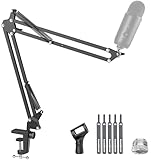
Spring arms are also a strong match for heavier microphones. A large dynamic broadcast microphone, shock mount, pop filter, and cable can add up to 2 or 3 pounds. Some desktop arms support more, but buyers should check the stated load limit rather than assuming all spring arms are interchangeable. For example, the InnoGear Mic Stand Desk Max Load 4.4 lbs Boom Arm Desktop Microphone Stand lists a 4.4-pound maximum load, giving it a generous stated capacity for a typical home setup.
Another benefit is repeatable positioning. Once the arm is balanced, you can usually return the microphone to a familiar height and distance with one hand. That consistency helps keep voice volume steadier and reduces the temptation to lean toward the microphone.
The tradeoff is that inexpensive spring arms may make more mechanical noise. Exposed springs can creak, and some arms transmit a tap through the desk or microphone if you handle them roughly. A spring arm can also look bulkier than a short friction arm. If your desk sits in a living room, bedroom, or visible home office, the industrial studio appearance may matter.
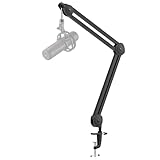
At the higher end, the RØDE PSA1 Professional Studio Arm is listed at $79.99 and represents the kind of recognizable studio-style product shoppers often consider when they want a conventional spring-balanced setup. At the budget end, many arms cost about $25 to $40, but clamp thickness, cable clips, and long-term joint smoothness can vary substantially.
Where Friction Hinge Mic Arm Wins
A friction hinge arm wins on flexibility and visual simplicity. Instead of balancing a long boom with a spring, it uses adjustable joints that can be angled in several directions. This makes the design useful beyond microphones. With the right thread adapter, the same style of arm can support a small camera, LED light, phone mount, or compact recorder.
The SMALLRIG 9.8 Inches Magic Arm Clamp Kit with 1/4″ and 3/8″ threaded holes is a good example of this broader accessory format. Its $18.99 price places it below many dedicated studio arms, and its threaded connections are useful for devices that do not use a standard microphone mount. It is important to distinguish this kind of short magic arm from a full-length vocal boom: a 9.8-inch arm is better for compact positioning than for reaching across a deep desk.
Friction arms can also be easier to hide. A short arm can fold close to a monitor or desk edge when not in use, making it attractive for a bedroom workstation or a dining table that serves multiple purposes. The absence of exposed springs gives some models a cleaner, more architectural appearance.
However, friction is not maintenance-free. If a joint is too loose, the microphone can sag. If it is too tight, repositioning becomes awkward and may put stress on the clamp or threaded mount. Over time, friction discs, washers, and knobs can wear. A friction arm is most satisfying when the user is comfortable making small adjustments instead of expecting instant, one-handed movement.
Dedicated low-profile options can split the difference. The InnoGear Mic Arm Low Profile Microphone Boom Arm Mic Stand 360° Flex, Black is listed at $25.19 and uses a lower-profile approach for desks where a tall overhead boom would be distracting. It still needs to be matched to the microphone’s weight and the available edge thickness.
Cost Over 5 Years
The purchase price is only part of the cost. A budget spring or friction arm commonly starts around $20 to $30. Midrange models run about $40 to $80, while premium or branded studio arms may reach $100 or more. Add roughly $10 to $30 if you need a shock mount, threaded adapter, replacement clamp, or longer USB or XLR cable.
Over five years, a $25 arm that remains stable costs about $5 per year. A $50 arm costs about $10 per year, and an $80 arm costs about $16 per year before accessories. Replacing a worn $10 friction washer or a damaged $20 clamp can extend the life of an otherwise usable arm. Conversely, replacing a complete low-cost arm twice can make a better $60 model the cheaper choice overall.
Spring arms may have higher repair risk if the spring, hinge, or plastic joint fails, while friction arms may need periodic tightening or replacement washers. Neither design requires electricity, so wattage is not a consideration; the relevant specifications are load capacity, clamp range, reach, and thread size.
Which One for Your Home
Small Apartment
Pick a short friction hinge arm or a low-profile spring arm if every inch of desk space matters. Look for a reach under about 12 inches when possible, or choose a model that folds close to the monitor. A compact friction arm is especially useful when the desk doubles as a dining, study, or craft surface. Avoid a long boom that must remain extended across the room’s visual field.
Family With Kids or Pets
A spring loaded boom arm is usually easier to move out of the way quickly, but stability is more important than mechanism. Choose a substantial clamp, keep the arm within its rated load, and route the cable so it cannot become a dangling pull point. If children or pets can reach the desk, a short friction arm may present fewer protruding parts, provided its knobs are tightened securely.
Rental
Use a clamp-mounted arm rather than drilling into a wall or desktop. Place a thin protective pad between the clamp and finished furniture, and confirm that the clamp opens wide enough for the desk. A friction arm is attractive for a rental because it can serve several devices and pack away easily. A spring arm is better if you record frequently and want fast, repeatable microphone positioning.
Long-Term Home
Invest in the arm that matches your routine rather than choosing solely by price. For daily podcasting or streaming, a well-balanced spring arm in the $50 to $100 range can be more comfortable for years. For a flexible office that may later hold a camera or light, a durable friction arm with 1/4-inch and 3/8-inch compatibility may offer more utility.
FAQ
Are spring loaded mic arms better for heavy microphones?
Often, yes, because the spring counterbalances the load. Still, check the manufacturer’s capacity, including the microphone, shock mount, pop filter, and cable. A 4.4-pound rating does not mean every part of the arm is equally rigid at full extension.
Do friction hinge arms sag?
They can if the microphone is too heavy, the arm is extended too far, or the joint knobs are loose. Keeping the load close to the clamp and tightening each joint evenly reduces sag. A worn friction washer may need replacement.
Which arm is quieter to adjust?
Neither design is automatically silent. Spring arms can creak or transmit movement through exposed springs, while friction arms can click or scrape at their hinges. Slow, deliberate movement and a shock mount help minimize handling noise during recording.
Can one arm hold a microphone and a camera?
Sometimes, but only with compatible threads, adequate load capacity, and a suitable reach. Dedicated microphone arms are designed around microphone mounts, while magic arms often use 1/4-inch or 3/8-inch threads for cameras and lights. Do not exceed the arm’s rating or assume an adapter increases its strength.