Key takeaways
- USB vs. XLR: USB mics are simple plug-and-play for most gamers and streamers, while XLR (or hybrid) options offer higher-end audio and an upgrade path but require an interface or mixer.
- Dynamic vs. condenser: Dynamic mics excel at rejecting background noise in untreated rooms, whereas condensers capture more detail but pick up more of your environment.
- Noise handling: Look for good off-axis rejection or built-in noise reduction so mechanical keyboards, fans, and room echo do not bury your voice.
- Convenience features: Tap-to-mute, onboard gain control, and a headphone monitoring jack make live gaming and streaming far smoother than fiddling with software.
- Desk setup: Decide whether you want a desktop-stand mic for simplicity or a boom-arm kit that clears your desk and positions the capsule closer to your mouth for cleaner sound.
What's inside
Clear audio has become just as important as sharp visuals for gamers in 2026, whether you are coordinating with teammates, streaming to an audience, or recording content for YouTube. A dedicated gaming microphone lifts your voice out of the background hiss and keyboard clatter that plague headset mics, instantly making you sound more professional and easier to understand.
The market now spans plug-and-play USB mics that anyone can set up in minutes to hybrid XLR options built for serious creators who want room to grow. We tested the standouts on voice clarity, background-noise rejection, ease of setup, and extras like tap-to-mute and RGB, so you can find a mic that makes your voice shine without overcomplicating your desk.
As an Amazon Associate we earn from qualifying purchases at no extra cost to you. Product prices and availability are accurate as of the date shown and are subject to change.




⚡ Save on Your Next PC — Amazon Prime
Prime members get fast free shipping on the systems above, plus early access to Prime Day & Black Friday PC deals. New members get a 30-day free trial.
Watch: Best Gaming MIC 2026 — Video Review
How to Choose a Gaming Microphone
- USB vs. XLR: USB mics are simple plug-and-play for most gamers and streamers, while XLR (or hybrid) options offer higher-end audio and an upgrade path but require an interface or mixer.
- Dynamic vs. condenser: Dynamic mics excel at rejecting background noise in untreated rooms, whereas condensers capture more detail but pick up more of your environment.
- Noise handling: Look for good off-axis rejection or built-in noise reduction so mechanical keyboards, fans, and room echo do not bury your voice.
- Convenience features: Tap-to-mute, onboard gain control, and a headphone monitoring jack make live gaming and streaming far smoother than fiddling with software.
- Desk setup: Decide whether you want a desktop-stand mic for simplicity or a boom-arm kit that clears your desk and positions the capsule closer to your mouth for cleaner sound.
The Best Gaming Microphones Reviewed
Shure MV6 USB
Drawing on Shure’s legendary broadcast heritage, the MV6 is a dynamic USB mic that delivers rich, focused vocals while shrugging off background noise in real rooms. With built-in noise cancellation, tap-to-mute, and 3.5mm headphone monitoring, it is the premium pick for gamers and streamers who want pro-grade voice quality without the complexity of an XLR chain.
FIFINE AmpliGame AM8
The AmpliGame AM8 is the versatile value champion, offering both USB and XLR connectivity so you can start simple and upgrade later. This dynamic mic tames keyboard noise well, and its RGB lighting, mute button, headphone jack, and included desktop stand make it a feature-packed choice that punches far above its price for streaming and recording.
Logitech Blue Yeti
A streaming icon, the Blue Yeti condenser mic remains a favorite thanks to its plug-and-play simplicity and four selectable pickup patterns for solo play, interviews, or group recording. Its Blue VO!CE effects add broadcast polish, and while a condenser picks up more room sound, the versatility and crisp detail keep it a staple on gaming desks.
MAONO DGM20S
The MAONO DGM20S packs impressive features into a budget-friendly gaming mic, combining clear voice capture with noise reduction, RGB lighting, tap-to-mute, and onboard gain control. It even includes a boom arm, making it a complete starter package for gamers who want a tidy setup and dependable Discord and streaming audio without overspending.
TONOR TC310+ Kit
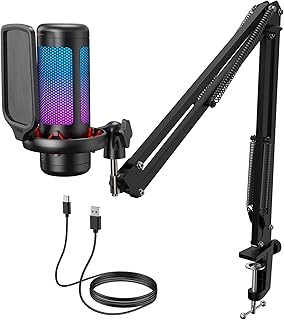
For newcomers who want everything in one box, the TONOR TC310+ condenser kit bundles a boom arm, controllable RGB light, one-tap mute, and volume control at an approachable price. It is an easy, cable-light way to instantly upgrade from a headset mic, delivering clean, clear voice for Twitch, Discord, and casual content creation.
Frequently Asked Questions
Do I need a USB or XLR microphone?
For most gamers and streamers, USB is the right call because it plugs straight into your PC with no extra gear. Choose XLR or a hybrid like the AM8 only if you plan to expand into a mixer or audio interface later for higher-end production.
Is a dynamic or condenser mic better for gaming?
Dynamic mics like the Shure MV6 are better in noisy, untreated rooms because they reject background sound, while condensers such as the Blue Yeti capture more detail but also more of your environment. If your space echoes or has fan noise, go dynamic.
Why choose a mic over my headset’s built-in one?
Dedicated microphones capture far clearer, fuller voice with less hiss and background noise, making you easier to understand in team chat and far more professional on stream. The difference is immediately obvious to your audience and teammates.
Do I need a boom arm?
A boom arm is not essential, but it clears desk space and lets you position the mic closer to your mouth for cleaner sound. Kits like the MAONO DGM20S and TONOR TC310+ include one, which adds real value for streaming setups.
Final Thoughts
The Shure MV6 is our top choice for gamers who want broadcast-quality voice with minimal fuss, while the FIFINE AmpliGame AM8 offers unbeatable flexibility with its USB and XLR options. The Blue Yeti endures as a versatile streaming classic, and the MAONO DGM20S and TONOR TC310+ deliver complete, boom-arm-included setups for budgets that need to stretch. Match the mic type to your room and ambitions, and your voice will come through clear and confident every session.