Our Top Picks



Quick answer: The Lamicall Headphone Stand in Black is the best gaming headset stand for most desks, because its aluminum frame, curved cradle and low center of gravity hold a single over-ear headset securely without adding charging ports, lights or cables to the desk. The Kanto H1 is the premium steel alternative for heavier headsets, the Avantree Neetto HS908 is the pick when two headsets share one desk, the GEVO walnut stand suits a warm wood setup with a storage base, and the New Bee Z1 is the compact budget pick that takes up the least desk space. Every stand in this roundup is a passive desktop stand with no USB charging, no wireless charging pad and no built-in hub, so the choice comes down to material, footprint and how many headsets need a home.
As an Amazon Associate, we earn from qualifying purchases.
Table of Contents
- Why a Headset Stand Earns Its Desk Space
- How to Choose a Gaming Headset Stand
- Quick Comparison
-
- Lamicall Headphone Stand, Black
-
- Kanto H1 Headphone Stand, Black
-
- Avantree Neetto HS908 Dual Headphone Stand
-
- GEVO Walnut Headphone Stand
-
- New Bee Headphone Stand Z1, Black
- Before You Order: Fit, Stability and Recall Checks
- Frequently Asked Questions
- Conclusion
- Product and ASIN Reference
Why a Headset Stand Earns Its Desk Space
A gaming headset spends most of its life off the head, and where it rests in those hours decides how long it stays comfortable. Left flat on a desk, a headset collects dust on the ear cushions, its cable tangles with the keyboard cable, and the headband takes the weight of anything set down beside it. Hung from a monitor edge or a desk hook, it stays out of the way but swings against the desk leg and presses the headband padding against a narrow edge every time it is grabbed in a hurry. A desktop stand solves the storage problem in the simplest way available: it gives the headset one fixed place, at arm’s reach, where the headband rests on a wide curve and the ear cups hang clear of the desk surface.
The headband is the part that benefits most. Most gaming headsets use a padded band with a flexible core, and that padding compresses wherever it bears weight on a narrow point. A stand with a wide, curved cradle spreads the load across a broad arc of the band instead of pinching it at one spot, which keeps the padding even and the clamping force of the headset closer to how it left the box. Stands with a narrow hook or a sharp top edge do the opposite, and over months of daily use the difference shows up as a flat spot in the padding or a crease in the band covering. That is why the cradle shape matters more than the stand’s looks, and why every pick in this roundup was chosen for a cradle that supports the band rather than a point that dents it.
A stand also changes how a desk behaves during a session. A headset on a stand is picked up with one hand and put back with one motion, which means it is actually put back instead of being dropped on the desk between matches. The cable hangs down the side of the stand instead of pooling across the mouse area, and the ear cups stay clear of coffee cups, notebooks and the edge of the keyboard. For a desk shared with work, the same logic applies twice over: the gaming headset and the work headset each need a place, and a dual stand or a second compact stand keeps both off the work surface without a second round of cable management.
There is a second, quieter benefit. A headset that lives on a stand is visible, which makes it easier to notice when an ear cushion starts to flake, when a cable sheath starts to fray near the cup, or when the headband padding needs a wipe. A headset buried under papers or hanging behind a monitor hides that wear until it becomes a failure. The stand does not prevent wear, but it puts the headset where wear is seen early, when a cushion replacement or a cable re-route still fixes the problem.
How to Choose a Gaming Headset Stand
Start with the cradle, because it touches the part of the headset that wears first. Look for a wide, curved rest that matches the arc of a headband, with a soft contact surface such as silicone, TPU rubber or a padded sleeve. A flat-topped post or a thin wire hook concentrates the headset’s weight on a narrow line, which is exactly the shape that leaves a dent in headband padding. The Lamicall and Kanto stands in this roundup both use a curved cradle with a soft lining, and that shape is the single most useful feature to check before anything else. If a stand’s product photos show the headset balancing on a point, keep shopping.
Match the base to the headset’s weight and to the desk space available. A heavy headset with a metal frame and large ear cups needs a weighted or wide base, or the stand tips when the headset is lifted off with one hand. A light headset is more forgiving, and a compact stand with a small footprint makes sense on a crowded desk. Measure the free space before ordering: a stand with a wide storage base needs a clear patch of desk roughly the size of a paperback book, while a compact post stand needs only a coaster-sized patch. The Avantree HS908 in this roundup has the widest base here because it holds two headsets, while the New Bee Z1 has the smallest footprint and suits a desk where every inch is already spoken for.
Check the height against the headset’s ear cups. A stand that is too short lets the bottom of the ear cups brush the desk, which wears the cushion edges and transfers desk vibration into the cups. A stand that is too tall is rarely a problem, but it can make a low desk shelf or a monitor arm hard to reach past. Most over-ear gaming headsets need a stand around nine to eleven inches tall for the cups to hang fully clear, and every stand here sits in or near that range except the low-profile Kanto H1, whose curved steel frame is designed to hold the headset lower and closer to the desk while still keeping the cups off the surface. Compare the stand height with the headset’s cup depth before ordering, especially for headsets with deep ear cups or a wide headband.
Choose the material for the desk it will sit on, not just for looks. Aluminum frames are light, resist corrosion and suit a modern desk with metal and glass. Solid steel, as on the Kanto H1, is heavier and harder to tip, and suits a desk where the stand gets bumped often. Walnut wood, as on the GEVO stand, adds warmth and a furniture look, and suits a desk where the stand is part of the room’s decor rather than a piece of gaming hardware. Wood needs a dry desk and a wipe now and then; metal needs only a wipe. None of these materials is better in the abstract, and the right one is the one that matches the desk, the room and how often the stand will be moved.
Decide how many headsets the stand must hold. A single-headset household needs one cradle and nothing more, and a dual stand wastes desk space on an empty second hanger. A household or a desk shared between a gaming headset and a work headset needs two cradles, and buying one dual stand is cheaper in desk space than buying two single stands. The Avantree HS908 is the only dual stand in this roundup, and it is the pick for that shared-desk case. If a third headset enters the picture later, a compact second stand such as the New Bee Z1 adds capacity without rearranging the desk.
Know what this roundup leaves out, so the scope is clear. Every stand here is a passive desktop stand with no USB charging ports, no wireless charging pad, no RGB lighting and no built-in hub. Stands with USB charging are a different class with their own wiring and power needs, and they are covered by a separate roundup on this site. VR headset stands and charging docks are also a different class, because a VR headset is bulkier, heavier and shaped differently from a gaming headset, and its stand has to support that shape. Under-desk hooks and wall mounts are a different class again, because they save desk space by moving the headset off the desk entirely. If the desk has no free surface at all, a hook is the better answer, and this roundup is not the place to find one.
Quick Comparison
| Product | Material | Height | Capacity | Standout Point | Tier |
|---|---|---|---|---|---|
| Lamicall Headphone Stand, Black | Aluminum and ABS | About 11.4 inches | 1 headset | Curved cradle with a low center of gravity | Mid-range |
| Kanto H1 Headphone Stand, Black | Solid steel with silicone | About 10.1 inches | 1 headset | Steel frame rated for heavier headsets | Premium |
| Avantree Neetto HS908 Dual Headphone Stand | ABS, sheet metal and aluminum alloy | About 10.6 inches | 2 headsets | Dual hangers with a storage tray base | Budget |
| GEVO Walnut Headphone Stand | Walnut wood | Not stated in the listing data reviewed | 1 headset | Walnut build with a storage base | Mid-range |
| New Bee Headphone Stand Z1, Black | Aluminum bar, ABS base, TPU cradle | About 8.9 inches | 1 headset | Smallest footprint in this roundup | Budget |
1. Lamicall Headphone Stand, Black

The Lamicall stand is the best gaming headset stand for most desks because it does the core job with no extras to get in the way. The frame is aluminum with ABS plastic at the contact points, and the shape follows a bird-inspired curve that puts the headset’s weight low and close to the base. That low center of gravity is the feature that matters day to day: when a headset is lifted off the stand with one hand, the stand stays where it is instead of rocking forward, and when the headset is set back down, the curved top guides the headband into the same resting position every time. The cradle itself is a curved ABS surface designed to protect the headband padding from scratches and from the narrow pressure point that flattens padding over time.
Compatibility is broad by design. The listing names AirPods Max, HyperX gaming headsets, Beats and Sennheiser models among the compatible headsets, and the open cradle shape accepts over-ear headsets of most sizes without adjustment. There is no clamp, no adhesive and no desk thickness to measure, which makes the stand easy to move between desks or rooms. The stand arrives in a disassembled form and assembles without tools, and the same lightweight build that makes it easy to move also makes it easy to pack for a move between rooms or to a new setup. The published dimensions are 5.12 by 5.12 by 11.42 inches, so the footprint is a square a little larger than a coaster, and the height clears the ear cups of most over-ear gaming headsets with room to spare.
The limits are the flip side of the simplicity. There is no storage tray, no cable hook and no place for a controller, so a desk that needs those extras will need a second organizer. The aluminum frame is light, which is good for moving the stand and less good for a very heavy headset pulled off at an angle, where a heavier steel base would resist tipping better. For a single gaming headset on a desk with a clear patch of surface, those limits rarely matter, and the stand’s job is to hold one headset well rather than to organize the whole desk. That focus is why it leads this roundup: it is the stand most desks need, with nothing extra to pay for, plug in or maintain.
Specs
- Brand and model: Lamicall Headphone Stand, Black
- Model number: H1-CA-B
- Material: Aluminum frame with ABS plastic contact surfaces
- Product dimensions: 5.12 x 5.12 x 11.42 inches
- Capacity: 1 over-ear headset
- Cradle: Curved ABS rest designed to protect the headband from scratches
- Base: Low center of gravity design for stability
- Assembly: Disassembled design, tool-free assembly
- Compatibility: AirPods Max, HyperX, Beats, Sennheiser and other over-ear headsets
- Charging ports: None
2. Kanto H1 Headphone Stand, Black
The Kanto H1 is the premium pick for a heavier gaming headset, because it is built from solid steel instead of aluminum or plastic. The frame is a low-profile steel form with a curved silicone cradle that mirrors the shape of a wide headband, and the silicone serves two purposes at once: it grips the headband gently so the headset does not slide, and it cushions the padding so the steel never presses a hard edge into it. The base carries a silicone layer as well, which grips the desk surface and protects it from scratches, and the whole stand weighs 600 grams, which is enough mass to keep it planted when a heavy headset is lifted off one-handed.
The published load rating is the clearest reason to choose this stand over a lighter one. Kanto rates the H1 for headsets up to 3 kilograms, which covers every mainstream gaming headset and the heavier audiophile models that share a desk with them. That rating matters because a headset’s published weight is only part of the story: the force on the stand is greater when the headset is grabbed quickly or set down at an angle, and a stand rated well above the headset’s weight absorbs that without rocking. The published dimensions are 15 by 12.8 by 25.7 centimeters, which works out to a footprint a little larger than the Lamicall stand and a height just over ten inches, so the ear cups of most over-ear headsets hang clear of the desk while the stand itself stays low enough to sit under a shelf or beside a monitor without dominating the desk.
The H1 is sold in black, silver and white, and the black version in this listing is the one that blends into a dark gaming setup. The steel frame carries a powder-coated finish, which resists the small scratches that come from daily handling better than bare metal. There are no ports, no lights and no moving parts, so there is nothing to plug in and nothing to wear out beyond the silicone cradle itself. The trade-off is that the stand holds one headset and offers no storage, no cable management and no second hanger, so a desk that needs those features should look at the dual Avantree or the walnut GEVO instead. For a single heavy headset that deserves a stand as solid as the headset itself, the H1 is the most reassuring pick in this roundup.
Specs
- Brand and model: Kanto H1 Headphone Stand, Black
- Model number: CA-H1
- Material: Solid steel frame with a powder-coated finish
- Cradle: Curved silicone padding shaped to the headband
- Base: Silicone base for grip and desk protection
- Load rating: Supports headsets up to 3 kg
- Product dimensions: 15 x 12.8 x 25.7 cm
- Weight: 600 g
- Capacity: 1 over-ear or on-ear headset
- Colors: Black, silver and white under separate listings
- Charging ports: None
3. Avantree Neetto HS908 Dual Headphone Stand
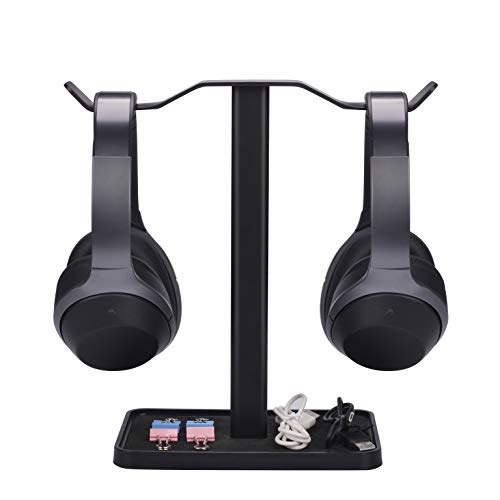
The Avantree Neetto HS908 is the pick for a desk where two headsets live side by side, because it is the only stand in this roundup built around two hangers instead of one. The contoured hanger is shaped to carry two or more headphones at once, which suits a desk shared between a work headset and a gaming headset, or a household where two players share one setup. The two hangers sit on a single metal base, so the desk space used is barely more than a single wide stand, and the published height of about 10.6 inches gives each headset room to hang clear of the tray below. That tray is a practical part of the design rather than decoration: its EVA foam surface holds small desk items such as binder clips, cards or a cable adapter, so the base earns its footprint twice over.
The construction mixes ABS with galvanized sheet metal and aluminum alloy, and the published dimensions are 6.69 by 4.33 by 10.63 inches with a weight of 1.21 pounds. The metal inside the base gives the stand the mass it needs to stay steady with two headsets hanging from it, while the ABS cover keeps the exterior smooth and easy to wipe. The hanger itself is a long contoured bar with two curved grooves, one for each headset, so the headbands rest in defined positions instead of sliding together toward the middle. That detail matters on a shared desk, because two headsets on one straight bar tend to bunch up and press their ear cups together, which wears the cushion edges and makes one headset hard to lift without disturbing the other.
The HS908 asks for the widest patch of desk in this roundup, and that is its main limitation. A desk with only a coaster-sized free patch cannot fit it, and a single-headset household gains nothing from the second hanger. There is also no charging of any kind in the stand, which keeps the scope of this roundup intact but means a controller or a phone still needs its own charger elsewhere on the desk. Within its lane, though, the HS908 is the most desk-efficient way to store two headsets, and it costs less desk space than two separate single stands while keeping both headsets visible, reachable and off the work surface.
Specs
- Brand and model: Avantree Neetto HS908 Dual Headphone Stand
- Model number: HDTB-HS908-BLK-2019
- Material: ABS, galvanized sheet metal and aluminum alloy
- Product dimensions: 6.69 x 4.33 x 10.63 inches
- Weight: 1.21 pounds
- Capacity: 2 or more headphones
- Hanger: Contoured dual hanger with two curved grooves
- Base: Metal-weighted base with an EVA foam storage tray surface
- Assembly: Tool-free
- Charging ports: None
4. GEVO Walnut Headphone Stand
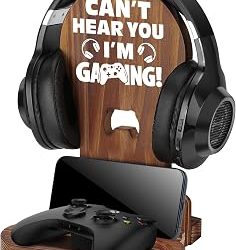
The GEVO walnut stand is the pick for a desk where the stand is part of the room’s look, because it is built from walnut wood rather than metal or plastic. The wood gives the stand a furniture feel that suits a desk with wooden shelves, a warm lamp and a setup that doubles as a living space, and the storage base underneath the headset adds a practical reason to choose wood over a plain post. The base holds small desk items within reach, so the stand functions as a small organizer as well as a headset rest, and the walnut grain makes each stand look a little different from the next, which is part of the appeal of a natural material.
Compatibility is universal by design. The listing names AirPods Max, Bose, Razer, Sennheiser, Jabra, JBL and AKG headsets among the models the stand fits, and the open cradle accepts over-ear headsets of most sizes without adjustment. The stand holds one headset, and the curved top rest supports the headband across a broad arc rather than a narrow point, which is the same headband care principle that guides the other picks in this roundup. The wood construction is solid rather than a veneer over plastic, so the stand has the mass to stay put when the headset is lifted off, and the base is wide enough to keep the stand stable on a flat desk surface.
The limits of a wood stand are the limits of wood itself. It should live on a dry desk away from drinks, and it benefits from an occasional wipe to keep dust out of the grain. The published dimensions were not stated in the listing data reviewed, so the desk space it needs should be confirmed against the listing before ordering, and a desk with only a small free patch may suit the compact New Bee stand better. There are no ports, no lights and no second hanger, so the GEVO stand is a single-headset, single-purpose piece. For a desk where the headset stand is visible from across the room and the setup leans warm rather than industrial, that single purpose is exactly the point, and the walnut build is the most considered-looking pick in this roundup.
Specs
- Brand and model: GEVO Walnut Headphone Stand
- Material: Walnut wood with a storage base
- Capacity: 1 over-ear headset
- Cradle: Curved top rest for the headband
- Base: Storage base for small desk items
- Compatibility: AirPods Max, Bose, Razer, Sennheiser, Jabra, JBL, AKG and other over-ear headsets
- Product dimensions: Not stated in the listing data reviewed
- Charging ports: None
5. New Bee Headphone Stand Z1, Black
The New Bee Z1 is the budget pick and the most compact stand in this roundup, and those two facts are related. The stand is a slim aluminum supporting bar on a solid ABS base, topped with a flexible TPU headrest that bends to the shape of the headband instead of forcing the band into a fixed curve. That flexible top is the stand’s best feature: it spreads the headband load across a wide arc, which is kinder to padding than a hard narrow rest, and it adapts to headsets of different widths without any adjustment. The published height is about 8.85 inches and the base measures about 3.7 by 3.7 inches, so the stand occupies a patch of desk roughly the size of a coaster, and the whole stand weighs about 3.6 ounces, which makes it the easiest pick here to move between desks or to pack away.
The compact size has a trade-off that the listing itself states plainly. The stand needs a flat, dust-free desk surface for best stability, because a light stand on a small base relies on the desk being level and clean rather than on mass. On a glass desk or a desk with a textured surface, the stand is less planted than a heavier steel or wood stand, and a heavy headset pulled off at an angle can rock it. The assembly is a three-piece, tool-free build, so the stand comes apart for storage and goes back together in moments, which suits a desk that is rearranged often or a headset that travels between a desk and a living room setup.
Compatibility covers headphones of all sizes, and the listing names Sennheiser, Sony, AKG, HyperX and Astro models among the headsets the stand fits. There is no charging, no lighting and no storage tray, and the plain Z1 in this listing should not be confused with the RGB charging version of the same brand’s stand, which adds ports and lights and belongs to the charging-stand class this roundup excludes. For a first stand, a second stand for a shared desk, or a desk where space is the scarcest resource, the Z1 is the honest baseline: it holds one headset, protects the headband, takes up almost no desk, and asks for nothing in return beyond a flat patch of surface.
Specs
- Brand and model: New Bee Headphone Stand Z1, Black
- Model number: Z1
- Material: Aluminum supporting bar with TPU rubber headrest and ABS solid base
- Height: About 8.85 inches
- Footprint: About 3.7 x 3.7 inches
- Weight: About 3.6 ounces
- Capacity: 1 headset of most sizes
- Cradle: Flexible TPU headrest that adapts to the headband
- Assembly: 3-piece, tool-free
- Compatibility: Sennheiser, Sony, AKG, HyperX, Astro and other over-ear headsets
- Charging ports: None
Before You Order: Fit, Stability and Recall Checks
Confirm the headset fit before anything else. Measure the depth of the ear cups and the width of the headband, then compare those numbers with the stand height and the cradle shape. A headset with deep ear cups needs a taller stand so the cups hang clear of the desk, and a headset with a wide, flat headband needs a wide cradle rather than a narrow one. The Kanto H1 suits the widest and heaviest headsets in this roundup, the Lamicall and GEVO stands suit most mainstream gaming headsets, and the compact New Bee Z1 suits lighter headsets where desk space matters more than load capacity. If the headset is a VR headset rather than a gaming headset, none of these stands is the right pick, because a VR headset is bulkier and heavier and needs a stand shaped for its visor and strap.
Then check the desk itself. A stand needs a flat, level patch of surface at least as large as its base, and a desk with a raised edge, a cable tray or a monitor arm base in that spot will fight the stand for the same space. The New Bee Z1 is the most demanding about surface condition, because its light build relies on a flat, dust-free patch for stability, while the steel Kanto H1 and the walnut GEVO stand are the most forgiving, because their mass keeps them planted on a wider range of surfaces. Put the stand where the headset is actually reached for, which is usually beside the monitor on the dominant-hand side, and leave enough clearance above it for the headset to be lifted straight up without hitting a shelf.
Check the exact model against the maker’s listing and the regulator databases before ordering, the same habit that applies to any desk accessory. None of the five stands in this roundup appears in a recall notice in the searches checked for this article, and passive stands as a class have a clean record, because they contain no wiring, no battery and no heating element. The nearest recalls in the wider stand space are a different class entirely: accent tables with built-in charging receptacles recalled over a wiring fault that could give a shock, and a wireless charging stand recalled over a shock and fire risk. Both are named here only as a reminder that the risk in stands lives in the powered parts, which is one more reason this roundup sticks to passive stands, and that the thirty seconds spent checking saferproducts.gov for the exact model you are about to buy is always worth it.
Finally, treat the stand as part of the headset’s care routine rather than as a piece of decoration. Wipe the cradle now and then so dust does not grind into the headband padding, keep the stand away from the edge of the desk where a cable tug can pull it down, and route the headset cable so it hangs down the side of the stand instead of pooling across the mouse area. A headset that is put back on its stand after every session stays cleaner, keeps its padding even and lasts longer than one that is set down wherever the session ended, and the stand repays its desk space many times over in the life of the headset it holds.
Frequently Asked Questions
Do gaming headset stands fit all headsets?
They fit most over-ear and on-ear gaming headsets, with two conditions. The stand must be tall enough for the ear cups to hang clear of the desk, and the cradle must be wide enough for the headband. The stands in this roundup cover those conditions for mainstream gaming headsets, with the Kanto H1 rated for the heaviest models and the Avantree HS908 covering two headsets at once. VR headsets, very wide audiophile headbands and headsets with unusually deep ear cups should be measured against the stand’s published height and cradle shape before ordering.
Is a headset stand better than an under-desk hook?
It depends on the desk. A stand keeps the headset visible and reachable on the desk surface, and it suits a desk with a free patch of surface. A hook saves desk space by moving the headset under the desk or onto a wall, and it suits a desk with no free surface at all. A stand is also kinder to the headband in most cases, because its cradle spreads the load across a wide arc, while a hook presses the band against a narrower edge. If desk space is the scarcest resource, a hook wins; if reach and headband care matter more, a stand wins.
Will a stand damage my headset’s headband?
A stand with a wide, curved, soft-lined cradle should not damage a headband, and it protects the padding better than leaving the headset flat on a desk or hanging it from a narrow hook. Damage comes from a narrow or hard contact point that concentrates the headset’s weight on one line of the band, which is why the cradle shape is the first thing to check. The Lamicall, Kanto and New Bee stands in this roundup all use a curved, soft contact surface for exactly that reason, and a headset that is lifted straight up and set down gently will show no wear from the stand itself.
Do I need a stand with USB charging?
Not for storage. A passive stand holds the headset, protects the headband and keeps the desk tidy, and it needs no power, no cable and no driver. A charging stand adds convenience for topping up a controller or a phone, but it also adds wiring, a power adapter and a failure point, and it belongs to a different class of product with its own roundup on this site. If the desk already has a charger for the controller and the phone, a passive stand is the simpler and more reliable choice, and every pick in this roundup is passive by design.
Conclusion
A gaming headset stand is a small purchase that pays for itself in the life of the headset it holds. Start with the Lamicall stand if you want the best all-round pick for a single headset, with its aluminum frame, curved cradle and low center of gravity. Choose the Kanto H1 when the headset is heavy and deserves a solid steel frame rated well above its weight, or the Avantree Neetto HS908 when two headsets share one desk and a dual hanger with a storage tray saves the most space. The GEVO walnut stand is the pick for a warm wood setup where the stand is part of the room, and the New Bee Z1 is the compact budget pick for a desk where space is the scarcest resource. Whichever you pick, confirm the fit, the desk space and the exact model first, and the headset will have a home that keeps its headband even, its ear cups clean and its cable out of the way for years.
Product and ASIN Reference
| Product | ASIN |
|---|---|
| Lamicall Headphone Stand, Black | B07ZYTS86X |
| Kanto H1 Headphone Stand, Black | B07XF1VC91 |
| Avantree Neetto HS908 Dual Headphone Stand | B07LGY5RSG |
| GEVO Walnut Headphone Stand | B0FQHRK7QP |
| New Bee Headphone Stand Z1, Black | B01GJQ7N94 |
More from Amazon
Programs that pair well with the guide above. Offers and eligibility are set by Amazon and may change.
Free shipping on eligible items, Prime Video and more. Eligible new members can start with a free trial.
Start a Prime free trialAd-free music streaming. Eligible new subscribers can start with a free trial.
Try Music Unlimited freeA Prime membership for ages 18-24 with a trial period. Eligibility is set by Amazon.
See Prime for Young AdultsAudiobooks and podcasts to listen to on the go. Eligible new members can start with a free trial.
Try Audible freeAs an Amazon Associate we earn from qualifying purchases.