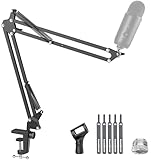
Key takeaways
- Payload range: A useful adjustable arm should state both a minimum and maximum load, not just “heavy duty.” For typical desktop microphones, a practical range is about 0.5 to 4 pounds. Larger studio or lighting arms may support considerably more, but they also need a heavier base.
- Reach: A desk arm may extend 24 to 36 inches. A studio cross arm can reach roughly 37 to 91 inches, depending on its adjustment. More reach increases leverage and stability requirements.
- Mounting method: Desk clamps are convenient but have limits. A C-stand receiver, baby pin, or heavy tripod base is more appropriate for lights and cameras.
- Adjustment hardware: Smooth, accessible knobs are preferable to a tension system that requires tools every time the payload changes.
What's inside
The Short Answer
Yes—spring tension adjustment is worth paying for if you regularly reposition a microphone, camera, light, or other load on a boom arm. The one condition is that the arm must carry changing loads or stay extended over a desk, set, or subject; for a nearly permanent setup with one lightweight device, a fixed-tension or friction-only arm is usually the better value.
A tension-adjustable arm is not automatically stronger, smoother, or safer. Its main advantage is control. You can compensate for a heavier microphone, a shock mount, a pop filter, a camera, or a small LED fixture without accepting a boom that slowly drops, snaps upward, or becomes difficult to move.
As an Amazon Associate we earn from qualifying purchases at no extra cost to you. Product prices and availability are accurate as of the date shown and are subject to change.

What You Actually Get
In practical terms, spring tension adjustment gives you a way to tune the arm’s counterbalance. Most adjustable arms use internal springs, external springs, friction joints, or a combination of those systems. A knob, bolt, or dial changes the resistance at one or more pivot points. More tension helps support a heavier payload; less tension makes a lighter payload easier to position.
That adjustment matters because the advertised load capacity is only part of the story. A microphone that weighs 1 pound may become a 2- to 3-pound load after adding a shock mount, cable, pop filter, adapter, and small accessory. A camera or light can also exert more leverage when it is mounted at the end of a long arm. A 2-pound load extended 30 inches from a pivot is substantially more demanding than the same load positioned close to the stand.
Look for four specifications before paying extra:
- Payload range: A useful adjustable arm should state both a minimum and maximum load, not just “heavy duty.” For typical desktop microphones, a practical range is about 0.5 to 4 pounds. Larger studio or lighting arms may support considerably more, but they also need a heavier base.
- Reach: A desk arm may extend 24 to 36 inches. A studio cross arm can reach roughly 37 to 91 inches, depending on its adjustment. More reach increases leverage and stability requirements.
- Mounting method: Desk clamps are convenient but have limits. A C-stand receiver, baby pin, or heavy tripod base is more appropriate for lights and cameras.
- Adjustment hardware: Smooth, accessible knobs are preferable to a tension system that requires tools every time the payload changes.
The AMBITFUL MF-01 illustrates an important distinction. It is a metal cross arm for a C-stand, listed at $85.49, with an adjustable length of approximately 94 to 232 centimeters, or about 37 to 91 inches. That is a positioning arm for studio equipment, not necessarily a microphone boom with a built-in spring-tension dial. Its long steel construction can be useful for lights or overhead equipment, but you should not assume that a long cross arm offers the same counterbalance behavior as a spring-loaded broadcast boom.
Also budget for the support system. A long arm carrying a light may need a C-stand weighing around 15 to 25 pounds, a properly tightened grip head, and a sandbag weighing 15 to 25 pounds. The arm itself can be inexpensive while the safe supporting hardware costs more than the arm.
Pros
- Better control across different payloads. You can move from a 1-pound microphone to a 3-pound microphone-and-accessory setup without replacing the arm.
- Less unwanted movement. Correct tension reduces sudden drops, upward snaps, and creeping after you release the arm.
- More useful reach. Long arms are easier to use when their resistance can be matched to the load and extension distance.
- Improved workflow. A podcaster can move the microphone out of the way between recordings, while a photographer can reposition a light without repeatedly tightening every joint.
- Longer usable life. An adjustable arm can remain useful when your equipment changes, whereas a fixed arm may become unsuitable after one upgrade.
- Potentially better cable management. Many better-designed microphone arms combine tension control with internal or guided cable routing, reducing snags when the boom moves.
Cons
- Higher price. A basic friction arm may cost $25 to $60, while a smoother adjustable model commonly costs $70 to $180. Heavy studio versions can cost $200 or more before the stand and grip hardware.
- More setup time. The arm may need several small adjustments before it balances correctly. A spring that is too tight can make a light microphone difficult to lower.
- More parts to wear. Springs, pivot bushings, knobs, and threads can loosen or lose smoothness. Friction-only arms have fewer specialized components.
- Capacity can be misunderstood. A manufacturer’s maximum load may assume the arm is short, nearly horizontal, or mounted to a very stable base. Full extension can reduce practical stability.
- Adjustment does not fix a weak base. No tension dial can make an undersized desk clamp, lightweight tripod, or poorly weighted C-stand safe for a long, heavy load.
- Some models are noisy. Exposed springs and stiff joints can produce clicks or squeaks, which is inconvenient for recording environments.
Who Should Buy It
Pay for spring tension adjustment if you record several times per week, change equipment often, or need the arm to move while remaining stable. It is especially worthwhile for broadcasters, podcasters, voice-over artists, streamers, photographers, and small video crews.
It also makes sense when the total payload is near the middle or upper portion of an arm’s stated range. For example, a 2.5-pound microphone package on a 30-inch boom benefits more from adjustable tension than a bare 10-ounce microphone mounted close to the pivot.
Choose an adjustable model when more than one person uses the setup. Different users may prefer different microphone heights and angles, and a properly tuned arm is easier to share. The feature is also valuable in a permanent studio where you occasionally move a light from a key-light position to an overhead or side position.
Who Should Skip It
Skip the upgrade if you use one lightweight microphone, keep it in one position, and already have a stable arm that does not sag. A $30 to $60 fixed or friction arm may perform just as well for a simple desk setup.
It is also reasonable to skip adjustable spring tension if your equipment is mounted on a fixed stand and adjusted only once per month. In that situation, spending on a sturdier base, better cable routing, or a quality shock mount may produce a more noticeable improvement.
Do not choose a tension-adjustable desktop arm for a long, heavy lighting setup merely because the feature sounds professional. A 5-pound light at the end of a 6-foot arm requires appropriate C-stand hardware, counterweighting, and safe operating habits. For that use, a steel cross arm such as the approximately 37- to 91-inch AMBITFUL MF-01 may be more relevant than a compact microphone boom, but only when paired with a suitable C-stand and grip head.
Cheaper Alternatives
| Option | Cost | Trade-off |
|---|---|---|
| Basic friction microphone arm | $25-$60 | Lowest cost, but it may sag with heavier microphones and offers less precise movement. |
| Fixed spring microphone arm | $40-$90 | Often smoother than a basic friction arm, but its preset tension may not suit very light or heavy loads. |
| Adjustable microphone boom | $70-$180 | Best balance for changing payloads, though adjustment knobs and springs add cost and maintenance. |
| Heavy desk clamp with extension arm | $60-$140 | Can support more weight than a low-cost arm, but it may occupy more desk space and still lack true counterbalance. |
| C-stand cross arm | $75-$150 | Useful for lights and cameras over a wider area, but it needs a heavy stand, grip head, and often a sandbag; it is not a plug-and-play desk boom. |
FAQ
Is spring tension adjustment the same as load capacity?
No. Load capacity describes how much weight the arm is designed to hold under specified conditions. Spring tension adjustment helps the arm balance that weight. A higher-capacity arm may still sag if it is extended too far, mounted poorly, or loaded beyond the manufacturer’s recommended position.
How much tension should a boom arm have?
Set it so the arm stays at the chosen height when released but can still be moved with one hand. Start with the lowest setting that prevents sagging, then increase tension in small steps. If the arm rises on its own or requires excessive force to lower, the tension is too high for the current load.
Is a long studio arm better than a desktop microphone boom?
Not automatically. A long studio arm provides more reach, but it needs a heavier support system and creates more leverage at the base. A desktop boom is faster to install and better for a microphone within roughly 24 to 36 inches of a desk edge. Choose based on reach, payload, and mounting hardware rather than length alone.
What is the smartest place to spend extra money?
For a changing microphone setup, spend on smooth tension adjustment and a strong clamp. For lights or cameras, prioritize the stand, grip head, locking hardware, and counterweight before paying for a sophisticated arm. In either case, a stable base and correctly balanced load matter more than a feature-rich adjustment dial.