Key takeaways
- It saves visual space. A low profile arm stays below or beside a monitor rather than creating a tall structure in your camera frame.
- It clears the desktop. Removing a tripod or desktop microphone stand can free roughly 6 to 12 inches of valuable workspace, depending on the stand.
- It is easier to position for speech. You can bring the microphone close to your mouth—often within 4 to 8 inches—without placing a stand directly in front of your keyboard.
- It makes microphone technique more consistent. Keeping the mic at a repeatable distance can produce more even volume than leaning toward a microphone on a desk.
- It can improve camera framing. A correctly positioned arm keeps the microphone available without covering your face, monitor, or most of the work surface.
- It offers flexible movement. Swiveling the arm 90 to 180 degrees can move it out of the way when you are writing, eating, or using the desk for another purpose.
- It often includes basic cable management. Clips or channels can route a USB or XLR cable along the arm, reducing loose cable clutter.
What's inside
The Short Answer
Yes—a low profile boom arm is worth the extra money if you use a microphone regularly and need a clean, unobstructed desk. The one condition is that your microphone, shock mount, and accessories must fall within the arm’s weight capacity and reach; otherwise, a cheaper standard arm or desktop stand will do the job just as well.
The price difference is often modest. A basic low-profile arm may cost about $25 to $35, while a sturdier model with smoother joints, better cable management, and more reliable positioning may cost $45 to $80. That extra money is not buying better audio by itself. It is buying a better way to place, move, and live with your microphone.
As an Amazon Associate we earn from qualifying purchases at no extra cost to you. Product prices and availability are accurate as of the date shown and are subject to change.


What You Actually Get
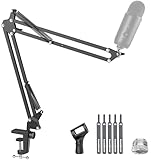
A low profile boom arm mounts to the rear or side of a desk and keeps the microphone closer to the desktop than a traditional broadcast arm. Instead of rising high above your monitor, it generally extends horizontally at desk level, then angles upward toward your mouth. This makes it useful for video calls, podcasting, streaming, voice-over work, and gaming setups where screen visibility matters.
Most models use a clamp rather than a permanent screw-through installation. Check the stated desk range before buying: many clamps fit surfaces roughly 0.8 to 2.4 inches thick, although the exact range varies. A reinforced clamp is preferable for a heavy microphone because it spreads pressure over more of the desk and reduces twisting.
Reach is equally important. Many low-profile arms provide about 15 to 20 inches of horizontal extension, with 360-degree rotation at one or more joints. That is usually enough for a microphone to come from the back corner of a desk and sit 4 to 8 inches from your mouth. A very deep desk, a wall-mounted monitor, or a keyboard tray may require a longer arm.
The arm itself typically weighs between 2 and 4 pounds. Weight capacity is often listed around 2 to 4.4 pounds, but you must count the microphone, shock mount, pop filter, and any adapter together. A 2.5-pound microphone can exceed the practical limit once accessories are attached. An arm that is technically compatible may still sag if it is operating at the edge of its rating.
For example, the InnoGear Low Profile Mic Arm Boom Arm Desk Mount is listed at $49.99, while the InnoGear Mic Arm Low Profile 360° Flex model is listed at $25.19. The gap is large enough to matter, but the less expensive arm may be perfectly adequate for a lightweight USB microphone. The more expensive choice makes more sense when stability, adjustment, and long-term desk use are priorities.
Pros
- It saves visual space. A low profile arm stays below or beside a monitor rather than creating a tall structure in your camera frame.
- It clears the desktop. Removing a tripod or desktop microphone stand can free roughly 6 to 12 inches of valuable workspace, depending on the stand.
- It is easier to position for speech. You can bring the microphone close to your mouth—often within 4 to 8 inches—without placing a stand directly in front of your keyboard.
- It makes microphone technique more consistent. Keeping the mic at a repeatable distance can produce more even volume than leaning toward a microphone on a desk.
- It can improve camera framing. A correctly positioned arm keeps the microphone available without covering your face, monitor, or most of the work surface.
- It offers flexible movement. Swiveling the arm 90 to 180 degrees can move it out of the way when you are writing, eating, or using the desk for another purpose.
- It often includes basic cable management. Clips or channels can route a USB or XLR cable along the arm, reducing loose cable clutter.
Cons
- The cheapest models can sag. Spring tension, joint friction, and clamp strength vary widely. A heavy microphone may slowly drop after adjustment.
- Desk vibration can still travel into the microphone. Typing, bumping the desktop, or moving a monitor can create noise unless the setup includes a shock mount and sensible cable slack.
- Low profile does not mean tiny. The joints and clamp still occupy space, and an arm with a 15- to 20-inch reach may not work well on a narrow desk.
- Cable management is rarely perfect. Clips can hold a cable in place, but they may not hide it completely. XLR cables with large connectors can also be difficult to route.
- Clamp placement is limited. Desks with thick lips, built-in drawers, glass tops, or rear cable trays may not provide a suitable mounting point.
- It is not an audio upgrade on its own. A boom arm does not reduce room echo, improve the microphone capsule, or replace acoustic treatment.
- Installation takes more effort than a desktop stand. You must tighten the clamp, balance the arm, route the cable, and occasionally readjust the joints.
Who Should Buy It
Buy a low profile boom arm if you use a microphone several times a week and want the desk to serve more than one purpose. It is particularly useful for streamers, remote workers, podcasters, and gamers who alternate between speaking and typing. It is also a strong choice for smaller desks where a desktop stand would consume too much surface area.
Choose the more expensive option when your microphone and accessories weigh close to 3 pounds, when you adjust the mic repeatedly during the day, or when you care about smooth movement and a less cluttered appearance. Spending $45 to $80 is easier to justify if replacing a sagging arm would be inconvenient.
Before buying, measure three things: desk thickness, the distance from the mounting point to your speaking position, and the combined weight of the microphone assembly. Leave some capacity in reserve rather than shopping at the absolute maximum rating.
Who Should Skip It
Skip a boom arm if you only make occasional calls and have enough room for a small desktop stand. A $15 to $30 stand can be simpler, quieter to reposition, and easier to remove when the desk is needed for other work.
You should also skip a low profile model if your desk cannot accept a clamp, your microphone is unusually heavy, or you need the microphone to reach more than about 20 inches. In those cases, a reinforced broadcast arm, a floor stand, or a properly mounted wall arm may be a better fit.
Cheaper Alternatives
| Option | Cost | Trade-off |
|---|---|---|
| Basic desktop microphone stand | $15–$30 | Lowest cost and easy to install, but it uses desk space and is more exposed to typing vibrations. |
| InnoGear Low Profile 360° Flex arm | $25.19 | Affordable way to get low-profile positioning, though budget joints and clamp hardware may offer less reserve for heavy microphones. |
| Standard scissor boom arm | $20–$40 | Often offers more vertical reach, but it can block a monitor, appear in a camera shot, and occupy more visual space. |
| InnoGear Low Profile desk-mount arm | $49.99 | Costs more than entry-level arms, but is the more sensible upgrade when stability, positioning, and a cleaner setup matter. |
| DIY shelf or clamp-mounted microphone holder | $10–$25 | Can be inexpensive and discreet, but it offers less adjustment and may not safely support a heavy microphone. |
FAQ
Does a low profile boom arm improve sound quality?
Not directly. Sound quality depends mainly on the microphone, room acoustics, placement, gain, and processing. The arm can indirectly improve results by keeping the microphone consistently close to your mouth and reducing awkward positioning. It cannot eliminate echo or background noise by itself.
How much should I spend on a low profile microphone arm?
Plan on $25 to $40 for a basic arm and $45 to $80 for a sturdier model. The lower range is appropriate for a light USB microphone used occasionally. Spend more when the microphone is heavy, the arm will be adjusted frequently, or you need dependable positioning for daily calls and recordings.
Is a low profile arm better than a regular boom arm?
It is better for a clean, low visual profile and for desks with monitors or cameras directly behind the microphone. A regular boom arm may be better if you need greater vertical adjustment, a longer reach, or a microphone positioned above the desk. The best design depends on your layout, not on the label alone.
What should I check before ordering?
Confirm the clamp fits your desk, measure the required reach, and compare the arm’s weight capacity with the complete microphone assembly. Also check whether the joints rotate enough for your preferred position, whether the clamp can clear cable trays, and whether the included cable clips fit your cable. Those details matter more than a small price difference.