Key takeaways
- Table of Contents 7 sections 10 min read 1 Quick Verdict 2 Side by Side 3 Where Desk Clamp Wins 4 Where Heavy Desktop Base Mic Stand Streaming Wins 5 Cost Over 5 Years 6 Which One for Your Home…
What's inside
Choosing between a desk clamp and a heavy desktop base mic stand for streaming is less about which design is universally better and more about how your room, desk, and recording habits work together. A clamp frees valuable desktop space and can put the microphone exactly where you want it, but it needs a compatible, sturdy mounting surface. A weighted base is easier to set up and move, though it occupies part of your work area and may be more visible on camera.
The real decision is whether you want the microphone attached to the desk or sitting on it. Consider your desk thickness, available depth, microphone weight, cable routing, household traffic, and whether you need to fold the setup away after each stream. The best choice for a permanent streaming station may be inconvenient in a shared room, while the most portable option may sacrifice some reach and stability.
As an Amazon Associate we earn from qualifying purchases at no extra cost to you. Product prices and availability are accurate as of the date shown and are subject to change.


Quick Verdict
Choose a desk clamp if you have a solid desk edge about 0.5 to 2.5 inches thick, want maximum usable surface area, and plan to keep a boom arm installed. It is usually the cleaner option for keyboards, mixers, notebooks, and compact desks. A quality clamp can support a microphone arm without adding a large footprint to the desktop.
Choose a heavy desktop base mic stand if you frequently move your microphone, use a folding table or unusually shaped desk, rent a furnished space, or want a setup that requires no permanent attachment. A weighted base is also more forgiving when your desk edge is inaccessible or too delicate for a clamp.
For most fixed home streaming stations, the clamp wins on space and positioning. For flexible rooms and shared homes, the heavy base wins on convenience and portability.
Side by Side
| Consideration | Desk clamp | Heavy desktop base |
|---|---|---|
| Comfort | Places the microphone close to your mouth while keeping the desk clear; arm adjustment may require two hands. | Simple to reposition, but the base can crowd your keyboard, mouse, or monitor stand. |
| Durability | Strong when tightened to a rigid desk; vulnerable to damage from overtightening or a weak desktop edge. | Generally dependable on a flat surface; felt or rubber feet may wear over time. |
| Price range | About $9 to $60 for a clamp or clamp-mounted arm, with premium articulated arms costing more. | About $20 to $80, depending on base weight, arm length, and construction. |
| Maintenance | Check the screw, pads, and joints periodically; cable management usually stays installed. | Wipe dust from the base and tighten arm joints; moving it often may require rerouting the cable. |
| Space needed | Typically uses only 2 to 4 inches of desk edge and little top-surface area. | Often needs a base roughly 6 to 10 inches wide or deep, plus room for the arm. |
| Look | Clean and streamlined, especially when the arm swings out of frame. | More traditional and visible; can look substantial or deliberately studio-like. |
| Resale | Easy to sell if it uses common 3/8-inch or 5/8-inch threads and includes its hardware. | Also broadly reusable, though a heavy base costs more to ship. |
| Best for | Permanent streaming desks, small workstations, and users who need maximum reach. | Shared rooms, portable setups, renters, and users who reposition a microphone often. |
Where Desk Clamp Wins
The biggest advantage is reclaimed desktop space. A clamp attaches below or at the back edge, leaving the surface available for a keyboard, audio interface, water bottle, or notes. This matters on desks under 48 inches wide, where a 7-inch weighted base can consume a meaningful portion of the usable area.
Clamps also provide better microphone placement for streaming. A boom arm can approach from the side, swing over a monitor, or move away when you are not speaking. Keeping the microphone 4 to 8 inches from your mouth can improve vocal consistency without forcing you to lean around a desktop stand. The arm can also place the microphone below eye level, which is useful when the camera frame includes your face and upper torso.
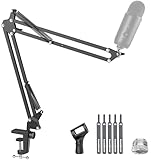
A clamp-mounted system is often easier to keep tidy. The microphone cable can follow the arm instead of crossing the desktop, and the assembly can fold toward the rear of the desk between sessions. Basic metal clamps are inexpensive: the Zeromall Universal C-Clamp Aluminum Support Clamp, listed at $11.99 for a two-piece set, and the SUNMON metal desk clamp, listed at $8.99, illustrate the low entry price for clamp hardware. These products are useful reference points when comparing the cost of a full clamp-and-arm setup.
However, inspect the mounting surface before buying. A clamp is a poor match for glass, hollow-core furniture, very thin particleboard, beveled edges, or desks with a rear cable tray blocking the screw. Tighten only until secure; excessive force can dent a laminate top or split an MDF edge. A protective pad or separate reinforcement plate can spread pressure across the underside.
Where Heavy Desktop Base Mic Stand Streaming Wins
A heavy base is the more flexible choice when the desk cannot accept a clamp. You can place it on a kitchen table, a folding table, a corner desk, or a temporary streaming surface without checking edge thickness. Setup is usually as simple as attaching the microphone, adjusting the clutch, and routing the cable.
Portability is another major benefit. If the desk serves as a work area during the day and a streaming station at night, a base can be lifted and stored in a closet. It is also useful for musicians who move between a desk, an amplifier, and a rehearsal space. The tradeoff is that the base must be heavy enough to resist tipping. A long boom arm and a large microphone create leverage, so a compact base may be stable only when the arm stays close to its center.
Expect a base to weigh roughly 2 to 6 pounds for a substantial home model, while a clamp and arm may weigh about 1.5 to 4 pounds. Weight alone is not everything: rubber feet, base diameter, arm length, and the microphone’s center of gravity all affect stability. The FIFINE BS1 Heavy-Duty Adjustable Desktop Mic Stand is listed at $29.99, as is the InnoGear Adjustable Desk Microphone Stand with a weighted base and 3/8-inch and 5/8-inch mounts. Those prices show that a usable heavy-base setup does not necessarily cost more than a basic boom-arm system.
A base may also be quieter on delicate furniture because it does not apply clamping pressure. Still, sliding it across a wood or laminate surface can cause scratches, so lift rather than drag it. Soft feet can collect dust and should be checked periodically.
Cost Over 5 Years
Initial price is only part of the calculation. A basic clamp can cost $9 to $25, while a clamp with a capable boom arm commonly lands between $25 and $100. A heavy desktop stand generally costs $20 to $80. For occasional users, either option can last five years with routine tightening and careful storage.
Over five years, a clamp setup may have lower replacement costs because the base itself has fewer moving parts. You might replace a worn pad, screw, or thread adapter for $5 to $15. A desktop base may need replacement feet, clutch hardware, or an entire stand if the arm loosens, typically costing $10 to $40. Frequent moving can also increase cable wear in either configuration.
There is no meaningful power or wattage difference: passive microphone stands do not consume electricity. Budget instead for accessories such as a pop filter, shock mount, or a 3/8-inch-to-5/8-inch adapter. If the microphone and arm together weigh 3 pounds, select hardware rated comfortably above that load rather than relying on the maximum rating at full extension.
Which One for Your Home
Small apartment
Pick a desk clamp if your desk is sturdy and positioned against a wall. The compact mounting footprint preserves floor and desktop space, and the arm can fold out of the way. Choose a heavy base instead if your only usable surface is a narrow console or a table that cannot be clamped securely.
Family with kids or pets
A clamp is usually safer from accidental bumps because it is attached to the desk and keeps fewer objects on the surface. Route the cable along the arm and secure loose sections. If children regularly use the desk, a heavy base may be preferable only when it can sit well away from the edge and the boom remains short.
Rental
Both choices are rental-friendly when used carefully. A base leaves no clamp marks and is easiest for a delicate or borrowed desk. A clamp can also work without damage if it has thick protective pads and is not overtightened. Check for scratches after removal, especially on veneer and soft wood.
Long-term home
For a permanent streaming or work-from-home station, choose a clamp with a replaceable pad, common thread sizes, and an arm that reaches at least 24 to 30 inches. It will keep the desk clearer and make microphone placement more repeatable. Choose a heavy base if you expect to redesign the room or use the microphone in several locations.
FAQ
Is a desk clamp more stable than a weighted base?
On a rigid desk, usually yes, because the clamp anchors the arm directly to the furniture. Stability depends on the edge, clamp pressure, arm extension, and microphone weight. A weighted base is stable when centered and properly sized, but a fully extended boom can make it tip.
Will a desk clamp fit every microphone?
The clamp supports the arm, not necessarily the microphone itself. Check whether the arm includes a 3/8-inch or 5/8-inch thread, then confirm your microphone or shock mount uses the same size or includes an adapter. Also verify the arm’s load rating.
Can I use a heavy desktop stand on a shallow desk?
Yes, but measure first. Allow approximately 6 to 10 inches for the base and additional clearance for the boom. On a shallow desk, keep the arm short and place the base behind the keyboard so it does not interfere with typing.
Which option is better for streaming in 2026?
For a dedicated, space-conscious station, a desk clamp is the stronger default. For a shared, temporary, or frequently rearranged setup, a heavy desktop base is easier to live with. The right choice is the one that stays stable, keeps the microphone close, and fits your room without creating daily setup friction.