Key takeaways
- Height: Corsair Vengeance low-profile sits around 34mm, clearing nearly every tower cooler; Trident Z5 stands roughly 44mm and can collide with a Noctua NH-D15.
- Profile support: Trident Z5 (Intel XMP 3.0) and Trident Z5 Neo (AMD EXPO) are sold as distinct SKUs; most Vengeance DDR5 kits carry both XMP and EXPO on one stick.
- Binning: G.Skill’s CL30 6000 kits use tighter-binned Hynix dies, which matters if you plan to manually tune subtimings.
- RGB: Trident Z5 RGB uses a wide diffuser bar that many builders prefer visually; Vengeance RGB is more restrained.
- Price: Vengeance kits typically undercut the equivalent Trident Z5 by a meaningful margin at the same speed grade.
- Capacity ceiling: Both scale to 64GB (2x32GB), but G.Skill’s 64GB EXPO kits at CL30 are the enthusiast favorite for editing rigs.
What's inside
Picking DDR5 memory in 2026 usually comes down to two heavyweights: Corsair’s Vengeance line and G.Skill’s Trident Z5 family. Both target the same sweet spot most gamers actually buy into, 32GB (2x16GB) kits running at 6000 MT/s with CL30 to CL36 timings, which is the tuned-for-AM5 range that keeps Ryzen’s Infinity Fabric happy. The difference between them is less about raw speed and more about heat spreader height, RGB behavior, and how aggressively each kit is binned.
This comparison focuses on the versions people cross-shop most: the low-profile Corsair Vengeance against the taller, flashier G.Skill Trident Z5 and Trident Z5 Neo. If you are building around a Ryzen 7 9800X3D or an Intel Core Ultra chip, the guidance below will help you decide which one belongs in your cart.
As an Amazon Associate we earn from qualifying purchases at no extra cost to you.


⚡ Save on Your Next PC — Amazon Prime
Prime members get fast free shipping on the systems above, plus early access to Prime Day & Black Friday PC deals. New members get a 30-day free trial.
Watch: Corsair Vengeance vs G.Skill Trident Z5 — Video Review
Quick Verdict
For AMD AM5 builds, the G.SKILL Trident Z5 Neo (the EXPO-optimized variant) is the smarter default because its timings are validated specifically for Ryzen, and CL30 kits at 6000 MT/s squeeze out a few extra frames in CPU-bound titles. For clearance-constrained builds with big air coolers, or anyone who just wants reliable plug-and-play memory at a lower price, Corsair Vengeance (especially the non-RGB low-profile version) is the safer, cheaper pick.
Key Differences
- Height: Corsair Vengeance low-profile sits around 34mm, clearing nearly every tower cooler; Trident Z5 stands roughly 44mm and can collide with a Noctua NH-D15.
- Profile support: Trident Z5 (Intel XMP 3.0) and Trident Z5 Neo (AMD EXPO) are sold as distinct SKUs; most Vengeance DDR5 kits carry both XMP and EXPO on one stick.
- Binning: G.Skill’s CL30 6000 kits use tighter-binned Hynix dies, which matters if you plan to manually tune subtimings.
- RGB: Trident Z5 RGB uses a wide diffuser bar that many builders prefer visually; Vengeance RGB is more restrained.
- Price: Vengeance kits typically undercut the equivalent Trident Z5 by a meaningful margin at the same speed grade.
- Capacity ceiling: Both scale to 64GB (2x32GB), but G.Skill’s 64GB EXPO kits at CL30 are the enthusiast favorite for editing rigs.
Corsair Vengeance
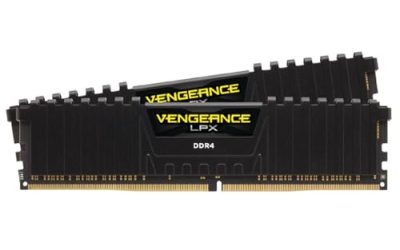
Corsair’s appeal is consistency. The Vengeance DDR5 lineup keeps heat spreaders low, ships with a single SPD profile that exposes both XMP and EXPO, and rarely fights with motherboard QVLs. On a mid-range B650 board, enabling the 6000 MT/s profile is a one-click affair, and stability at CL36 is dependable even on early BIOS revisions. The RGB RS and non-RGB versions give you a way to save money if lighting is not a priority.
Where Vengeance loses ground is manual tuning headroom. The dies are good, not exceptional, so hand-tuning subtimings yields smaller gains than you would get from a top Trident Z5 kit. For 90% of gamers who will never touch a timing beyond the profile, that trade-off is invisible, and the lower price is real money back in your pocket.
G.Skill Trident Z5
The Trident Z5 family is the tuner’s choice. The Neo variant is EXPO-first and validated on AMD, while the standard Z5 leans XMP for Intel platforms, and both use premium Hynix dies that respond well to tightening tCL, tRCD, and tRFC. A 32GB CL30 6000 kit here can shave loop times in memory-sensitive titles and holds a slight edge in 1% lows over a comparable CL36 Vengeance kit.
The cost is height and price. That 44mm heat spreader is genuinely tall, so verify cooler clearance before buying, and expect to pay a premium over Vengeance. If you are chasing every last frame on a 9800X3D or building a showcase rig where the wide RGB bar is part of the look, that premium is easy to justify.
Which Should You Buy?
- Buy Trident Z5 Neo if: you run AMD AM5 and want validated CL30 EXPO timings out of the box.
- Buy Trident Z5 (XMP) if: you are on Intel and plan to hand-tune for maximum bandwidth.
- Buy Corsair Vengeance if: you want the lowest reliable price at 6000 MT/s or need low-profile clearance under a big air cooler.
- Buy the 64GB EXPO kit if: you game and also edit video or run VMs and want capacity headroom.
- Skip RGB entirely if: your case has no window, and put the savings toward storage.
Frequently Asked Questions
Is CL30 really faster than CL36 in games?
Yes, but modestly. At the same 6000 MT/s, CL30 lowers latency enough to add a few frames and tighten 1% lows in CPU-bound titles like competitive shooters. In GPU-bound scenarios at 1440p or 4K, the difference is often within margin of error.
Will Trident Z5 fit under my air cooler?
Check clearance first. At about 44mm the RGB version can conflict with tall dual-tower coolers like the Noctua NH-D15. If your cooler’s fan sits low over the RAM slots, choose low-profile Vengeance instead.
Do I need XMP or EXPO for my platform?
Use EXPO on AMD AM5 and XMP on Intel. Many Corsair Vengeance kits include both profiles on one stick, while G.Skill often splits them into separate Neo (EXPO) and standard (XMP) SKUs, so match the SKU to your CPU.
Is 32GB enough for gaming in 2026?
For pure gaming, yes, 32GB is the comfortable standard. Step up to a 64GB kit only if you stream while gaming, run heavy multitasking, or edit video on the same machine.
Final Verdict
Both kits are excellent, so the decision hinges on your platform and priorities. Choose G.Skill Trident Z5 Neo for a Ryzen build where tight EXPO timings and tuning headroom matter, and choose Corsair Vengeance when value, low-profile clearance, and effortless stability lead your list. Either way, target 32GB at 6000 MT/s and you will have memory that never bottlenecks your 2026 gaming build.