Getting a great gaming picture out of a new TV rarely happens straight out of the box. Default settings are tuned for bright showroom floors, which means input lag, motion smoothing, and color processing are often working against you instead of for you. If your fast-paced shooters look smeared or your RPGs feel a frame behind your controller, the display’s settings menu is usually the culprit, not the hardware.
This guide breaks down the TVs worth building your setup around in 2026, the settings that actually matter for competitive and casual gaming alike, and how to match a panel to your console, PC, or hybrid setup. We’ve focused on models with real gaming credentials: high refresh rates, VRR support, HDMI 2.1, and dedicated game modes that keep latency low without sacrificing picture quality.
Our top picks
 TCL 55" T7 4K QLED Google TV
- 4K UltraHD Resolution: Experience incredible detail with 4X…
- QLED (Quantum Dot Technology): Rich, vibrant colors covering…
- 120Hz Panel Refresh Rate: Watch action-packed movies, fast-paced…
 iFFALCON 55" 4K MiniLED Smart TV
- [Silky 144Hz MiniLED picture with VRR up to…
- [Every major HDR format
- [4 × HDMI 2.1
| Product | Key specs | |
|---|---|---|
| TCL 55" T7 4K QLED Google TV | 4K UltraHD Resolution: Experience incredible detail with 4X… QLED (Quantum Dot Technology): Rich, vibrant colors covering… 120Hz Panel Refresh Rate: Watch action-packed movies, fast-paced… | Check price |
 Hisense 55" U7 Mini-LED ULED 4K UHD | Check price | |
| iFFALCON 55" 4K MiniLED Smart TV | [Silky 144Hz MiniLED picture with VRR up to… [Every major HDR format [4 × HDMI 2.1 | Check price |
 LG 65-Inch Class OLED evo AI 4K | OLED Technology: Celebrating 12 years of perfecting award-winning… Brightness Booster: Our Brightness Booster technology magnifies each… Bright Room Ready: Verified by UL for Discomfort… | Check price |
 Hisense 43" E6 Cinema Series Hi-QLED 4K | Experience a visual treat with Hi-QLED Color See every basket and goal in all its… The fusion of Dolby Vision HDR imaging and… | Check price |
 TCL 55-Inch Q65 QLED 4K UHD Smart | 4K UltraHD Resolution - Experience incredible detail with… Quantum Dot Technology - Rich, vibrant colors covering… High Brightness+ LED Backlight - Q6 models produce… | Check price |
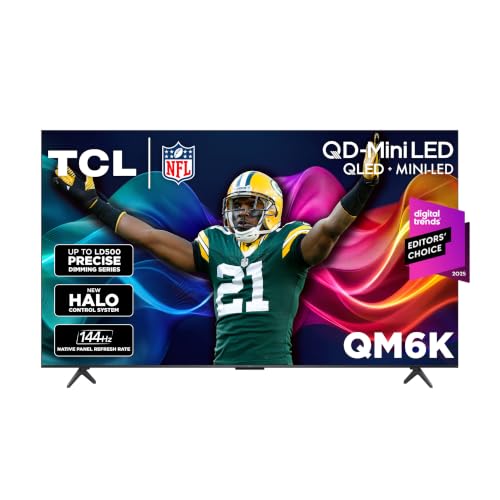 TCL 65 Inch Class QM6K Series | AFFORDABLE PREMIUM PERFORMANCE FOR SPORTS, GAMING & STREAMING QD-MINI LED BETTER BLACKS | Check price |
As an Amazon Associate we earn from qualifying purchases at no extra cost to you.
🎮 Get More From Your Setup — Free
Prime Gaming gives you free PC games every month, in-game loot, and a free Twitch channel sub — plus fast free shipping on all the gear above. New members get a 30-day free trial.
Watch: Best TV Settings For Gaming — Video Review
How to Choose a TV Settings For Gaming (2026)
- Refresh rate & VRR range: Look for at least 120Hz native refresh with variable refresh rate (VRR) support that spans your console or GPU’s output range to eliminate screen tearing.
- Input lag: Check for a dedicated “Game Mode” with sub-10ms input lag; this matters more for competitive titles than raw resolution.
- HDMI 2.1 ports: Confirm the TV has at least two full-bandwidth HDMI 2.1 ports if you’re running both a current-gen console and a PC.
- Panel type: OLED delivers the best contrast and response time, Mini-LED offers strong HDR brightness for well-lit rooms, and standard QLED/LED is the budget-friendly middle ground.
- Motion handling: Prioritize models with strong native motion clarity over ones that rely heavily on interpolation, which can add the “soap opera effect” and extra lag if not disabled.
The Best TV Settings For Gaming (2026)s Reviewed
Samsung 75″ U8000H Crystal UHD
A strong pick for anyone wanting a big-screen upgrade on a budget, the U8000H pairs Samsung’s Crystal Processor 4K upscaling with a dedicated game mode that keeps casual and story-driven titles looking sharp without a premium price tag.
TCL 55″ T7 4K QLED
The T7’s 144Hz panel and Google TV smarts make it a standout for hooking up a gaming PC, with smooth motion handling that also pulls double duty for sports viewing.
Hisense 55″ U7 Mini-LED (55U7SG)
This is the enthusiast’s choice on this list, combining native 165Hz refresh, VRR up to 330Hz, and Dolby Vision IQ with a 2.1.2 channel speaker system, making it one of the most complete gaming and home theater packages under premium OLED pricing.
iFFALCON 55″ 4K MiniLED (55U85)
Built specifically with PS5 and Xbox in mind, the U85 offers four full HDMI 2.1 ports and 144Hz VRR, a rare combination that lets multiple next-gen consoles run at full spec simultaneously.
LG 65″ OLED evo C5
The C5 remains the benchmark for response time and per-pixel contrast, and its AI-driven upscaling makes older titles look cleaner while Filmmaker Mode ensures cutscenes and cinematic games retain accurate color.
Frequently Asked Questions
What game mode setting should I use for competitive multiplayer?
Enable the TV’s dedicated Game Mode (sometimes labeled Game Mode Plus or similar) and disable motion smoothing features, which prioritizes low input lag over picture processing.
Does 4K resolution matter more than refresh rate for gaming?
For fast-paced games, refresh rate and VRR support generally matter more than resolution, since smooth, tear-free motion has a bigger impact on gameplay feel than extra pixel detail.
Is OLED or Mini-LED better for gaming?
OLED offers near-instant pixel response and perfect blacks, ideal for dark, fast-motion titles, while Mini-LED counters with higher peak brightness, making it a better fit for bright rooms and HDR-heavy games.
Do I need HDMI 2.1 for current-gen consoles?
Yes, HDMI 2.1 is required to unlock 4K at 120Hz and VRR on the PS5 and Xbox Series X, so confirm the TV has enough full-bandwidth 2.1 ports for all your devices.
Final Thoughts
For most gamers, the Hisense U7 Mini-LED delivers the best balance of refresh rate, HDR, and audio for the price, while the LG OLED C5 is the clear upgrade pick for anyone prioritizing picture quality above all else; budget-conscious buyers should look to the TCL T7 for reliable 144Hz performance without breaking the bank.