Our Top Picks
Active speakers, also called powered speakers, carry their amplifier inside the cabinet. That single design choice changes the whole setup. There is no separate amplifier to match, no speaker wire running to a receiver, and no guesswork about whether an amplifier has enough headroom for the drivers in front of it. The manufacturer has already paired the amplifier with the woofer and tweeter, tuned the crossover, and set the protection limits. You plug the speakers into mains power, connect a source, and listen.
The challenge is that not every powered pair suits every room. A small desktop pair with a 2.75-inch woofer will sound clear at arm’s length but will not move much air in a large living room. A studio monitor with balanced XLR inputs is ideal for an audio interface but awkward for a television that only has an optical output. A bookshelf pair with a phono input is a gift for a vinyl listener and irrelevant to someone who only streams from a laptop. Choosing well means matching the speaker to the source, the room, and the listening distance before anything else.
This guide compares five powered pairs that cover those different jobs. Each one is a complete active system: amplifier built in, drivers matched to that amplifier, and inputs chosen for a particular kind of listener.
At a Glance
| Speaker | Type | Woofer | Tweeter | Key Inputs | Best For |
|---|---|---|---|---|---|
| Edifier R1280DBs | Powered bookshelf pair | 4-inch | 13 mm silk dome | Bluetooth, optical, coaxial, dual RCA | Desk and TV versatility |
| Edifier R1700BTs | Powered bookshelf pair | 4-inch | 19 mm silk dome | Bluetooth, RCA | Warm nearfield listening |
| JBL 305P MkII Pair | Powered studio monitor pair | 5-inch | 1-inch | Balanced XLR, 1/4-inch TRS | Studio and editing work |
| Audioengine A2+ Wireless | Powered desktop pair | 2.75-inch aramid fiber | 0.75-inch | Bluetooth, USB-C, RCA, 3.5 mm | Small desks and tight spaces |
| Klipsch R-41PM | Powered bookshelf pair | 4-inch spun copper | 1-inch aluminum with Tractrix horn | Bluetooth, USB, optical, RCA, phono | Turntables and living rooms |
Edifier R1280DBs
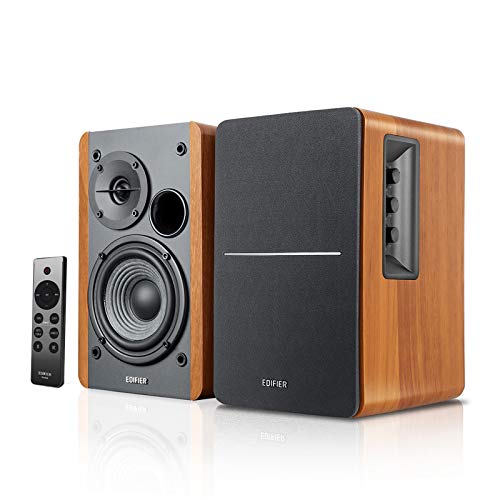
The Edifier R1280DBs is the most versatile pair in this guide, and that versatility is the reason it leads the list. It is a 2.0 powered bookshelf system with 42 watts RMS total output, a 4-inch mid-bass driver, and a 13 mm silk dome tweeter in each cabinet. The wooden MDF enclosure gives it a classic look that sits comfortably in a living room, a study, or a home office, and the removable mesh grille lets you choose between a covered front and exposed drivers.
Connectivity is where this pair earns its place. Bluetooth 5.0 handles wireless streaming from a phone, tablet, or laptop. Optical and coaxial digital inputs connect directly to a television or a computer with a digital output, keeping the signal in the digital domain until it reaches the speaker. Dual RCA inputs allow two wired sources to stay connected at once, so a turntable preamp and a computer can share the same pair without cable swapping. A subwoofer output with automatic detection and a built-in crossover makes it simple to add a powered subwoofer later and move from a 2.0 setup to a 2.1 system.
Control is handled on the side panel of the active speaker, where dials adjust volume, bass, and treble, and a press of the volume dial switches between inputs. A wireless remote covers the same functions from across the room, including mute, input switching, and a soundfield spatializer mode that widens the perceived soundstage.
Considerations
The 4-inch woofer sets a natural limit on deep low-end extension. In a small or medium room, the bass is full and musical for most genres, but listeners who want the physical weight of a kick drum or a film soundtrack will want the subwoofer output. Measure the cabinet depth before ordering, because the wooden enclosure is deeper than many compact desktop speakers.
Edifier R1700BTs
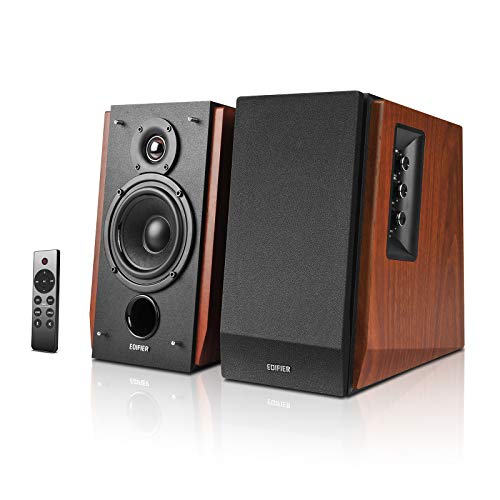
The Edifier R1700BTs steps up from its smaller sibling with more output and a larger tweeter, aimed squarely at nearfield listening where detail and tone matter. It delivers 66 watts RMS through a 4-inch woofer and a 19 mm silk dome tweeter in each cabinet, with built-in digital signal processing and dynamic range control that guard against distortion when the volume rises. The result is a pair that stays composed at higher listening levels and keeps vocals and acoustic instruments clear.
Bluetooth 5.0 with aptX HD support is the headline wireless feature, allowing high-resolution wireless audio from compatible sources. Wired listening runs through RCA inputs, and the subwoofer output lets you extend the low end with a powered subwoofer when the room calls for it.
The larger tweeter is the meaningful difference here. A 19 mm silk dome moves more air at the top of the frequency range and tends to sound smoother on cymbals, strings, and sibilant vocals than a smaller tweeter working at the same level.
Considerations
This pair trades digital inputs for simplicity. There is no optical or coaxial input, so a television or a computer with only a digital output will need an external converter or an analog connection. The cabinets are larger and heavier than the R1280DBs, so a shallow desk or a narrow shelf may not suit them.
JBL 305P MkII Pair

The JBL 305P MkII is a different kind of active speaker. It is a powered studio monitor, sold here as a matched pair, designed for creators who need to hear what is actually in a recording rather than a flattering version of it. Each cabinet carries its own dual 41-watt Class-D amplifiers, one for the 5-inch woofer and one for the 1-inch tweeter, for 82 watts of bi-amplified power per cabinet. That bi-amped design gives each driver its own amplifier and crossover, which keeps the low end tight and the top end detailed even when the material gets busy.
The patented Image Control Waveguide around the tweeter widens the sweet spot, so the stereo image stays stable when you shift in your chair or lean toward a second monitor. The Slip Stream low-frequency port is shaped to reduce turbulence and extend the low end cleanly at all playback levels. Boundary EQ and high-frequency trim controls on the rear panel let you adjust the response for placement near a wall, on a desk, or in a corner, which is where many home studios actually live.
Inputs are balanced XLR and 1/4-inch TRS, with a switch for plus 4 dBu or minus 10 dBV input sensitivity. That makes the pair a direct match for an audio interface, a mixer, or a professional source, and it keeps long cable runs quiet in a room full of other electronics.
Considerations
Studio monitors are honest, which is useful for editing and less forgiving for casual background listening. The balanced inputs mean a phone or a laptop will need an interface or an adapter to connect cleanly, and there is no Bluetooth or remote control. Each cabinet needs its own mains connection, so plan for two power outlets and two cable runs.
Audioengine A2+ Wireless

The Audioengine A2+ Wireless is the compact answer in this guide, built for desks where space is the scarcest resource. Each cabinet measures roughly 6 inches wide, 6 inches deep, and 7 inches tall, yet the pair delivers 60 watts through a 2.75-inch aramid fiber woofer and a 0.75-inch tweeter. The cabinets are hand-finished wood with a high-gloss coating, and the small footprint leaves room on the desk for a keyboard, a monitor arm, and the other tools of a working setup.
Despite the size, the input list is generous. Bluetooth 5.3 with aptX-HD provides wireless streaming with a long usable range, while USB-C, RCA, and 3.5 mm AUX cover wired connections to a computer, a phone, or a gaming console. A built-in 24-bit digital-to-analog converter handles the USB input, and a subwoofer output allows a powered subwoofer to fill in the lowest octave that a 2.75-inch woofer cannot reach on its own. The Class A/B amplifier and the custom-tuned drivers give the pair a warm, musical character that suits long sessions at a desk.
The A2+ Wireless also works well as a second-zone pair. Its size makes it easy to place on a kitchen shelf, a bedside table, or a small office credenza, and the Bluetooth input means it can serve a phone or tablet without any wired source nearby.
Considerations
Physics sets the limits here. A 2.75-inch woofer cannot move as much air as a 4-inch or 5-inch driver, so the lowest notes in music and film will be lighter without a subwoofer. This pair is at its best within a few feet of the listener, on a desk or a small shelf, rather than trying to fill a large open living room.
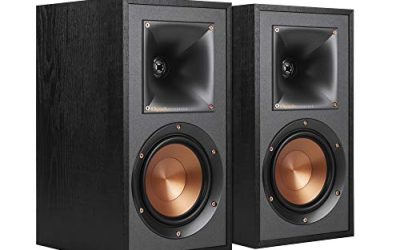
Klipsch R-41PM

The Klipsch R-41PM brings a living-room sensibility to the powered speaker category, with a horn-loaded tweeter and a copper woofer that give it a lively, forward character. The 4-inch spun-copper woofer and 1-inch aluminum tweeter sit behind Klipsch’s 90-degree by 90-degree Tractrix horn, which controls the dispersion of the high frequencies and helps the sound stay clear across a wider listening area. The built-in amplifier is custom-engineered for these drivers, so the pair needs no external amplifier or receiver.
The input list is the broadest in this guide. Bluetooth handles wireless streaming, USB connects directly to a computer for high-resolution digital audio, optical takes a digital feed from a television, and RCA and 3.5 mm inputs cover analog sources. A built-in phono preamp is the standout feature for vinyl listeners: a turntable connects directly, with no separate phono stage required, and a ground screw terminal keeps hum under control. A subwoofer output extends the system when deeper bass is wanted, and the included remote handles volume, input selection, and mute from the sofa.
That combination makes the R-41PM a genuine all-in-one for a living room. It can serve as the sound system for a television, a turntable, and a phone without any other audio component in the rack, and the horn-loaded tweeter keeps dialogue intelligible at modest volumes.
Considerations
The horn-loaded tweeter has a distinct character. It is detailed and energetic, and some listeners will love that immediacy while others will prefer the softer top end of a silk dome tweeter. Listen to the balance in your own room before deciding, because room surfaces and seating distance shape how a horn sounds. The cabinets are compact for a living-room pair but still need a stable shelf or stand, and the active speaker needs mains power plus a speaker wire run to the passive partner. Keep the interconnect cable tidy and leave enough slack to pull the active speaker forward for rear-panel access.
How to Choose
Begin with the source. List everything you will connect: a computer, a phone, a television, a turntable, an audio interface, a gaming console. Then check each candidate pair against that list. A pair with optical input solves the television problem. A pair with a phono input solves the turntable problem. A pair with balanced XLR inputs solves the audio interface problem. A pair with only Bluetooth and RCA will frustrate you if your main source is a television with no analog output. The right input list is worth more than a larger woofer you cannot connect.
Next, match the speaker to the room and the listening distance. Nearfield listening at a desk, with the speakers two to four feet away, suits a compact pair with a 2.75-inch or 4-inch woofer. A living room or a studio where you sit six feet or more from the speakers calls for a larger woofer, more amplifier headroom, and a wider dispersion pattern.
Think about the low end honestly. Every pair in this guide can be extended with a powered subwoofer through its subwoofer output. If you listen mostly to acoustic music, podcasts, and dialogue, a 4-inch woofer on its own is often enough. If you listen to electronic music, film soundtracks, or bass-heavy games, plan for the subwoofer from the start.
Consider the controls you will actually use. A remote matters in a living room and barely matters on a desk. Side-panel tone controls matter when you switch between music and video and want to adjust the bass without reaching behind the cabinet. Rear-panel trim controls matter in a studio, where you set them once for the room and leave them alone.
Fit and Installation
Placement shapes the sound more than any single specification. Put the two speakers at ear height, with the tweeters level with your ears when you sit in your normal listening position. On a desk, that usually means a pair of small stands or isolation pads that lift the cabinets and angle them slightly upward. On a shelf, it means choosing a shelf at the right height rather than the highest available shelf. Angling the speakers inward so they point at your listening position, forming an equilateral triangle between the two cabinets and your head, gives the most stable stereo image.
Give the cabinets room to breathe. A rear bass port needs a few inches of clearance from the wall behind it, and a side control panel needs enough space for your hand. Keep the active speaker, the one with the amplifier and the mains cable, on the side where the power outlet and the source cables already run.
Cable planning is simple but worth doing before the speakers arrive. Count the inputs you will use, buy the right cables for those inputs, and route them before you place the speakers. If the active speaker will live in a living room, plan the mains connection and the subwoofer cable at the same time, because a subwoofer placed after the fact often ends up with a cable stretched across a walkway.
When you first set the pair up, begin with the tone controls flat and the volume low, then raise the level gradually and listen to material you know well. Small moves, a few inches toward or away from the wall, change the bass more than any setting on the speaker.
Frequently Asked Questions
What does active mean for a speaker?
Active means the amplifier is built into the speaker cabinet and matched to the drivers inside it. You connect a source directly to the speaker and plug the speaker into mains power. There is no separate amplifier or receiver to buy, match, or place, and the crossover between the woofer and tweeter is handled inside the active system.
Do active speakers need a separate amplifier?
No. That is the point of the design. Each pair in this guide carries its own amplifier, sized and tuned for its drivers. You still need a source, such as a computer, phone, television, turntable, or audio interface, and the right cable for the input you choose, but no external amplifier is required.
Can I add a subwoofer to active speakers?
Yes, when the pair has a subwoofer output, which all five pairs in this guide do. Connect a powered subwoofer to that output, set the subwoofer level to blend with the main pair, and the system becomes a 2.1 setup.
Are active speakers good for a television?
Yes, provided the pair has the input your television uses. A television with an optical output pairs naturally with a speaker that has an optical input, such as the Edifier R1280DBs or the Klipsch R-41PM. A television with only an analog output needs a pair with an RCA or 3.5 mm input.
Conclusion
The best active speakers are the ones that fit your sources, your room, and your listening distance without forcing a compromise. The Edifier R1280DBs covers the most ground, with digital and analog inputs, Bluetooth, and a subwoofer output in a classic wooden cabinet. The Edifier R1700BTs trades digital inputs for more output and a smoother top end, making it a strong nearfield choice. The JBL 305P MkII pair is the studio tool, with balanced inputs, bi-amplified drivers, and room-tuning controls for creators who need accuracy. The Audioengine A2+ Wireless is the compact desk pair, small enough for a crowded workspace and flexible enough to serve a second room. The Klipsch R-41PM is the living-room all-rounder, with a phono input for vinyl, USB and optical for digital sources, and a horn-loaded tweeter that keeps dialogue clear.
Choose by source first, then by room size, then by the low end you actually need. Place the pair at ear height, give the cabinets room to breathe, and add a subwoofer only if the room and the music call for it.
As an Amazon Associate, we earn from qualifying purchases.
FAQ
What does active mean for a speaker?
Do active speakers need a separate amplifier?
Can I add a subwoofer to active speakers?
Are active speakers good for a television?
More from Amazon
Programs that pair well with the guide above. Offers and eligibility are set by Amazon and may change.
Free shipping on eligible items, Prime Video and more. Eligible new members can start with a free trial.
Start a Prime free trialAd-free music streaming. Eligible new subscribers can start with a free trial.
Try Music Unlimited freeA Prime membership for ages 18-24 with a trial period. Eligibility is set by Amazon.
See Prime for Young AdultsAudiobooks and podcasts to listen to on the go. Eligible new members can start with a free trial.
Try Audible freeAs an Amazon Associate we earn from qualifying purchases.