Our Top Picks



As an Amazon Associate we earn from qualifying purchases.
Lights get the attention in a streaming setup, but the stand underneath decides where the light can actually go, how much floor it eats, and whether it stays put when a cable gets tugged. The five supports below cover the main ways creators hold lights in home studios: a stainless C-stand for grip work and overhead booming, an air-cushioned aluminum stand as the all-round floor option, a wheeled stand for fixed studio layouts, a spring-cushioned two-pack for key and fill on a starter rig, and a desk-clamp pole that uses no floor space at all.
A few reading notes before the picks. Height, load and weight figures below come from each product’s Amazon listing and maker documentation, and load figures assume a centered, vertical load. A softbox acts like a sail and levers against the top section, so a light plus modifier should sit comfortably under the stated limit, not right at it. Cushioning also differs by design: air-cushioned stands lower a raised section slowly on a pocket of air, spring-cushioned stands absorb the shock when a section reaches its stop, and plain stands do neither. Finally, most stands sold for this market end in a 1/4 inch screw tip, while many studio lights have a 5/8 inch receiver socket. The match between the two matters, and the How to Choose section covers it.
Affiliate Disclosure: This article contains affiliate links. If you buy a product through one of these links, the site may earn a commission at no extra cost to you.
1. NEEWER Pro C Stand with Holding Arm
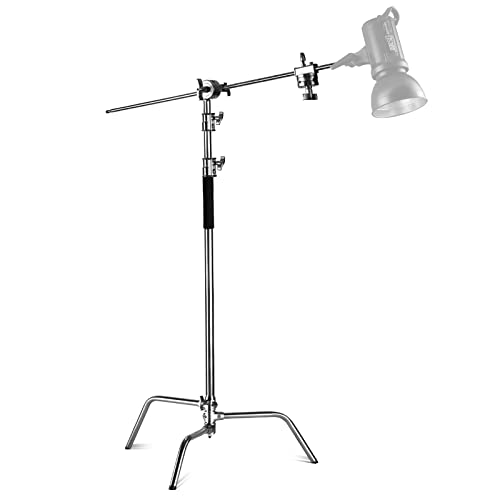
The C-stand is the grip department’s default support, and this Neewer version is built the traditional way: 100% stainless steel tubing, a maximum height of 10.5 feet (320 cm), and a 4.2 foot (128 cm) holding arm with two grip heads included in the box. That arm is the reason to choose it. A grip head locks the arm at any angle, so a small LED panel, a flag, or a reflector can hang over a desk or a gaming setup without the stand’s column standing in the shot, and the second grip head holds the accessory at the arm’s end.
The base is the other C-stand advantage in small rooms. The legs fold flat, so the stand stores against a wall, and when open they sit lower and narrower than a typical tripod light stand’s spread, which makes it easier to place near a desk or in a corner. The trade-offs are weight and handling: stainless steel is heavier than the aluminum stands here, and there is no cushioning in the column, so sections are raised and lowered entirely by hand on their locking knobs. Used with a boom load, the long leg should point in the direction of the arm and a sandbag should hang on the base, as covered in the safety notes below.
Specs
- Type: C-stand with grip arm and 2 grip heads included
- Material: 100% stainless steel
- Maximum height: 10.5 ft (320 cm)
- Holding arm length: 4.2 ft (128 cm)
- Base: Folding legs, folds flat for storage
- Model: ST-C-CB
- Best for: Overhead booming, flags, reflectors and heavier fixtures
2. SmallRig RA-S280 Air-Cushioned Light Stand
The RA-S280 is the conventional tripod light stand done carefully. It is aluminum, rises from 94 cm to 280 cm (about 9.2 feet), and the listing gives a maximum load of 8 kg (17.6 lb), which covers the realistic streaming range of LED panels and mid-size softboxes with room to spare. The sections are air-cushioned, so if a flip lock is released with a light mounted, the column sinks slowly instead of dropping, which protects both the light and the fingers under it.
SmallRig’s hardware details suit a working desk studio. The locks are flip levers rather than knobs, the connections are metal, and the legs spread up to 1.2 m for a stable base on the floor. At about 2.1 kg (4.6 lb) the stand itself is light enough to move between a streaming desk and a filming corner without thinking about it. The top ends in a 1/4 inch screw, standard for this class, so panel lights with a threaded hole mount directly and lights with a 5/8 inch socket need the usual adapter or a tilting bracket. For a single-stand setup that has to do everything, this is the balanced pick.
Specs
- Type: Tripod light stand, air-cushioned sections
- Material: Aluminum alloy
- Height range: 94–280 cm (up to about 9.2 ft)
- Maximum load: 8 kg (17.6 lb) per listing
- Stand weight: About 2.1 kg (4.6 lb)
- Top mount: 1/4 inch screw
- Leg spread: Up to 1.2 m
- Locks: Flip locks with metal connections
3. NEEWER Heavy Duty Light Stand with Casters (SC305W)
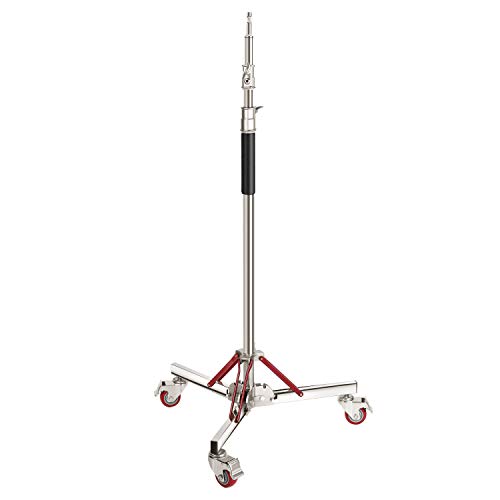
In a fixed studio, the fastest way to adjust lighting is to roll it. The SC305W is a 100% stainless steel stand on three 360-degree swivel casters with step-on brakes, reaching a maximum height of 10 feet (305 cm). A key light can be nudged a few inches between a streaming position and a video position without lifting anything, then locked down with a press of the brake pedal. A built-in buffer spring softens the column’s descent when a section is lowered under load.
This is the heaviest support in the roundup at about 17 lb, and that mass is the point: a wheeled stand has a narrower effective base than a splayed tripod, so its own weight plus the listing’s stated weight limit of 30 kg (66 lb) keep tall loads settled. Casters do ask for a hard, reasonably flat floor; on thick carpet the wheels dig in and the stand behaves more like a fixed one. Streamers who rearrange a room daily will not want to drag it around, but for a dedicated streaming corner where the layout is stable and small adjustments are constant, wheels remove real friction from the routine.
Specs
- Type: Wheeled light stand with 360-degree swivel casters
- Material: 100% stainless steel
- Maximum height: 10 ft (305 cm)
- Brakes: Step-on caster brakes
- Cushioning: Built-in buffer spring
- Weight limit: 30 kg (66 lb) per the Amazon listing’s product information
- Stand weight: About 17 lb (7.7 kg)
- Model: SC305W
4. EMART 2-Pack Heavy Duty Light Stand 8.5 ft
Most streaming lighting is two-point lighting: a key on one side, a weaker fill or rim on the other. This EMART set simply sells that as one purchase, with two aluminum stands that each reach 8.5 feet, dual spring cushioning in the sections, and a carrying bag in the box. The springs absorb the jolt when a section is lowered to its stop, a small protection that matters when the mounted gear is a lightweight panel with a plastic housing.
Expectations should match the class. These are light-duty stands aimed at LED panels, flashes and small softboxes, which is exactly the load profile of a typical desk streaming rig, and their aluminum build keeps each stand easy to carry between rooms. Large modifiers, boom arms and heavy fixtures belong on the C-stand or the air-cushioned stand above instead. The top of each stand is a 1/4 inch screw tip, matching the threaded mounts on most small panels and brackets. As a first pair of stands, or as the fill and background pair behind a stronger key stand, the set covers the common cases without overspending on capacity that small lights never use.
Specs
- Quantity: 2 stands with carrying bag included
- Maximum height: 8.5 ft (102 in) per stand
- Material: Aluminum construction
- Cushioning: Dual spring cushioned sections
- Top mount: 1/4 inch screw tip
- Model: EM-K726A-2
- Intended loads: LED panels, flashes and small softboxes, per the listing
5. SmallRig Camera Desk Mount 3488
The desk mount answers a different question: what if the stand used no floor at all? SmallRig’s 3488 clamps to a tabletop up to 48 mm (1.9 in) thick and raises a three-section telescopic pole from 39 to 91 cm above the desk. On top sits a mini ball head with a 1/4 inch-20 mount, and the kit includes a 1/4 inch to 5/8 inch spigot adapter, so lights with a standard studio socket can mount as well as threaded accessories. The maximum load is 3 kg (6.6 lb), which suits ring lights, compact panels, webcams and small cameras.
For desk studios this solves the two persistent stand problems at once: there is no tripod footprint competing with chair casters and feet, and the light moves with the desk if the desk is rearranged. The limits are reach and leverage. Ninety-one centimeters of pole puts a light above monitor height for seated streaming, but it cannot light a standing shot, and a heavy panel on a fully extended pole will flex and sway more than a floor stand would. Keep loads light, keep the pole as short as the shot allows, and this is the cleanest way to light a desk.
Specs
- Type: Desk-clamp mount with telescopic pole and ball head
- Pole height: 39–91 cm (15.4–35.8 in), 3 sections
- Maximum load: 3 kg (6.6 lb)
- Clamp: Fits tabletops up to 48 mm (1.9 in) thick, rubber-coated jaws
- Top mount: 1/4 inch-20 ball head; 1/4 inch to 5/8 inch spigot adapter included
- Weight: About 430 g
- Model: 3488
How to Choose a Light Stand for Streaming
Start with height and ceiling. A stand lights a seated streamer best when the light sits above eye level and angles down, which most 8 to 9 foot stands manage in a normal room. Taller stands, 10 feet and up, earn their size when the light must clear a backdrop, hang overhead, or light a standing shot. Check the folded length as well: long stands store badly in small apartments, while C-stand legs fold flat and desk clamps disappear entirely.
Match the load figure to the whole load. Add up the light, its bracket, and the modifier. A bare LED panel is light; the same panel inside a softbox with a grid weighs more and catches air movement, which multiplies the stress at the top section. Choose a stand whose stated maximum is comfortably above the combined weight, and treat boom use as a separate, harsher case than vertical use.
Pick cushioning for how you work. Air cushioning lowers a section slowly and is the safest option around delicate lights. Spring cushioning only absorbs the final stop, which is still far better than a free drop. Uncushioned stands, including C-stands, demand a hand on the column whenever a lock is loosened.
Be honest about footprint. A tripod stand at working height spreads its legs roughly a meter or more across; in a small streaming room that space comes out of the same floor the chair rolls on. C-stand legs sit lower and tighter, wheeled stands trade spread for weight, and a desk clamp removes the question entirely at the cost of height and load.
Check the stud before anything arrives. Most stands in this market end in a 1/4 inch-20 screw. Lights with a 5/8 inch receiver need an adapter or a bracket with a threaded hole, and some panels accept both. Confirming the pairing on paper is easier than discovering the mismatch during setup.
Sandbag any boom, every time. The moment a light hangs out on an arm, the stand’s balance point shifts toward the load. Point the longest leg under the load, hang a sandbag on the base or the opposite side as a counterweight, keep the arm as short as the shot allows, and never leave a boomed light where it can be bumped. This applies to grip arms and boom attachments on every stand type, not just C-stands.
FAQ
How tall a stand does a streaming setup actually need?
For seated streaming, a stand in the 8 to 9 foot range places a key light above the camera and angled down, which is the standard look. Taller stands only become necessary for standing shots, overhead lighting, or clearing tall backdrops, and a desk-clamp pole covers the seated case with no floor stand at all.
Can one stand hold both a light and a softbox?
Yes, if the combined weight of the light, bracket and softbox sits comfortably under the stand’s stated maximum load. Keep the modifier centered over the column rather than pushed forward, and step up to a heavier stand class, or a C-stand with a sandbag, as modifiers get larger.
What is the difference between air-cushioned and spring-cushioned stands?
An air-cushioned section sinks slowly when unlocked, because trapped air escapes gradually. A spring-cushioned section still drops when unlocked, but a spring absorbs the impact at the bottom of the travel. Both protect lights and fingers compared with an uncushioned column, with air cushioning the gentler of the two.
Will a stand’s 1/4 inch screw fit a light with a 5/8 inch socket?
Not directly. The light needs an adapter, a spigot, or a mounting bracket that bridges the two standards. Some mounts, like the desk mount in this roundup, include the adapter in the box; otherwise it is a small separate accessory worth ordering with the stand.
Conclusion
The right stand is the one that fits the room as much as the light. The Neewer C-stand is the choice for overhead work, flags and anything on an arm. The SmallRig RA-S280 is the safest single floor stand for a mixed streaming and video routine, with air cushioning and a useful load figure. The wheeled Neewer SC305W suits a fixed studio that gets fine-tuned often, the EMART two-pack covers key and fill for starter two-light rigs, and the SmallRig 3488 desk mount lights a desk while using no floor whatsoever. Match the load, mind the footprint, sandbag every boom, and the support half of the lighting kit stops being the weak half.
More from Amazon
Programs that pair well with the guide above. Offers and eligibility are set by Amazon and may change.
Free shipping on eligible items, Prime Video and more. Eligible new members can start with a free trial.
Start a Prime free trialAd-free music streaming. Eligible new subscribers can start with a free trial.
Try Music Unlimited freeA Prime membership for ages 18-24 with a trial period. Eligibility is set by Amazon.
See Prime for Young AdultsAudiobooks and podcasts to listen to on the go. Eligible new members can start with a free trial.
Try Audible freeAs an Amazon Associate we earn from qualifying purchases.