Our Top Picks
 ASUS ProArt PA279CRV 27 Inch 4K UHD USB-C27 Inch24.1 x 8.46 x 16.07 inches18.25 poundsCheck on Amazon
 ViewSonic VP2766-4K 27 Inch 4K UHD ColorPro IPS8.15 x 24.15 x 16.09 inches12.1 poundsCheck on Amazon
Video editing on a 4K monitor comes down to three things: how accurately the panel shows color, how much of the timeline you can see at once, and how well the screen connects to your laptop or tower. A gaming-style monitor that boasts speed may fall short on color coverage, while a pro display may offer little for play. The question is how far your work needs to go.
This guide is for editors who cut footage for social channels, game clips or client work and want a 4K screen that matches how they actually deliver. We compare eight monitors using only what their listings state, so you can balance color coverage, ports and size in 2026 and avoid paying for features you will not use.
Quick Picks

Dell 27 Monitor S2725QS, 4K UHD IPS, 120Hz, 5ms, FreeSync Premium | 350 cd/m2 Brightness, 1,500:1 Contrast, 99% sRGB, Anti-Glare, HDMI, DisplayPort, USB‑C, Height Adjustable, Swivel, Pivot
One of the home product options compared in this guide.
View on AmazonASUS ProArt PA279CRV 27 Inch 4K UHD USB-C HDR Professional Monitor for Mac | Calman Verified, Delta E<2, Daisy Chain, IPS, USB-C PD 96W, Height Adjustable, 99% DCI-P3, 99% Adobe RGB
One of the home product options compared in this guide.
View on Amazon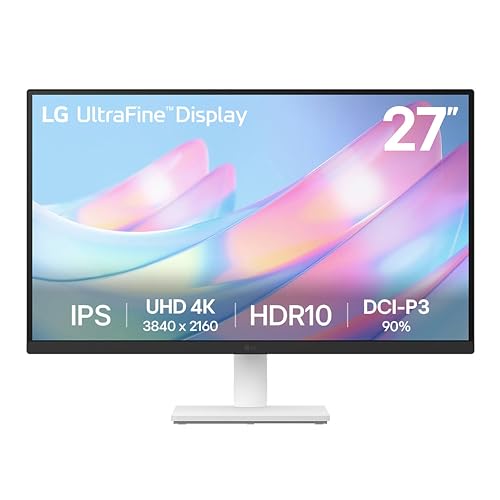
LG 27US500-W Ultrafine Monitor 27-Inch 4K UHD (3840x2160) HDR10 IPS Borderless Design Reader Mode Flicker Safe Switch App HDMI DisplayPort - White
One of the home product options compared in this guide.
View on AmazonViewSonic VP2766-4K 27 Inch 4K UHD ColorPro IPS Monitor 90W USB-C 120Hz | Built for video editing, graphic design and animation, 120Hz refresh rate for fast-moving video, Pantone validated 100% sRGB
One of the home product options compared in this guide.
View on Amazon
Samsung 27" ViewFinity S7 (S71H) 4K UHD IPS HDR10 High Resolution Monitor | Explore and buy 27 inch 4K UHD ViewFinity S7 S71H Monitor LS27H710EANXZA, Featuring IPS Panel, HDR10 and Eye Saver Mode
One of the home product options compared in this guide.
View on Amazon
HGFRTEE 32 Inch 4K UHD Monitor, Computer Monitor, 4000:1 Contrast Display | 3840×2160 UHD Resolution, IPS Panel, 100% sRGB, AMD FreeSync, 60Hz, HDMI 2.0 & DisplayPort 1.4, VESA 100x100mm
One of the home product options compared in this guide.
View on Amazon
Samsung 32" ViewFinity S7 (S71H) 4K UHD IPS HDR10 High Resolution Monitor | Explore and buy 32 inch 4K UHD ViewFinity S7 S71H Monitor LS32H710EANXZA, Featuring IPS Panel, HDR10 and Eye Saver Mode
One of the home product options compared in this guide.
View on Amazon
CUNPU 27" 4K 70Hz IPS Ultra-Slim Bezel Black Photo Video Editing Monitor | ΔE<2, 100% DCI-P3, 1.07B Colors, PIP/PBP, Adaptive Sync, DP/HDMI
One of the home product options compared in this guide.
View on Amazon| Product | Best for | Key feature from the listing |
|---|---|---|
| Dell S2725QS | Editing plus gaming on one desk | 4K IPS, 120Hz, 99% sRGB, USB-C |
| ASUS ProArt PA279CRV | Color-critical work | Delta E under 2, 99% DCI-P3, 99% Adobe RGB |
| LG 27US500-W | Basic 4K on a modest scale | HDR10 IPS, Flicker Safe, Reader Mode |
| ViewSonic VP2766-4K | Editors who want 120Hz and USB-C | ColorPro IPS, 90W USB-C, Pantone validated |
| Samsung ViewFinity S7 27 | Everyday 4K with eye comfort | IPS, HDR10, Eye Saver Mode |
| HGFRTEE 32 Inch 4K | A large canvas | 32 inches, 100% sRGB, DisplayPort 1.4 |
| Samsung ViewFinity S7 32 | Bigger timelines with the same panel type | 32 inch IPS, HDR10, Eye Saver Mode |
| CUNPU 27 Inch 4K | Wide-gamut editing on a narrow frame | 100% DCI-P3, PIP/PBP, ultra-slim bezel |
How to Choose
Color coverage and accuracy claims
Match the color space to your delivery. Web and social video targets sRGB, so a panel listing 99 or 100 percent sRGB is enough. Editors working toward cinema or wide-gamut HDR look for DCI-P3 coverage, and print designers look at Adobe RGB. Listings that cite a Delta E figure under 2 or a verification program suggest factory attention to accuracy, but you should still calibrate if color decisions matter.
Size and pixel density
A 27 inch 4K screen looks sharp at a comfortable distance, while a 32 inch panel gives timelines and panels more room at the cost of density. Pick the size that matches your desk depth and whether you scale the interface.
Connectivity and power
USB-C with power delivery lets one cable carry video, data and charging to a laptop, which helps mobile editors. Check the wattage against your laptop’s needs, and confirm DisplayPort or HDMI versions support 4K at the refresh rate you want. A listing that says HDMI 2.0 will cap you at modest refresh rates at 4K.
Refresh rate, panel type and extras
IPS panels give wide viewing angles and are the usual choice for color work. Higher refresh rates help if you also play, but make little difference to editing. Budget models often cut corners on stand adjustment, built-in color modes and included cables, so look for height adjust and pivot if your desk needs them.
Even a well-specified monitor needs a little care before it earns its place on an editing desk. Set the operating system scaling so interface text is readable without wasting the extra pixels, and pick the display’s own color mode that matches your working space, usually sRGB for web delivery. Lower the brightness to a comfortable level for your room instead of leaving it at maximum, since a screen far brighter than the surroundings makes grading harder and tires your eyes. If you edit near a window, a hood or a neutral wall behind the screen reduces reflections that shift how colors look. Finally, keep the original cable that comes with the monitor, or buy one rated for the resolution and refresh rate you want.
The 8 Best Options
Dell S2725QS
For editors who also game, this 27 inch 4K IPS monitor lists 120Hz, FreeSync Premium and a USB-C port, with 99 percent sRGB coverage, 350 nits of brightness and a height-adjustable, pivoting stand.
- Strength: 120Hz and USB-C add flexibility for both editing and play.
- Strength: height, swivel and pivot adjustments suit a variety of desks.
- Trade-off: coverage is listed as sRGB only, with no wide-gamut figures.
Skip it if your deliverables call for DCI-P3 coverage.
ASUS ProArt PA279CRV
The color-focused pick, with a Calman-verified listing, Delta E under 2, 99 percent DCI-P3 and 99 percent Adobe RGB, plus USB-C power delivery up to 96W and daisy chain support for a tidy multi-screen desk.
- Strength: wide-gamut coverage across both DCI-P3 and Adobe RGB.
- Strength: 96W USB-C and daisy chaining simplify a laptop-based desk.
- Trade-off: it is built for color accuracy, so expect a professional-tier cost level.
Skip it if all you need is a standard 4K screen for casual cuts.
LG 27US500-W
A plain 27 inch 4K IPS screen with HDR10, a borderless design, Reader Mode and Flicker Safe, finished in white and connecting through HDMI and DisplayPort. It is aimed at everyday use more than color work.
- Strength: a simple 4K IPS panel at an accessible tier.
- Strength: Flicker Safe and Reader Mode are aimed at long sessions.
- Trade-off: the listing mentions no color coverage figure and no USB-C.
Skip it if you need to match specific color targets.
ViewSonic VP2766-4K
Positioned for creative work, with a ColorPro IPS panel, 90W USB-C, 120Hz and Pantone validation, plus 100 percent sRGB coverage. The listing says it is built for video editing, graphic design and animation.
- Strength: 90W USB-C and 120Hz together are an uncommon pairing among editing monitors.
- Strength: the listing targets video editing and animation directly.
- Trade-off: sRGB coverage is the only gamut figure mentioned.
Skip it if you need wide-gamut coverage.
Samsung ViewFinity S7 27 (S71H)
A mainstream 27 inch 4K IPS monitor with HDR10 and an Eye Saver Mode, suited to general editing and office use where a recognizable brand and a familiar size matter more than color specifications.
- Strength: IPS panel with HDR10 support in a familiar size.
- Strength: Eye Saver Mode supports long sessions.
- Trade-off: the title lists no color coverage numbers or USB-C.
Skip it if color accuracy is a deliverable requirement.
HGFRTEE 32 Inch 4K
A large 32 inch 4K IPS screen, with 100 percent sRGB, a 4000:1 contrast figure, FreeSync, DisplayPort 1.4, HDMI 2.0 and a VESA 100x100mm mount for arms.
- Strength: a big canvas for timelines and bin panels.
- Strength: DisplayPort 1.4 and VESA mounting add setup options.
- Trade-off: 60Hz and the lack of USB-C limit it for gaming and one-cable laptop setups.
Skip it if you want USB-C or a faster refresh rate.
Samsung ViewFinity S7 32 (S71H)
The 32 inch version of the same ViewFinity line, with a 4K IPS panel, HDR10 and Eye Saver Mode. It suits editors who prefer a larger workspace and a known brand.
- Strength: extra screen space at 4K without leaving the IPS family.
- Strength: Eye Saver Mode is useful for long edits.
- Trade-off: no color coverage figures appear in the title.
Skip it if your desk is shallow and a 32 inch panel will feel too large.
CUNPU 27 Inch 4K
A 27 inch 4K IPS monitor listing 100 percent DCI-P3, Delta E under 2, 1.07 billion colors, PIP and PBP, adaptive sync and an ultra-slim bezel, with DisplayPort and HDMI inputs.
- Strength: wide DCI-P3 coverage and PIP/PBP for comparing sources.
- Strength: slim bezels suit dual-monitor desks.
- Trade-off: the 70Hz refresh rate is modest for gaming, and the listing shows no USB-C.
Skip it if you need USB-C power delivery for a laptop.
Which One Fits Your Situation
You edit for cinema-style delivery and need wide color
The ASUS ProArt PA279CRV lists DCI-P3 and Adobe RGB coverage with a Delta E figure and USB-C power for a laptop, making it the natural fit.
You edit and game on the same screen
The Dell S2725QS and ViewSonic VP2766-4K both list 120Hz and USB-C, so they serve both uses without switching displays.
You want maximum timeline space on a budget
The HGFRTEE 32 Inch 4K or the Samsung ViewFinity S7 32 give you more screen area, and the Samsung adds Eye Saver Mode for long sessions.
Common Mistakes
- Assuming 4K means accurate color; check the gamut and calibration details.
- Buying for a gaming refresh rate you will not use while editing.
- Overlooking port versions, then finding the monitor cannot show 4K at the speed you expected.
- Choosing size without measuring desk depth.
- Skipping calibration for color-critical work.
Related guides
- Hall Effect Vs Potentiometer Controller Sticks Explained
- Low Profile Cpu Coolers For Small Form Factor Pcs
- How To Transfer Nintendo Switch Data To A New Console
Frequently Asked Questions
Is 27 inch or 32 inch better for editing?
A 32 inch screen gives more room for panels, while 27 inches keeps pixels sharper at a shorter distance. Choose by desk depth and how you scale the interface.
Do I need DCI-P3 coverage?
Only if you deliver wide-gamut or cinema-style work. Web and social content is mostly viewed in sRGB, so a panel with solid sRGB coverage is enough for most creators.
Does USB-C help video editing?
It helps laptop editors by carrying video, data and charging through one cable. Confirm the wattage suits your laptop before relying on it as the only charger.
Should I still calibrate?
Yes, for color-critical work. Factory claims are a start, but panels drift over time and between units, so a calibration pass keeps your grading consistent.
FAQ
Is 27 inch or 32 inch better for editing?
Do I need DCI-P3 coverage?
Does USB-C help video editing?
Should I still calibrate?
More from Amazon
Programs that pair well with the guide above. Offers and eligibility are set by Amazon and may change.
Free shipping on eligible items, Prime Video and more. Eligible new members can start with a free trial.
Start a Prime free trialAd-free music streaming. Eligible new subscribers can start with a free trial.
Try Music Unlimited freeA Prime membership for ages 18-24 with a trial period. Eligibility is set by Amazon.
See Prime for Young AdultsAudiobooks and podcasts to listen to on the go. Eligible new members can start with a free trial.
Try Audible freeAs an Amazon Associate we earn from qualifying purchases.