Key takeaways
- IPX6: protection against powerful water jets. This is a useful target for exposed speakers, but it does not mean the speaker is designed to remain submerged.
- IPX7: protection during temporary immersion under the stated test conditions. It is valuable for areas that may collect water, although installation still needs drainage.
- UV-resistant materials: essential for grilles, cones, surrounds, and plastics exposed to sunlight.
- Corrosion-resistant hardware: stainless or treated fasteners and terminals help prevent failures around salt water.
- Sealed motor and connection areas: reduce the chance that moisture reaches the voice coil or terminals.
The best marine speakers for most boats are 6.5- or 6.75-inch coaxial speakers with UV-resistant construction, at least an IPX6-level water-resistance claim, 50–100 watts RMS of power handling, and sensitivity around 88–91 dB; choose 7.7-inch or larger models when you have room and want stronger midbass.
Best marine speakers compared
There is no single winner for every boat. A small runabout needs shallow, efficient speakers that play clearly from a modest stereo, while a wake boat or offshore cruiser benefits from larger cones, higher power handling, and an amplifier. The table below compares useful buying categories rather than relying on nominal peak-watt numbers.

Skar Audio SK65M 6.5" 2-Way Marine Full Range 320 Watt Coaxial Speakers, Pair (White)
Included for 'Best Marine Speakers for Clear Sound' because the listing specifies Pair (White), details this guide uses to compare options.
View on Amazon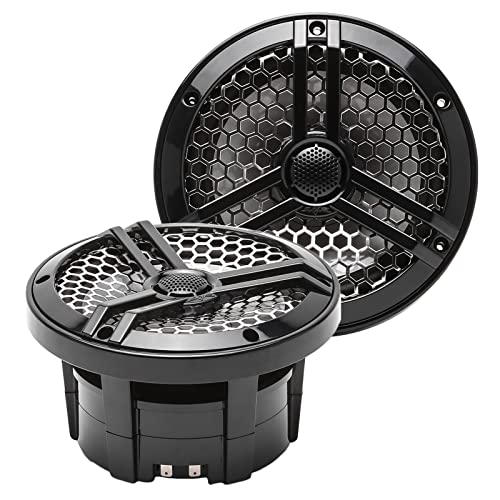
Skar Audio SK65MB 6.5" 2-Way Marine Full Range 320 Watt Coaxial Speakers, Pair (Black)
Included for 'Best Marine Speakers for Clear Sound' because the listing specifies Pair (Black), details this guide uses to compare options.
View on Amazon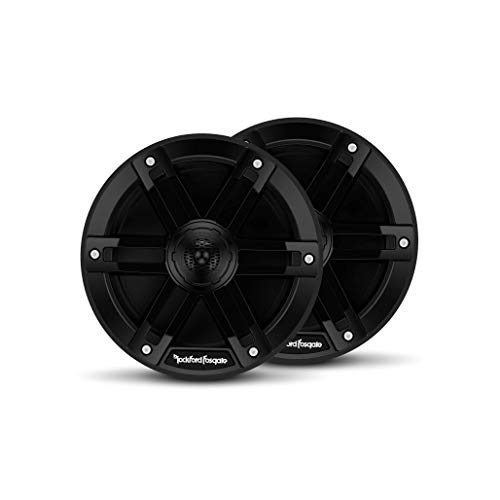
Rockford Fosgate M0-65B 6.5" Coaxial Full Range Speakers - Black (Pair)
Included for 'Best Marine Speakers for Clear Sound' because the listing specifies Black (Pair), details this guide uses to compare options.
View on Amazon
Polk Audio DB692 DB+ Series Coaxial Marine 6x9 Speaker for Car & Boat
Included for 'Best Marine Speakers for Clear Sound' as a relevant option in this category; details come from the product listing.
View on Amazon| Speaker class | Typical RMS handling | Typical sensitivity | Approximate mounting depth | Best use |
|---|---|---|---|---|
| 5.25-inch coaxial | 30–60 W | 87–90 dB | 2.25–3.0 inches | Compact consoles, cabins, and shallow side panels |
| 6.5/6.75-inch coaxial | 50–100 W | 88–92 dB | 2.5–4.0 inches | Best all-round choice for most boats |
| 7.7/8-inch coaxial | 75–150 W | 89–92 dB | 3.5–5.0 inches | More midbass and output on larger boats |
| 6.5-inch component set | 60–120 W | 86–90 dB | Usually 2.5–4.5 inches | Focused listening areas where you can mount separate tweeters |
Actual dimensions vary by model, so treat these as planning ranges. Before ordering, measure the cutout diameter, mounting depth, screw-hole pattern, and clearance behind the panel.
Strong marine speaker choices by boat and system
Best all-round upgrade: 6.5- or 6.75-inch coaxials
A quality 6.5-inch coaxial is the safest recommendation for most boats. It fits many factory openings, provides clear vocals, and does not demand an unusually large amplifier. Look at established marine lines such as the JL Audio M6, Kicker KM, Rockford Fosgate M1, and Fusion XS series. Exact sizes, impedance options, grilles, and power ratings differ within each range, so match the specific model rather than assuming every speaker in a family has identical specifications.
These speakers generally work well with a head unit delivering roughly 15–25 watts RMS per channel, but an external amplifier makes them substantially cleaner at higher volume. Coaxial designs are simpler to install because the tweeter is built into the speaker, making them a good fit for consoles, seating areas, and side panels.
Best for larger boats and stronger midbass: 7.7- or 8-inch coaxials
Larger speakers move more air and can produce fuller midbass at the same listening level. They are useful on open boats where engine noise and wind mask low frequencies. JL Audio M6 7.7-inch models, for example, are a well-known option in this category, while Wet Sounds and other marine-focused brands offer comparable larger-format designs.
The trade-off is physical: larger speakers need wider cutouts, more rear clearance, and often more amplifier power. They also cannot create deep sub-bass by themselves. If you want bass below roughly 60–80 Hz, add a properly enclosed marine subwoofer instead of expecting a coaxial speaker to do everything.
Best for limited depth: shallow 5.25- or 6.5-inch models
Shallow speakers are the practical answer when a fuel tank, wiring bundle, flotation cavity, or molded fiberglass structure sits behind the mounting location. Do not use a grille diameter as a substitute for mounting depth. A speaker can fit the visible opening and still hit an obstruction when the basket is installed.
When depth is restricted, prioritize a published mounting-depth measurement, a corrosion-resistant basket, and a sensitivity of at least about 88 dB. A shallow speaker with higher sensitivity will usually produce more useful volume from the same head-unit power than a less efficient model.
Weatherproof ratings: what to look for
Marine speakers are exposed to salt, spray, condensation, ultraviolet light, and rapid temperature changes. A water-resistance claim alone is not enough; inspect the entire construction.
- IPX6: protection against powerful water jets. This is a useful target for exposed speakers, but it does not mean the speaker is designed to remain submerged.
- IPX7: protection during temporary immersion under the stated test conditions. It is valuable for areas that may collect water, although installation still needs drainage.
- UV-resistant materials: essential for grilles, cones, surrounds, and plastics exposed to sunlight.
- Corrosion-resistant hardware: stainless or treated fasteners and terminals help prevent failures around salt water.
- Sealed motor and connection areas: reduce the chance that moisture reaches the voice coil or terminals.
IP ratings are not a complete durability score. Check the manufacturer’s wording for the exact model, because different sizes and revisions in the same product family may have different certifications. Use tinned marine wire, adhesive-lined heat-shrink terminals, and a drip loop where practical; a water-resistant speaker can still fail because of an unprotected connection.
Power handling and sensitivity: a useful system calculation
Choose RMS power handling, not peak or “maximum” power. For example, suppose you install four 6.5-inch speakers rated for 75 watts RMS each:
4 speakers × 75 watts = 300 watts RMS total.
An amplifier producing about 50–75 watts RMS per channel is a sensible match. If you want clean headroom, a four-channel amplifier rated at 75 watts RMS per channel can deliver 300 watts across the system. A 450-watt amplifier can also work if its gain is set correctly and the speakers are not driven beyond their thermal and mechanical limits; amplifier power is not automatically harmful, but clipping and excessive volume are.
At 88 dB sensitivity, a speaker produces roughly 88 dB at one watt and one meter under the manufacturer’s test conditions. Increasing power from 1 watt to 10 watts theoretically adds about 10 dB. Increasing from 10 watts to 50 watts adds roughly 7 dB more. Real boats produce less predictable results because speakers are not in ideal enclosures, listeners are off-axis, and wind and engine noise vary.
Bluetooth and source compatibility
Bluetooth is convenient, but it is a feature of the stereo or controller rather than the passive speaker itself. A boat system may use:
- A Bluetooth marine head unit: the most integrated option, with volume, source selection, and sometimes zone control at the helm.
- A Bluetooth receiver or controller: useful for a minimalist system, but verify its water resistance and remote-control range.
- Bluetooth through an amplifier: compact and flexible, though you may lose display information, radio, and advanced zone features.
For open-water listening, Bluetooth’s convenience matters more than small codec differences. Keep the phone dry and secure, and retain a wired input when possible. A wired connection can be useful when the phone battery is low or wireless interference becomes inconvenient.
Decision matrix: match the speaker to your boat
| Your situation | Recommended specification | Why |
|---|---|---|
| Factory head unit, moderate cruising volume | 6.5-inch coaxial, 50–75 W RMS, 89 dB or higher | Efficient and easy to drive without adding an amplifier |
| Open boat with engine and wind noise | 6.5–7.7-inch model, 75–150 W RMS, external amplifier | More acoustic output and stronger midbass |
| Very shallow fiberglass panel | Shallow 5.25- or 6.5-inch speaker under the measured depth | Prevents basket interference with structure or wiring |
| Saltwater exposure and uncovered installation | Published IPX6 or IPX7 claim, UV resistance, corrosion-resistant hardware | Better protection from spray, sun, and salt deposits |
| Dedicated listening zone with amplifier | Component speakers or premium coaxials, 75–120 W RMS | Improves imaging and gives more clean-volume headroom |
Installation details that affect sound
Seal the speaker-to-panel interface with the supplied gasket or closed-cell foam. Air leaks around the frame reduce midbass and can allow water behind the panel. Aim coaxial tweeters toward the listening area when the model allows adjustment, but avoid pointing every tweeter directly at the driver; a slightly wider distribution usually sounds more natural across the boat.
Use the correct impedance for the amplifier, commonly 4 ohms per speaker. Do not connect multiple speakers to one amplifier channel unless the resulting load is within the amplifier’s specified range. Keep speaker polarity consistent: reversing one speaker can cancel bass around the listening position.
Final buying recommendation
For most installations, choose a 6.5- or 6.75-inch marine coaxial with a published IPX6 or IPX7 rating, UV-resistant materials, roughly 50–100 watts RMS handling, and sensitivity near 90 dB. Select a shallow model only after measuring the cavity. Move to 7.7 or 8 inches when your boat has the space and you want more midbass, then add an amplifier based on RMS output rather than peak claims. Finally, treat wiring, sealing, and mounting as part of the speaker upgrade: those details often determine whether the system stays clear after months of spray and sunlight.