Our Top Picks



As an Amazon Associate we earn from qualifying purchases.
A haptic vest puts vibration motors against your torso so that impacts, recoil, engine rumble and near misses in a game land on your body instead of only on a screen. It is a compelling idea, and the hardware genuinely works. What the marketing tends to skip is that the vest is only ever as good as the software feeding it. In a game with native haptic support, each motor fires in a mapped pattern: a hit to your left shoulder feels different from one to your lower back. In a game without support, the vest falls back to an audio mode that converts sound, mostly bass, into generic buzzing. That fallback works with almost anything, but it cannot tell a gunshot from a door slam, and it is a much duller experience than the box art suggests.
One more piece of honesty before the picks: the haptic vest market is small, and on Amazon the verifiable listings currently come from a single maker, bHaptics. Rival vests from Woojer, OWO and Skinetic are real products, but they are sold through their own stores or other retailers rather than Amazon, so they do not appear here. What follows is therefore a comparison within the one ecosystem Amazon actually stocks, across two hardware generations, plus a bundle that extends feedback to your arms. The good news is that the differences between these five listings, motor count, weight, battery and connection options, are exactly the differences that decide whether a vest gets worn every session or gathers dust.
Affiliate Disclosure: This article contains affiliate links. If you buy through a link on this page, the site may earn a commission at no extra cost to you. Products are chosen on specifications and platform support, not on commission rates.
1. bHaptics TactSuit Pro

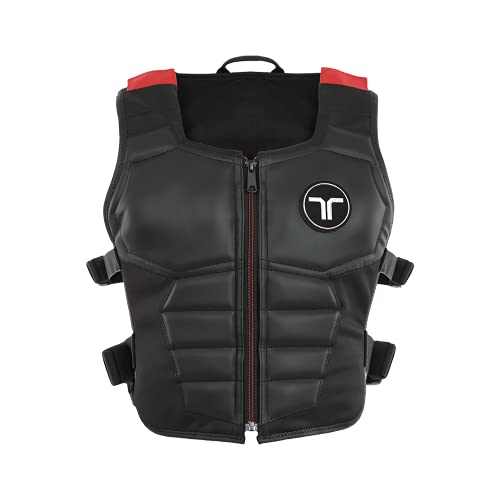
The TactSuit Pro is the current flagship vest, built around 32 individually controllable ERM motors spread across the front and back of the torso. It replaces the older X40 generation with fewer motors but a more refined layout, a front control wheel for adjusting intensity without opening an app, and a removable mesh lining. In natively supported games, the Pro gives the most detailed positional feedback of any vest in this roundup: developers have more discrete points to work with, so effects can travel across the chest or land in a specific quadrant of the back rather than arriving as one whole-torso thud.
The trade-offs are weight and heat. At roughly 4.1 pounds it is the heaviest vest here, and a layer of motors and fabric over a t-shirt gets warm during active roomscale play, especially in summer. The mesh lining helps and can be removed for washing, but anyone who already finds a headset hot should expect the vest to add to that. Battery life is a claimed 13.5 hours from the 9,800 mAh cell, with a full charge taking around five hours, so overnight charging becomes part of the routine. Connection is over Bluetooth Low Energy for mapped game effects, or a 3.5 mm cable for audio mode, with the caveat that wired audio feedback is limited to a stereo signal.
Specs
- Motors: 32 ERM vibration motors, individually controllable
- Connectivity: Bluetooth Low Energy; 3.5 mm audio input for audio-to-haptics mode
- Battery: 9,800 mAh lithium-ion, up to 13.5 hours of playtime, about 5 hours to charge
- Fit and weight: one size, adjustable for roughly 26–50 in body circumference; about 4.1 lb
- Extras: front intensity control wheel, removable washable mesh lining
- Compatibility: Meta Quest headsets, SteamVR and PC VR, PS VR2, plus flat-screen PC games with native or mod support
2. bHaptics TactSuit X40
The X40 is the previous-generation flagship and still the motor-count leader, with 40 ERM motors split evenly between the front and back panels. On paper that is the most granular feedback array in this list. In practice, the advantage over the 32-motor Pro is smaller than the numbers imply, because what you feel depends on how each game’s haptic patterns were authored, and most supported titles were mapped with broad zones in mind rather than 40 unique points. Where the X40 does earn its keep is coverage: the longer, denser panel layout suits taller players and seated simulation rigs, where effects like engine vibration and airflow are spread over a wide area.
Being an older design, it connects over standard Bluetooth with a wired audio option, and pairs through the same bHaptics Player software as the rest of the range, so the supported-games library is shared. Its 9,800 mAh battery carries a generous manufacturer playtime rating, although real runtime drops when patterns run at high intensity. The X40 makes the most sense when it is the cheaper route to maximum coverage, or for sim players who sit down and want the largest feedback surface. Roomscale players who move a lot will feel its size and warmth more.
Specs
- Motors: 40 ERM vibration motors (20 front, 20 back), individually controllable
- Connectivity: Bluetooth; 3.5 mm audio input for audio-to-haptics mode
- Battery: 9,800 mAh lithium-ion, manufacturer-rated for extended play sessions
- Fit and weight: one size with adjustable straps; longer torso coverage than the X16
- Compatibility: Meta Quest headsets, SteamVR and PC VR, PS VR2, per the Amazon listing
3. bHaptics TactSuit X16
The X16 halves the motor count to 16 and trims the vest to a shorter cut that was designed not to bunch up when you sit down, which makes it a natural fit for seated PC gaming and sim racing as well as standing VR. At 950 grams it is light enough to forget about during shorter sessions, and the smaller 4,900 mAh battery still delivers up to around 12 hours of play with a charge time of roughly two and a half hours. The box includes a USB Bluetooth dongle, which matters more than it sounds: desktop PCs without Bluetooth, or with a weak onboard radio, are a common source of pairing headaches with every vest in this guide.
Feedback detail is the obvious compromise. Sixteen points can still separate front from back and left from right, which covers the most valuable information, but fine effects such as rain, a heartbeat or a traveling impact feel coarse next to the Pro and X40. The X16 also uses the older Bluetooth standard rather than Low Energy, so keep the dongle close and unobstructed to hold latency down. As the entry point into the previous generation, it remains a sensible buy for players whose favourite games are on the supported list and who do not want a long, heavy vest.
Specs
- Motors: 16 ERM vibration motors, individually controllable
- Connectivity: Bluetooth with included USB dongle; 3.5 mm audio input for audio-to-haptics mode
- Battery: 4,900 mAh lithium-ion, up to 12 hours of playtime, about 2.5 hours to charge
- Fit and weight: one size, adjustable straps, roughly 25–50 in body circumference; 950 g
- Compatibility: Meta Quest headsets, SteamVR and PC VR, PS VR2, Windows PC
4. bHaptics TactSuit Air
The TactSuit Air is the current lightweight model: 16 ERM motors in a flexible fabric shell that weighs about 2.4 pounds, in Ash, Onyx and Camo finishes sold as separate listings. It keeps the same feedback count as the X16 but wraps it in a slimmer, more breathable vest with a fit range that starts at a smaller 24-inch body circumference, which suits smaller frames better than the Pro. For rhythm games, fitness titles and social VR, where you are moving constantly and sessions run long, the missing weight matters more than the missing motors.
Underneath, the Air runs the modern version of the platform: Bluetooth Low Energy pairing through the bHaptics Player app, a wired 3.5 mm option for audio mode, and the same supported-games library as the Pro. Battery capacity is 4,900 mAh with a claimed 12 hours of playtime and a relatively quick two and a half hour charge. The honest limitation is positional detail: with eight motors per side, effects are zonal rather than precise, and players who mainly want directional hit information in shooters will get more from the Pro. Everyone else gets most of the experience with noticeably less bulk and heat.
Specs
- Motors: 16 ERM vibration motors (8 front, 8 back), individually controllable
- Connectivity: Bluetooth Low Energy with included dongle; 3.5 mm audio input for audio-to-haptics mode
- Battery: 4,900 mAh lithium-ion, up to 12 hours of playtime, about 2.5 hours to charge
- Fit and weight: one size, adjustable for roughly 24–50 in body circumference; about 2.4 lb
- Compatibility: Meta Quest headsets with native support, SteamVR and PC VR, PS VR2
5. bHaptics Starter Bundle (TactSuit Air and TactSleeve)
The Starter Bundle pairs the TactSuit Air with a set of TactSleeve arm bands, adding three ERM motors per arm to the vest’s 16. That changes the character of the feedback more than another few torso motors would: recoil that travels down the arm in a shooter, or a sword swing you feel from shoulder to wrist, reads clearly even with only three points per side. For players who know they want arm feedback eventually, the bundle is the straightforward way to get a matched set that pairs through the same software and charging routine.
The compromises are practical. The sleeves are light at about 185 grams each and rated for around 10 hours, but they are one more thing to put on, adjust and recharge, and their strap design can dig in near the inner elbow during long sessions of bending and aiming. Coverage also stops at the arms: there is no leg or foot feedback in this kit. Buyers should also be clear-eyed that the vest half of the bundle is the 16-motor Air, so torso detail is the same as the standalone Air above; the premium here buys breadth of coverage, not sharper torso effects. As a first purchase for an enthusiast, though, it is the most complete package in this roundup.
Specs
- Motors: 16 ERM in the vest plus 3 ERM per arm in the included TactSleeve pair
- Connectivity: Bluetooth Low Energy via the bHaptics Player app; 3.5 mm audio input on the vest
- Battery: vest up to 12 hours of playtime; sleeves up to 10 hours per charge
- Fit and weight: one-size vest with adjustable straps; sleeves about 185 g each
- Compatibility: Meta Quest headsets, SteamVR and PC VR gaming
How to Choose
Start with your games list, not the hardware. Every vest here depends on the same bHaptics support library, a few hundred titles across Quest, SteamVR and PS VR2, mixing native integrations and community mods. Look up your most-played games before buying anything. If they are supported, choose on fit and motor layout. If they are not, understand that you are buying an audio-driven rumble vest, and set expectations, and budget, accordingly.
Next, be honest about session length and heat. The Pro’s extra motors come with the most weight and warmth; the Air and X16 are easier to wear for an hour of active play. One-size fits all really means a stated circumference range, so measure your torso and check the ends of the range rather than assuming. Finally, think about the connection. Bluetooth is convenient and fine for most mapped effects, but a crowded wireless environment or an old PC radio adds latency and dropouts; the included dongle, kept close, fixes most of it. Wired audio mode avoids wireless issues entirely, at the cost of a cable and simpler stereo-only feedback.
FAQ
Do haptic vests work with every VR game?
No. Mapped, directional feedback only exists in games with native support or a compatible mod. Everything else runs through audio-to-haptics mode, which turns sound into general vibration. It works, but it is not the same experience, and it should not be the main reason for buying a vest at the higher end.
Is a 40-motor vest twice as good as a 16-motor vest?
No. Motor count sets the ceiling for detail, but placement, pattern quality and fit decide what you actually feel. A well-mapped 16-motor game can feel clearer than a lazily mapped 40-motor one, and a loose vest wastes motors of any count because the vibration never reaches your body cleanly.
Can these vests be used with PS VR2 and consoles?
Yes, within limits. Supported PS VR2 titles can drive these vests natively, and audio mode can be fed from a wired connection. Support is decided per game and per platform, though, so the same title may be supported on PC VR and unsupported on console. Check the maker’s compatibility list for your exact version.
How long do the batteries really last?
Manufacturer figures, 12 to 13.5 hours for the current models, assume moderate intensity. Strong patterns, high volume audio mode and an ageing battery all shorten that. In practice the battery is rarely the limiting factor; heat and comfort usually end a session first.
Conclusion
A haptic vest is a luxury add-on that earns its place only when your favourite games can actually drive it. Check the supported list first. If your library qualifies, the TactSuit Pro offers the sharpest torso feedback, the TactSuit Air is the easiest to live with, the X40 remains the coverage pick from the older line, the X16 is the seated player’s entry point, and the Starter Bundle is the route to arm feedback. Buy for the games you already play, not the ones the marketing imagines.
FAQ
Do haptic vests work with every VR game?
Is a 40-motor vest twice as good as a 16-motor vest?
Can these vests be used with PS VR2 and consoles?
How long do the batteries really last?
More from Amazon
Programs that pair well with the guide above. Offers and eligibility are set by Amazon and may change.
Free shipping on eligible items, Prime Video and more. Eligible new members can start with a free trial.
Start a Prime free trialAd-free music streaming. Eligible new subscribers can start with a free trial.
Try Music Unlimited freeA Prime membership for ages 18-24 with a trial period. Eligibility is set by Amazon.
See Prime for Young AdultsAudiobooks and podcasts to listen to on the go. Eligible new members can start with a free trial.
Try Audible freeAs an Amazon Associate we earn from qualifying purchases.