Key takeaways
- Wattage headroom: Match your PSU to your GPU’s peak draw plus 20-30% headroom, not just its average load, to handle transient spikes safely.
- Efficiency rating: An 80+ Gold certification or higher means less wasted power as heat, which translates to lower electricity costs and quieter cooling.
- ATX 3.1 & PCIe 5.1 support: A native 12V-2×6 connector handles modern GPU power spikes far more reliably than a 12VHPWR adapter chain.
- Modularity and cable quality: Fully modular designs simplify cable management and improve airflow, especially in compact or small-form-factor cases.
- Noise and warranty: Semi-passive or zero-fan modes keep idle systems silent, and a longer warranty (7-10 years) signals real confidence in component durability.
What's inside
Picking a power supply is easy to get wrong, and the mistakes aren’t obvious until your rig randomly shuts down under load or your new GPU’s power cables don’t fit. With ATX 3.1 and PCIe 5.1 now standard on high-end graphics cards, an older or underpowered PSU can bottleneck an otherwise great build, or worse, damage components during transient power spikes.
This guide breaks down six of the best gaming power supplies available right now, ranging from compact 700W units for mid-range builds to 1000W monsters ready for flagship GPUs. We’ll cover what actually matters when choosing a PSU, review each pick based on real-world performance and build quality, and answer the questions gamers ask most before hitting “buy.”
As an Amazon Associate we earn from qualifying purchases at no extra cost to you. Product prices and availability are accurate as of the date shown and are subject to change.


🎮 Get More From Your Setup — Free
Prime Gaming gives you free PC games every month, in-game loot, and a free Twitch channel sub — plus fast free shipping on all the gear above. New members get a 30-day free trial.
Watch: Best Gaming Power Supply — Video Review
How to Choose a Gaming Power Supply
- Wattage headroom: Match your PSU to your GPU’s peak draw plus 20-30% headroom, not just its average load, to handle transient spikes safely.
- Efficiency rating: An 80+ Gold certification or higher means less wasted power as heat, which translates to lower electricity costs and quieter cooling.
- ATX 3.1 & PCIe 5.1 support: A native 12V-2×6 connector handles modern GPU power spikes far more reliably than a 12VHPWR adapter chain.
- Modularity and cable quality: Fully modular designs simplify cable management and improve airflow, especially in compact or small-form-factor cases.
- Noise and warranty: Semi-passive or zero-fan modes keep idle systems silent, and a longer warranty (7-10 years) signals real confidence in component durability.
The Best Gaming Power Supplys Reviewed
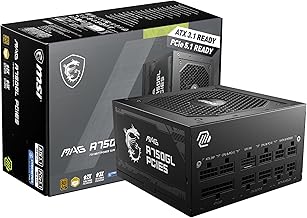
MSI MAG A750GL PCIE5
The MAG A750GL packs 750W into a compact, fully modular chassis with native dual-color 12V-2×6 cabling, making it an excellent fit for mid-size gaming builds running a single high-end GPU. Its 80+ Gold efficiency and 10-year warranty make it a low-risk, long-term investment for anyone upgrading to ATX 3.1 hardware.
MSI MAG A850GL PCIE5
Essentially the A750GL’s bigger sibling, the A850GL adds an extra 100W of headroom for power-hungry flagship GPUs while keeping the same compact footprint and native PCIe 5.1 cable. It’s a smart pick for gamers who want future-proofing without stepping up to a full-size ATX unit.
CORSAIR RM850e (2025)
Corsair’s refreshed RM850e brings 105°C-rated capacitors, Cybenetics Gold efficiency, and a genuinely low-noise fan curve to an 850W fully modular unit. The native 12V-2×6 cable and Modern Standby support make it a well-rounded choice for anyone building a quiet, ATX 3.1-ready system.
Thermaltake Toughpower GT 850W
The Toughpower GT stands out with its Smart Zero Fan mode, which keeps the unit completely silent at low-to-moderate loads, and a native 450W PCIe 5.1 connector that skips the adapter entirely. Backed by 80+ Gold efficiency and a 5-year warranty, it’s a strong option for gamers who prioritize quiet operation.
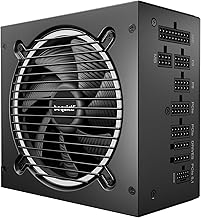
be quiet! Pure Power 13 M 1000W
With up to 94.4% efficiency, a semi-passive 120mm fan, and a full 600W-capable 12V-2×6 connector, the Pure Power 13 M is built for high-end multi-GPU or power-hungry single-card setups. Its LLC topology and 10-year warranty make it one of the most future-proof options here for enthusiasts pushing serious wattage.
Frequently Asked Questions
How much wattage do I actually need for gaming?
Most single-GPU gaming builds run comfortably on 650-850W, but if you’re pairing a flagship card like an RTX 4090-class GPU with a high-end CPU, stepping up to 850-1000W gives you safer headroom for power spikes.
Do I need an ATX 3.1 power supply for my new GPU?
If your graphics card uses a 12V-2×6 or 12VHPWR connector, an ATX 3.1 PSU with a native cable is strongly recommended, since it’s designed to handle the transient power spikes modern GPUs produce more safely than older PSUs with adapters.
Does 80+ Gold matter, or should I pay more for Platinum/Titanium?
80+ Gold is the sweet spot for most gamers, offering strong efficiency and lower heat output without the price premium of Platinum or Titanium units, which mainly benefit those running systems under heavy load 24/7.
Is a fully modular power supply worth the extra cost?
Yes for most builds, fully modular PSUs let you use only the cables you need, which improves airflow and makes cable management significantly easier, especially in smaller cases.
Final Thoughts
For most gamers, the MSI MAG A750GL PCIE5 hits the best balance of price, efficiency, and future-proofing for a single-GPU build, while the CORSAIR RM850e (2025) is the top pick if quiet operation and premium components are the priority. If you’re building a high-end system with serious headroom for tomorrow’s GPUs, the be quiet! Pure Power 13 M 1000W is the safest long-term bet.