Key takeaways
- Rate: the gain or loss in seconds per day.
- Amplitude: an estimated angular swing of the balance, normally expressed in degrees.
- Beat error: the difference between the clockwise and counter-clockwise impulse intervals, shown in milliseconds.
- Beat rate: the movement frequency, such as 18,000, 21,600, 28,800, or 36,000 beats per hour.
- Lift angle: a movement-dependent setting used to calculate amplitude correctly.
- Trace or waveform: a graphical representation of the sound pattern, useful for spotting irregular impulses, noise, or an unstable escapement.
Best Digital Watch Timing Machines and Timegraphers
The best digital watch timing machines and timegraphers depend on your movement range and accuracy requirements: a Weishi-style 1000 timegrapher is the practical home choice, while a Witschi Chronoscope X1, Witschi Watch Expert, or Vibrograf B200 is better suited to professional diagnosis and documentation.
Quick comparison
| Model or class | Typical use | Movement support | Measurement modes | Readability and workflow | Typical market range |
|---|---|---|---|---|---|
| Weishi 1000-style timegrapher | Home regulation and basic checks | Most mechanical and automatic movements with a detectable beat signal | Rate, amplitude, beat error, beat rate, lift-angle setting | Large numeric display; simple controls | Usually $100–$250 |
| Mid-range digital timegrapher | Serious hobbyist or small repair bench | Mechanical movements, including many unusual beat rates | Multiple sampling periods, trace display, position comparison, memory or printing on some units | Clearer graphs and more stable readings | Usually $250–$700 |
| Witschi Chronoscope X1 | Professional service and regulation | Broad mechanical movement coverage, including modern high-beat calibres | Rate, amplitude, beat error, beat rate, lift angle, waveform and positional analysis | Professional interface and detailed diagnostics | Usually $2,000–$4,000 or more |
| Witschi Watch Expert | Professional timing and watch testing | Mechanical watches, with additional watch-test functions depending on configuration | Timing analysis plus broader diagnostic measurements | High-resolution display and repeatable service workflow | Usually $4,000–$8,000 or more |
| Vibrograf B200 | Independent workshop or service department | Mechanical movements across common and specialist beat rates | Timing parameters, graphical analysis and positional testing | Designed for repeated bench use | Usually $2,000–$5,000 |
Prices vary substantially with region, accessories, software, calibration status, and whether the instrument is new or professionally serviced. A low-cost timegrapher can be useful, but its readings should not be treated as equivalent to a calibrated professional instrument.

OTOOLWORLD New Coaxial MTG Watch Tester Timing Multifunction Timegrapher LCD Screen NO.1900
Included for 'Best Digital Watch Timing Machines and Timegraphers' as a relevant option in this category; details come from the product listing.
View on Amazon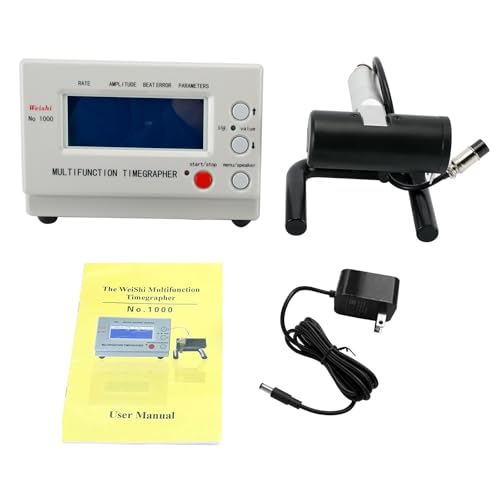
YaeTek Watch Timing Machine Tester Tools Multifunction Timegrapher
Included for 'Best Digital Watch Timing Machines and Timegraphers' as a relevant option in this category; details come from the product listing.
View on Amazon
KINSANINC No.1900 Watch Tester Timegrapher, Multifunctional Watch Timing Machine for Calibration with LCD Screen
Included for 'Best Digital Watch Timing Machines and Timegraphers' as a relevant option in this category; details come from the product listing.
View on Amazon
TICFROG Watch Timegrapher No.1000, Multifunctional Watch Tester, Wristwatch Timing Machine for Watchmaker, Wristwatch Calibration Tool for Mechanical Watches with EN Instruction Cleaning Cloth
Included for 'Best Digital Watch Timing Machines and Timegraphers' because the listing specifies Multifunctional Watch Tester and Wristwatch Timing Machine for Watchmaker, details this guide uses to compare options.
View on AmazonWhat a timegrapher actually measures
A timegrapher listens to the sound produced by the escapement and converts the intervals between detected ticks and tocks into timing data. The main readings are:
- Rate: the gain or loss in seconds per day.
- Amplitude: an estimated angular swing of the balance, normally expressed in degrees.
- Beat error: the difference between the clockwise and counter-clockwise impulse intervals, shown in milliseconds.
- Beat rate: the movement frequency, such as 18,000, 21,600, 28,800, or 36,000 beats per hour.
- Lift angle: a movement-dependent setting used to calculate amplitude correctly.
- Trace or waveform: a graphical representation of the sound pattern, useful for spotting irregular impulses, noise, or an unstable escapement.
Rate is often the easiest value to understand, but amplitude and beat error provide more diagnostic information. A watch showing a steady rate with low amplitude may be running acceptably only because the regulator is compensating for a mechanical problem.
Head-to-head: home timegrapher versus professional analyzer
Low-cost 1000-style machines
A Weishi 1000-style timegrapher is usually the best starting point for home watchmakers. It commonly displays rate, amplitude, beat error, and beat rate, and it normally offers selectable beat-rate presets or automatic detection. The microphone clamp holds the watch in several positions, allowing a basic positional comparison.
Its main advantage is value. You can compare dial-up, dial-down, crown-up, and crown-down readings without paying professional-instrument prices. Its limitations are equally important: the microphone can be affected by room noise, the trace may be less informative, and the amplitude calculation depends heavily on the correct lift-angle setting.
Witschi and Vibrograf instruments
Professional machines such as the Witschi Chronoscope X1, Witschi Watch Expert, and Vibrograf B200 are aimed at repeatable diagnosis rather than occasional adjustment. They generally provide better signal processing, clearer waveform analysis, broader movement support, and more controlled measurement workflows.
These instruments make more sense when a workshop needs to document a watch before and after service, compare several positions consistently, or diagnose a movement whose signal is difficult for an inexpensive microphone to interpret. The additional cost is less about displaying a single rate number and more about confidence, repeatability, and service efficiency.
Compatibility: movement type matters more than brand
Most timegraphers are designed for mechanical watches, including hand-wound and automatic movements. They do not regulate quartz watches in the same way because quartz watches do not produce a conventional mechanical tick pattern. A quartz tester or frequency counter is the appropriate tool for those watches.
For mechanical movements, check these points before buying:
- Beat-rate range: the unit should support the movement’s frequency, including high-beat rates such as 36,000 beats per hour.
- Automatic beat detection: useful when testing unfamiliar calibres, but manual selection can be more reliable in a noisy environment.
- Lift-angle adjustment: essential if you want meaningful amplitude readings.
- Microphone sensitivity: important for quiet vintage movements or watches with a solid case.
- Position fixture: a stable clamp is more useful than a long list of software features if you are making positional comparisons.
- Power supply: verify the instrument’s voltage and plug configuration before importing one.
Decision matrix for different buyers
| Your situation | Best fit | Why | What to avoid |
|---|---|---|---|
| Regulating one or two mechanical watches at home | Weishi 1000-style unit | Provides the essential four readings at low cost | Paying for advanced documentation features you will not use |
| Working on vintage watches with inconsistent signals | Mid-range or professional analyzer | Better filtering and waveform interpretation reduce false readings | Relying on automatic detection without checking the trace |
| Servicing modern high-beat movements | Unit explicitly supporting 36,000 beats per hour | Prevents incorrect beat-rate assumptions and amplitude errors | Older devices with limited beat-rate presets |
| Running a paid repair bench | Witschi Chronoscope X1, Witschi Watch Expert, or Vibrograf B200 | Better repeatability, diagnostics, and professional workflow | Using an uncalibrated hobby unit for customer documentation |
| Testing quartz watches | Quartz frequency tester, not a timegrapher | Quartz movements require frequency and electrical measurements | Interpreting a silent quartz movement as a timegrapher fault |
How long should each measurement run?
Use a short interval for quick regulation and a longer interval for diagnosis. A 12-second or 30-second display updates quickly, but the result can move considerably if the watch has an uneven escapement. A 60-second reading is a better minimum for a stable comparison, while two to three minutes gives a clearer picture of average rate and trace quality.
For example, a movement running at 28,800 beats per hour makes:
28,800 ÷ 3,600 = 8 beats per second.
During a 60-second measurement, the instrument hears approximately 8 × 60 = 480 beats. If the displayed rate changes significantly after those 480 beats, the movement may have unstable amplitude, an inconsistent escapement signal, or insufficient winding. A longer measurement cannot repair a mechanical fault, but it helps distinguish a real trend from a noisy short sample.
Calibration and setup are part of accuracy
Timegraphers rarely need frequent user calibration in the same way as a laboratory instrument, but they do need correct setup. Place the machine on a solid surface away from speakers, fans, computers with noisy cooling systems, and vibrating benches. Fully wind a hand-wound watch, or give an automatic watch enough winding to produce a consistent power reserve.
Set the correct beat rate and lift angle before comparing amplitude. If the rate looks plausible but amplitude is implausibly high or low, check the lift angle first. The amplitude figure is calculated from the timing pattern; it is not a direct optical measurement of balance rotation.
For a useful home procedure:
- Wind the watch consistently and note its state of wind.
- Enter the known beat rate and the calibre’s lift angle when available.
- Measure dial-up for at least 60 seconds.
- Repeat in dial-down and the main crown positions.
- Record rate, amplitude, and beat error rather than relying on one screen.
- Make only one regulator adjustment at a time, then repeat the same positions.
Keep the watch in the same position for every comparison. Changing both the regulator and the measurement position makes it difficult to tell which change caused the result.
Which one should you buy?
For most home users, a well-built Weishi 1000-style timegrapher is the best value because it covers the essential measurements and makes positional testing accessible. Choose a mid-range unit if you regularly service vintage watches, encounter unusual beat rates, or want clearer traces and better filtering.
Choose the Witschi Chronoscope X1, Witschi Watch Expert, or Vibrograf B200 when the instrument will support professional servicing, customer records, or repeated diagnosis across many movements. The right purchase is not the machine with the most numbers on its screen; it is the one that supports your movements, gives a readable trace, and remains consistent after proper setup and calibration checks.